Charles de Gaulle Quotes
The enemy will not be able to halt our pursuit… and we shall have all the glory of beating the army that thought itself the finest in the world… and this without the Russians being absolutely necessary to us.
Note that even then, De Gaulle’s nationalist ego focused not only on glory but glory that need not be shared. It was always a great strength and a great weakness for him. He and many French officers were so fixed on the glory of beating the Germans, that they did not focus on their ½ million casualties and were not prepared for the German countermeasures that turned the battle from a French victory to a long standoff and stalemate of the “Western Front” where neither side could advance much. Note also that De Gaulle failed to mention the British Expeditionary Force that twice saved the French from being overrun. Denial for the honor of France was always one of De Gaulle’s characteristics. See {642233} for the English commander’s view of the outcome of the Battle of the Marne.
Charles De Gaulle, 1890-1970, French President, Statement during the French Marne Offensive of the First World War when he was a mid-level officer, 1914
Sourced by: Eigen's Political and Historical Quotations

This is one of the most classic military quotations--one of the great examples of spin.


The Americans had attacked the Belgian city of Brest and had been repulsed by a well fortified and led German contingent. Analysis of the wartime situation showed that Brest, a port city was no longer necessary for the Allied supplies as numerous other ports were taken and were available. Many of the officers wondered why Bradley wanted them to attack and defeat the Germans in Brest when all they had to do was surround them and eventually starve them out. Bradley’s response explained a subtle aspect of military and foreign policy. It is that the United States Army, once committed, will never be defeated or stopped. Had the Americans not already attempted to take Brest, they would not have bothered at this stage of the war, but since they had, it was imperative that they succeed. Otherwise, it was felt that Allies and enemies would not take future American threats as seriously and that the morale of American soldiers would even be affected if they thought they could be beaten. A similar problem occurred in the Vietnam War and later in the Iraq war. Once the short term military necessity of fighting was gone, the long-term factors came into play and often will. Others argue that the United States military is so strong and well equipped, that it no longer necessary to take casualties just to prove a psychological point.

See the American ambassador’s assessment after the war began {41089}


Asked to estimate his chances of winning his next reelection attempt:


The allies had differences in desirable strategy alternatives. Russia was facing the German Army on its Eastern front and causing huge German casualties but were paying for them in large loss of Russian life—civilian and military (The Russians suffered 22 million deaths as a result of WWII.) Stalin wanted to open a second front in France which would force the Germans to move some divisions from the Russian front, thereby relieving some of the pressure.


Note that he assumes that not only will there be another World War, but he assumes that we will be on opposite sides.

This historic speech is regarded as one of the most important in Australia's history, marking a turning point in Australia's relationship with its founding country, the United Kingdom. Many felt that Prime Minister Curtin was abandoning Australia's traditional ties to the British Isles. -- Wikipedia

This quotation is important for two reasons. First, it shows that there was a very hostile environment in Europe well before the assassination of the Archduke of Austria that “triggered” WWI. Second, that the Germans were racist before Hitler ever came on the scene. The Emperor demagogued the issue and took it to new extremes, but the evil was there. To the Germans, the Slavs and Russians were a lesser form of humanity than the Germans. The Austrians were threatening to attack Serbia and Russia. The Austro-Hungarian Empire, ruled many ethnic Slavs, Russians and Muslims—the lower forms of humanity—and long before Hitler, Wilhelm and other leading Germans thought that the Germanic Peoples should rule that part of the world as the lesser “races” were not fit to rule.

A few months later, that is exactly what Germany did. She was hoping that England would not enter the war despite her treaty obligations, but she was willing to risk the possibility. The Czar had a strong espionage and intelligence service active in Germany, but, like so many other intelligence failures, the intelligence operatives and analysts had military and economic facts but had little understanding of the German culture which propelled Germany to what to most other cultures was “irrational policy making.” People and nations often engage in irrational activities, even against their own self-interest.
German ally, the Austro-Hungarian Empire had declared war on Serbia. See {642085}. The Russian Czar was under great pressure because a large Roman Catholic Empire was warring against a small Orthodox co-religionist of Russia and Russians of all classes wanted Russia to defend Serbia. The Czar was making a good faith effort to stave off the war. What he did not realize was that Germany had actually planned for war against Russia and France and was using the alliance with Austria as an excuse.

The Times regretted that the Germans did not speak to the Austrians more vigorously when they were threatening to attack Serbia who harbored anti-Austro-Hungarian terrorists (see {642085}). What the Times editors did not realize was that the Germans had already made their war plans (see {642092}) and the Serbian issue was just the justification they needed to implement them. So there was no real reason for the Germans to discourage the Austro-Hungarian Empire from its mission to punish Serbia.

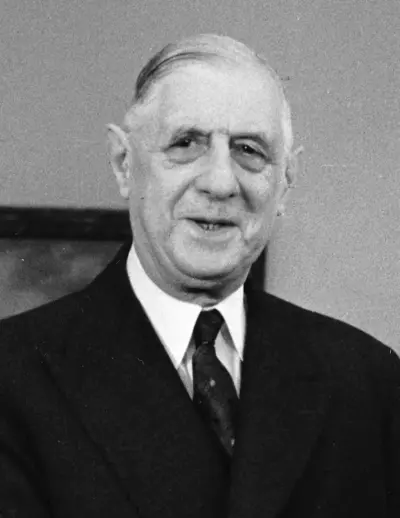
- Born: November 22, 1890
- Died: November 9, 1970
- Nationality: French
- Profession: Leader
Charles André Joseph Marie de Gaulle was a French army officer and statesman who led Free France against Nazi Germany in World War II and chaired the Provisional Government of the French Republic from 1944 to 1946 in order to reestablish democracy in France. In 1958, he came out of retirement when appointed President of the Council of Ministers (Prime Minister) by President René Coty. He rewrote the Constitution of France and founded the Fifth Republic after approval by referendum. He was elected President of France later that year, a position to which he was reelected in 1965 and held until his resignation in 1969.
