John Denton Pinkstone French Quotes
It is a stalemate in our favor.
This is one of the most classic military quotations--one of the great examples of spin.
John Denton Pinkstone French, 1852-1925, British Field Marshall, Commander-in-Chief of the British Expeditionary Force in WWI, Assessment of the Status of the First World War After the Battle of the Marne, September 16, 1914
Sourced by: Eigen's Political and Historical Quotations

Note that even then, De Gaulle’s nationalist ego focused not only on glory but glory that need not be shared. It was always a great strength and a great weakness for him. He and many French officers were so fixed on the glory of beating the Germans, that they did not focus on their ½ million casualties and were not prepared for the German countermeasures that turned the battle from a French victory to a long standoff and stalemate of the “Western Front” where neither side could advance much. Note also that De Gaulle failed to mention the British Expeditionary Force that twice saved the French from being overrun. Denial for the honor of France was always one of De Gaulle’s characteristics. See {642233} for the English commander’s view of the outcome of the Battle of the Marne.


This was one of the most remarkable statements made by a Congressional leader. At the time, the Congress was in the midst of one of the worst stalemates in American Political History. The national debt limit had to be raised in order to legally pay for the expenses that the Congress had voted for and the President had approved. A minority of the House—the Tea Party--tried to use the necessary legislation to get a program of theirs legislated when they did not have the votes to pass it in both houses of Congress. The House would not approve any solution that the Senate would pass, and the Senate would not pass any of the House proposals. The Boenner and the President had reached a compromise but the minority of his own party refused to go along and threatened to oust the Speaker and not vote for the Compromise. To them, compromise was surrender and doing business as usual. At the same time, the left wing of the President’s party did not want to vote for the Compromise plan that the President and the Speaker had worked out. Then the Minority Leader of the Senate, create a new plan that would transcend solve the immediate problem and defer the larger issues which would continue to be debated. The Senate Majority Leader agreed to go along with it and so did the President, but the Minority Leader’s fellow Republicans in the House refused to vote for that compromise. The President and then Boenner went on national television sequentially to explain the situation and the Speaker made this famous quotation, Boenner, we caught in an impossible situation. His Tea Party faction insisted that there need not be a stalemate. The President and the Senate needed the debt limit raised and they would have to give in and vote for the Tea Party plan. Almost all of the Tea Party members were new to Congress and Bonner realized that an entire party who controlled the Senate would never be blackmailed that way, and even if they did, the President would Veto. Yet his own deputy was preferred by the Tea Party and some others, so if Boenner tried to act statesman like, he was risking his speakership. So he became the spokesperson of the Tea Party wing and denied what 90 percent of all Americans knew to be true. Usually absurd statements clearly contrary to the facts at the time are the results of mistakes or gaffs. Occasionally, a more complex situation explains it.


George was referring to the brutal realities of war (during the First World War).


The Falkland Islands were very close to Argentina and far from England. The Argentineans had offered the few Islanders large sums of money to become part of Argentina, but this was rejected. Argentina was a military dictatorship with a terrible record of human rights abuses. The Falklanders preferred their traditional British style of government and affiliation. The Argentinean generals assumed that if they invaded, once they controlled the Falkland Islands, they could negotiate with the British over issues of sovereignty. They misinterpreted the American UN Delegate and concluded that America would not support Britain in a military response; they also assumed that while the British would complain in the UN, they would never go halfway around the world to invade the islands, now occupied and reinforced by Argentina. Thatcher would not negotiate unless the invaders left the islands. They did not do so voluntarily. The Argentinian military had been abusing their own citizens for so long that they had an inflated concept of their fighting ability. Britain freed the islands militarily, and Argentina was humiliated. The military government fell bringing democracy to Argentina—the only good that came out of the Faulklands War.


The French manipulated the war news more than the other nations but nations all did to some extent tending to exaggerate the positive and minimize the negative.

1st Viscount Grey of Fallodon. The first published version of this prescient quotation appeared.

There was deep hostility and suspicion between Germany and England for several years before WWI. See {642066}.


1914 was the outbreak of WWI in which all the belligerents had very different interests and reasons for war—even allies on the same side greatly differed as to their motivation for fighting.


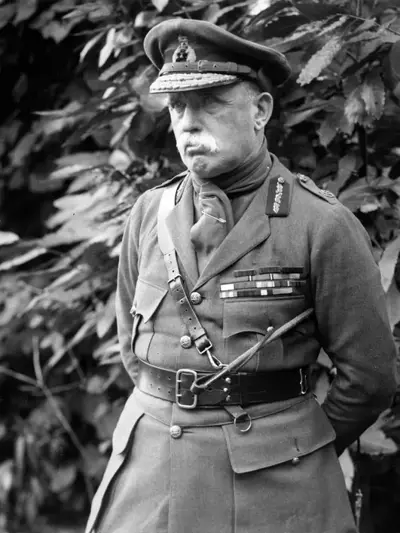
- Born: September 28, 1852
- Died: May 22, 1925
- Nationality:
- Profession:
Field Marshal John Denton Pinkstone French, 1st Earl of Ypres, KP, GCB, OM, GCVO, KCMG, ADC, PC, known as Sir John French from 1901 to 1916, and as The Viscount French between 1916 and 1922, was a senior British Army officer. Born in Kent to an Anglo-Irish family, he saw brief service as a midshipman in the Royal Navy, before becoming a cavalry officer. He achieved rapid promotion and distinguished himself on the Gordon Relief Expedition. French had a considerable reputation as a womaniser throughout his life, and his career nearly ended when he was cited in the divorce of a brother officer while in India in the early 1890s.
