Georg Brandes Quotes
In Norway, as in America, prohibition has been carried through from moral motives; but the outcome has been highly unfavorable. In the first place, much more and far worse home-made spirits are drunk, so that intoxication has increased instead of decreasing. In the second place, Portugal and Spain, whose sales to Norway were suddenly stopped, grew furious and took revenge by ceasing to buy Norwegian klip-fish (salted and dried fish), which had been the chief nourishment of the poorer part of the population in those countries. Norwegian finances suffered severely in consequence.
This is a wonderful historical quotation which illustrates the effect of Prohibition on Norway—most of which was negative. Despite the fact that this article had been published in a leading American journal, virtually no one paid attention to it when Prohibition was being debated and instituted in America a few years later. Another aspect of the quotation is the economic effect. It illustrates how easy it is to start a trade war that was completely unintended. Also how a country, in this case Portugal and Spain, will make foreign policy decisions of which their poorer people bear the brunt.
Georg Brandes, 1842–1927, Danish Critic & Scholar, “Scandinavian Sympathies and Destinies”, Foreign Affairs, March 1923
Sourced by: Eigen's Political and Historical Quotations

Samuel Langhorne Clemens, 1835-1910. The Congressmen who voted for Prohibition in the next century had not read or believed this quotation of Twain’s.


This method of substance abuse prevention represents what scientists now call “environmental prevention” where instead of dealing with individual alcoholics the environment is altered to reduce the likelihood of developing fewer alcohol-related problems. Almost every state uses Locke’s principle and regulates the number of liquor outlets in any most areas. Those communities which have a very high density of bars and liquor stores tend to have more alcohol-related violence. The riots of the Watts area of Los Angeles in the late 20th century took place in one of the highest densities of liguor stores in the country.

Before we had national prohibition, many Southern states and counties outlawed alcohol. “Wets” were those who wanted to allow drinking of alcohol. “Drys” were those who did not. The South was “dry” and voted overwhelmingly for national prohibition, and later voted to keep it even when a majority of the country voted to repeal it. The irony was that the South has always been, and still is, one of the highest alcohol consumption regions and has had much alcoholism. Hence Roger’s humor.

This has always been a problem for the US Military. Attempts at prohibition have been bad for morale, and there is a cultural tradition that military men drink alcohol. However in the Gulf War, our military men and women stationed in Saudi Arabia could not drink as a consequence of the Islamic prohibition of alcohol in Saudi Arabia. There has never been, in the history of our military a period with fewer courts martials, and discipline problems in general. Very few assaults, rapes and murders.


The poem was his summary of the Wickersham Commission’s (National Commission on Law Observance and Enforcement) conclusion regarding Prohibition.


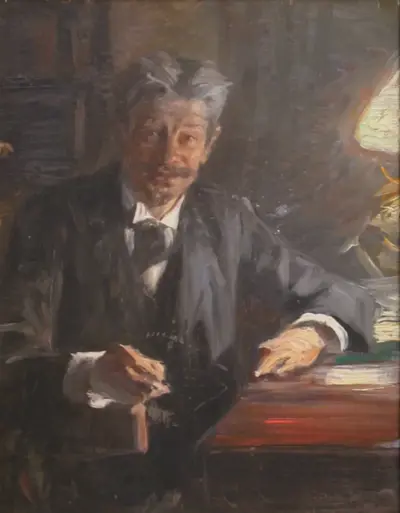
Georg Morris Cohen Brandes was a Danish critic and scholar who greatly influenced Scandinavian and European literature from the 1870s through the turn of the 20th century. He is seen as the theorist behind the "Modern Breakthrough" of Scandinavian culture. At the age of 30, Brandes formulated the principles of a new realism and naturalism, condemning hyper-aesthetic writing and also fantasy in literature. His literary goals were shared by some other authors, among them the Norwegian "realist" playwright Henrik Ibsen.
