Robert Ross Quotes
They [the Americans] feel strongly the disgrace of having had their capital taken by a handful of men and blame very generally a government which went to war without the means or ability to carry it out.
Robert Ross, 1766–1814, British General who led the attack upon and burning of Washington DC in the War of 1812, Letter to his wife
Sourced by: Eigen's Political and Historical Quotations

He was then serving as the U. S. Ambassador to Russia

3rd Earl Russell of Kingston


This amazing quotation was made in 2011 when he, President Xi Jinping, and some other senior Chinese leaders embarked on a reform program of the People’s Liberation Army which with decades of peace had grown soft and corruption was quite prevalent. See also {632517}.


What is interesting about this quote is that it is very much like many American politicians who support a large and strong military.
3rd Earl Russell of Kingston. The military weak nations agreed with him, but the militarily strong ones did not—especially America and England which had the Atomic Bomb when others did not.


With a professionalized all volunteer military, most of whom came from just a few socio-economic strata of our society, wars at the time were fought and the risks and burdens borne by a small part of American society. The rest of society, unlike the Second World War did not experience any change in their style or standard of living.

The concept of race then was not what it is today where it is, if anything, a genetic or anthropological distinction. Then race was a combination of blood (genetics) and culture. Wittgenstein, an Austrian by nationality, considered himself German racially. This concept of race was common in 1914 and rose to be absolute in the Nazi era. So the absorption of Austria by Germany did not seem to most Austrians a diminution of anything but a natural recognition of the unity of one people—the German race. Wittgenstein was not alone among intellectual “Germans” who believed the English “race” superior. Their ability to operate a democracy without a powerful leader was considered a great strength as was the diffusion of power and control were both admirable accomplishments which some German intellectuals envied.

This quotation illustrated a military phenomenon whereby leading military commanders are important as long as they have and control many military assets. Therefore, they avoid serious battles where the might lose. Preserving assets becomes more important than the war objectives and honor and reputation trumps contribution to the war effort. History remembers well military leaders who battle and win. It also remembers leaders who control many assets and who do not lose or win. But the losing military leaders are consigned to the “dustbin of history”.

The Wars continued over a decade, costing thousands of American (and Coalition) troops their lives, many more their limbs and mental well-being, with a monetary cost of over trillions of dollars, and the achievements have been few and meager.
The Boers had just a few years before lost their war with the British who were then in control of South Africa. However, the British did not treat the Boers harshly in defeat and most Boers were at the time farmers and land owners who were a major force in democratic South Africa and had much invested in the nation. Others were still resentful of the British. The Boers sided with the British and fought the Germans who had troops and colonies in Africa. Like the Irish, culturally, they were always up for a good fight.
Everyone could see the First World War coming, but the government leaders and diplomats were not able to prevent it.

There was deep hostility and suspicion between Germany and England for several years before WWI. See {642066}.

In retrospect Marshall was prescient and if his advice had been followed, the country would have been much better off at the beginning of WWII. The nation was isolated politically and militarily with Republicans and southern Democrats often opposing President Roosevelt’s attempts to help them defend themselves. There was of yet no political will for military preparedness.
A negotiated end to the war made sense for both sides. The English budget was in terrible shape with the huge costs of dealing with Napoleon and although Liverpool wanted to teach the Americans a lesson, he could not get the money to finance it. The Americans could prevent British conquest but they could not defeat the British overall or eject them from the continent.


Essentially similar ideas were expressed earlier by George Washington and in antiquity by Vegetius and Horace.
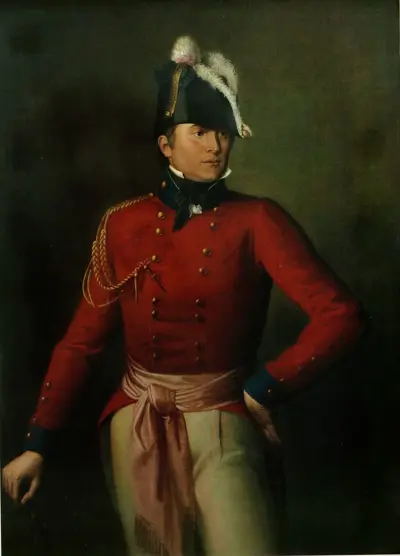
Major-General Robert Ross was an Irish-born officer in the British Army who served in the Napoleonic Wars and its theatre in North America in the War of 1812.
