John Quincy Adams Quotes
It has become a sort of by-word among the common people here that the two Russian Generals who have conquered Napoleon and all his Marshalls are General Famine and Genera Frost..
He was then serving as the U. S. Ambassador to Russia
John Quincy Adams, 1767-1848, 6th President of the United States (Independent, MA), Letter to his mother, Abigail Adams, from Russia, 1813
Sourced by: Eigen's Political and Historical Quotations

Jefferson was not the only one who thought that taking Canada and driving the English out would be relatively easy as Canada was vast and the English troops were spread very thin. However, although the English had great strategic weakness, the American officers who led the Canadian effort were not very competent and made a series of terrible tactical decisions and the Canadian operation failed in a terrible fiasco.


Hoover headed the American Food agency early in his career. In a sense, he was right. Without American Food, the Allies in Europe woul;d have collapsed, and after the war, Amerocan feed kept the peace.


The Vietnam War was certainly not a victory for the U. S. Some saw it as our first defeat. While it was not ended on Johnson’s watch, he must certainly share that responsibility with Nixon and even JFK as these three all were responsible for our Vietnam failure. Johnson, ended up with what he feared most.

Most American felt that way at the time of the Russian occupation and the Mujahedeen resistance.


There were a number of world leaders who were not happy about the German Reunification. See Henry Kissinger {610355} for another.

The Russians, who had invaded Afghanistan successfully, then proceeded to lose Afghanistan.


Ruling group of France during the French Revolution. The purchase and transportation of an army in the field was a very expensive element of war and was very difficult as well. The Directory urged its generals to live off the land and get their food from the enemy country they were invading. Rarely did they pay for it but typically just took it from the civilians. Napoleon who served under the directory took this principle one step further. He also stole the invaded country’s art—paintings and statues mostly. These he sent back to Paris where they were sold to rich people. This way he could pay the salaries of the troops and buy more weapons and ammunition. Napoleon could conquer so much territory because France did not have to pay for the military effort as other countries did. This is one of the major reasons for example that the Louvre Museum in Paris has so many great Italian and Spanish paintings.

This is a very important quotation because it and {641523} show the great difficulty that Washington was under and the fact that he repeatedly asked Congress for assistance very little of which was provided.

He conquered Korea in an act of blatant aggression, but got bogged down in a complicated occupation. He died before the Chinese part of the plan could be carried out. However, ever since China, Korea and other Asian countries have distrusted Japan and her aggressive intentions and history. The horrible Japanese record of aggression and atrocities of WWII solidified that anti-Japanese sentiment which still exists to some extent.

This amazing quotation was made in 2011 when he, President Xi Jinping, and some other senior Chinese leaders embarked on a reform program of the People’s Liberation Army which with decades of peace had grown soft and corruption was quite prevalent. See also {632517}.
Trieste was occupied by the British and Americans theoretically, but Tito’s Yugoslavian troops had done most of the WWII fighting and dying in the area and wanted control for the Russian Allies of which Tito was then one. There were frequent armed standoff’s of Anglo Americans and Yugoslav troops that could easily have evolved to full scale fighting. Nine months later, Tito broke with Stalin. An interesting historical fact is that Richard M. Nixon was one of the Congressional Delegation then visiting Trieste.

This concept of Total War turns out to be the only way to bring many conflicts to an end. Sherman was hated by generations of Southerners because he appeared to be vengeful to humble the Southern pride and spirit. But actually, Sherman was not personally vengeful at all and respected the South and understood its point of view more than most in the North. However, he was one of the first of the Western World’s military leaders to realize that with modern warfare and the then modern weapons, the only way to win a war was to persuade the enemy to stop fighting and if they refused, as the South kept doing, the only rational and humane course was to end the war as swiftly and totally as possible.
Lincoln and the Union leaders were still hopeful of ending the rebellion and getting things back to a pre-war footing economically. At this point they were trying to preserve components of the Southern Economy at no small cost. As that hope was shown to be futile, the Total War strategy of Grant and Sherman prevailed to the satisfaction of men like Opdycke. That actually ended the war quickly, but the Southern Economy was devastated in the process.

The U. S. was evacuating all its forces and agents as the Viet Cong overran Saigon. This ended the Vietnam War. The CIA, had been telling the President and the National Security Staff that the Army reports were exaggerated and we were not faring well in the Vietnam War. Events proved them right. Their earlier track record, especially with President Nixon was very poor in intelligence analysis and prediction. See {634511}, {634509}, and {634503} for Nixon’s view of the CIA.

When McNamara was itemizing the list of dangers with the Joint Chiefs’ Cuban invasion plan, McGeorge Bundy told the not to forget the possibility of a nuclear exchange. The Joint Chief’s plan and recommendation was to invade Cuba, which could have been accomplished with relative military ease they thought. However, they had not gone the next steps and had no planned responses to the various possible Russian responses. The Chiefs of Staff were senior battle hardened WWII and Korean War veterans whose tactical knowledge and leadership was as good as there was. However, none of the had any experience or training with the strategic aspects of military planning the way senior military officers did in the next generation of military leaders. The civilian leadership had to put the breaks on the Joint Chief’s notion of simplistic invading Cuba.
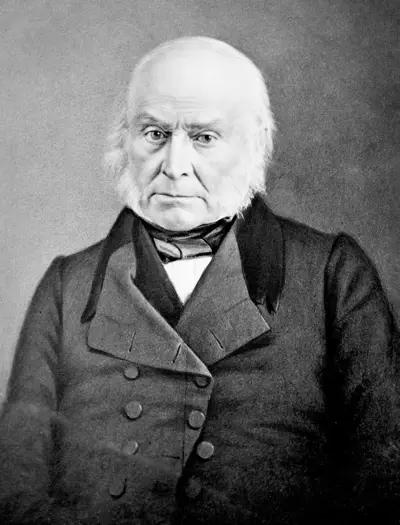
John Quincy Adams was an American statesman, diplomat, lawyer, and diarist who served as the sixth president of the United States, from 1825 to 1829. He previously served as the eighth United States Secretary of State from 1817 to 1825. During his long diplomatic and political career, Adams also served as an ambassador, and as a member of the United States Senate and House of Representatives representing Massachusetts. He was the eldest son of John Adams, who served as the second U.S. president from 1797 to 1801, and First Lady Abigail Adams. Initially a Federalist like his father, he won election to the presidency as a member of the Democratic-Republican Party, and in the mid-1830s became affiliated with the Whig Party.
