John L. Sullivan Quotes
I will not fight a Negro. I never have and I never will.
At the time, American racism was rampant, and about 150 Blacks were lynched each year with no punishment for the murderers. The heavyweight boxing champion of the world was a major hero, and the thought of a Black possibly winning the title was unthinkable.
John L. Sullivan, 1858-1918, Heavyweight Boxing Champion of the World, Statement shortly after he beat Jim Corbett for the Heavyweight Championship in 1892
Sourced by: Eigen's Political and Historical Quotations


Perhaps there is no more dramatic quotation illustrating MacArthur’s arrogance where his own views and decisions should obviously prevail regardless of the policies of his superiors and his commander-in-chief. The army had been officially integrated by President Truman, The reality was that the general honestly believed that he had no superiors among the military, that civilians should not control the military, and in any event that the President—Truman—was not fit to be Commander-in-Chief.

This quotation shows two important historical facts about Southern Racism. The first is now great the social pressures were against any white who would try and alter the status quo. The second was that none the less there have always been whites in the South who, despite the great social penalties, did the right thing and not only improved the situation, but more important, made most Americans realize that Southerners were not all racists any more than all of any group had any negative behavior.


In never occurred to him that he and his family were also adverse to the backbreaking stoop labor of cotton picking.

Nixon, in his second attempt to win the Presidency was told by a small group of Southern Republican politicians that his support was wavering in the South. They had already left the Democratic Party in reaction to the Passage of the 1964 Civil Rights Act. They were concerned because in order to try and capture some of the more liberal anti-war Democrats, Nixon had been making speeches advocating the vigerous enforcement of of civil rights and improving the lot of the Negro. But Nixon could not afford to lose his political base inb the south. Hence the promise which did not keep very long after he was elected President. Nixon was not a strong civil rights President, but he was totally without principles and had no political idiology he would sacrifice any of his political capital for. So once he was elected, he didn't want to offend the centerists whose support he needed for his legislatrive program so he did pay lip service to the prinicples of equality when he himself was anti-Black, andti-Semitic and prejudiced in many areas including against intelelctuals.


Like so many of his other predictions about America, he saw that the evil of racism and slavery was bound to cause the nation to implode. And this was decades before the Civil War, but the problem was inescapable to a critical observer like de Tocqueville.


He and other founders believed that Blacks freed from slavery would still suppress wages for whites and hurt industry. The possibility of intermarriage was also viewed as a moral degeneration. Approximately 15,000 Blacks chose to emigrate.


Like many Black players of the era, Flood suffered endless hateful epithets and curses from a white crowd, many of whom resented the fact that Blacks were integrating baseball, but resented them even more when their performance exceeded that of a favorite white player.

Incredibly enough, after the Civil War and emancipation, most Virginia leaders opposed any form of rights for Blacks with one of the major reasons being that they were ignorant and uneducated. It was actually a crime to teach even a free Black to read.

Johnson was then Vice President.

Forrest went on to be the first National Leader of the Terrorist Organzation.

Booth was the younger son of a very prominent Northern family of actors. His older brother was considered the greatest American actor, and the rest of the family were abolitionists and vehement Union supporters. They found young John’s views reprehensible.
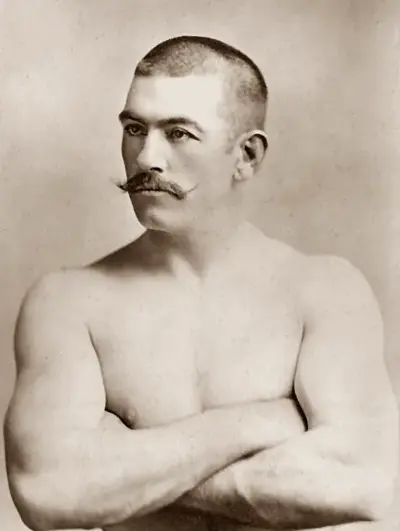
John Lawrence Sullivan, known simply as John L. among his admirers, and dubbed the "Boston Strong Boy" by the press, was an American boxer recognized as the first heavyweight champion of gloved boxing, de facto reigning from February 7, 1882 to September 7, 1892. He is also generally recognized as the last heavyweight champion of bare-knuckle boxing under the London Prize Ring Rules, being a cultural icon of the late 19th century America, arguably the first boxing superstar and one of the world's highest-paid athletes of his era. Newspapers' coverage of his career, with the latest accounts of his championship fights often appearing in the headlines, and as cover stories, gave birth to sports journalism in the United States and set the pattern internationally for covering boxing events in media, and photodocumenting the prizefights.
