Benjamin Disraeli Quotes
I have no fear about the result, as I have intimated in the proper quarter that I should break up the Congress if England’s views are not adopted.
The great European powers were attending an International Congress—Summit Meeting of the heads of government and their diplomats to deal with the crisis of Tsarist Russian military expansionism. None of the other European powers of the time wanted or could afford war so Russia could only be thwarted by Great Britain. There were many in England who thought that the British should not even attend and should send troops immediately. The Queen and the Royal Family were among those. At the Congress Disraeli, who had much personal affection for Queen Victoria, wanted to reassure her. 1st Earl of Beaconsfield. If the Congress did not succeed the mainland of Europe would have been at war. Disraeli obtained everything England wanted. See Russian Ambassador Prince Gortchakoff’s observation.
Benjamin Disraeli, 1804-1881, British Prime Minister (Tory), Letter to Queen Victoria, ]
Sourced by: Eigen's Political and Historical Quotations

She and her husband, like many of the "America Firsters", believed that Hitler should be allowed to overrun Europe and Russia.

Germany had demanded that Belgium allow German troops to cross Belgium to the French frontier. However, King Albert was concerned that this would be a de facto German occupation of Belgium and asked for help. The British tried diplomacy but things were out of anyone’s control and the First World War ensued.


After the attack on Fort Sumter, the South Sent “diplomats” to negotiation with the Government. Unfortunately for all, the South really was not open to negotiations as they only had two predetermined positions they would agree to: The first was that the Government should guarantee the perpetual right of states to have slavery if they wished and that fugitive slaves would be returned by the non-slave states. The second was that the Union should recognize the Confederacy as an independent nation and have peaceful relations between the two. The first was impossible to deliver even if the Union would agree to continue slavery, there was no way that the Federal Government could enforce the return of fugitive slaves from many northern states where they were free the second they set foot in the state, and the Northern states demanded States Rights and not being forced to return Fugitive Slaves forcing the Southern States to oppose States Rights when it came to Fugitive Slaves while favoring it for slavery itself. The Federal government could not enforce the Dred Scott Decision under the pro-South Buchanan administration. And Lincoln and most of the Northern Politicians would not accept a complete dissolution of the Union. There are no other possibilities the South would accept and there was really nothing to negotiate.

The French had arrived there first an “claimed” the area with a tiny military contingent under Lieutenant Marchand. However, the British arrived afterward with a much larger military force. London and Paris decided that the French should withdraw in favor of the British. Delcasse had been right. Another case of “might makes right.”


Some people believe that the United States pressured Pakistan to enable America to support the Mujahideen in their effort to fight the Russian occupation of Afghanistan. Actually the President (and virtual dictator) of Pakistan wanted aid from America and was offering bases. America did not want bases but did want a platform for arming and training the Mujahideen, Pakistan allowed us to use Pakistan as a platform. We increased our foreign aid to Pakistan by 500 percent. There was no arm twisting.

Charles Wilkes, a Union Navy Captain enforcing the naval blockade of the South, intercepted a British mail ship in the Caribbean and discovered two Confederate diplomats on board. He took them into custody to the cheers of Congress. England, however, was outraged that passengers—diplomats—on one of their ships was seized after boarding. This was technically an act of war. Abraham Lincoln, to the distress of many in Congress ordered the Confederate diplomats released explaining with this quotation.


This was the first organization in Great Britain devoted to foreign affairs. In 1867 Linton emigrated to America where he devoted most of his time to the arts.


FDR was hoping to defeat or at least stop Hitler and Germany by arming England and Russia and thus avoid having American troops committed. However. when the Japanese launched their sneak attack on Pearl Harbor, Hitler immediately declared war on the United States, and our troops were suddenly in a two continent war.


Instructing the navy not to act precipitously during the Cuban missile crisis:

L. P. Jacks


England in this quotation claims the right to interfere in the internal affairs of another nation if there is mismanagement or crises AND her national interests are affected.

Misha Saakashvili, the President of Georgia, the ex-Soviet State, had a good bit of support in American political circles and decided to start a military conflict with Russia attacking a disputed area whose people had rejected Georgia and preferred the Russian affiliation and control. He was confident that the US would protect him from major retaliation. The Russians first moved troops into the attacked area and then started attacking Georgia military assets. Rice and the Russian Foreign minister were negotiating a cease fire on which they agreed to details and were going to impose them on Georgia. However, Lavrov demanded that Georgia President Saakashvili be deposed. Either nation had the power to do this, and both had in many past instances deposed or overthrown the leaders of other nations—democratically elected or not. This quote is very interesting because in this particular case the United States was stating its idealistic policy and not its “real-politic: that it exhibited in helping to bring down and depose democratically elected in Iran, Chile, Vietnam, Venezuela, Haiti, and others. Ironically, there were many in the US who wanted Saakashvili deposed for unilaterally starting a military conflict Russia that had to involve the U. S.

Despite the fact that there were no formal political polls at the time, public opinion was very influential in curtailing what might be a tendency to use of the American military. Starting with the Cold War later, Presidents tended to use American military force regardless of public opinion or would exaggerate or lie (Vietnam and Iraq wars for example) to temporally gain some public support.
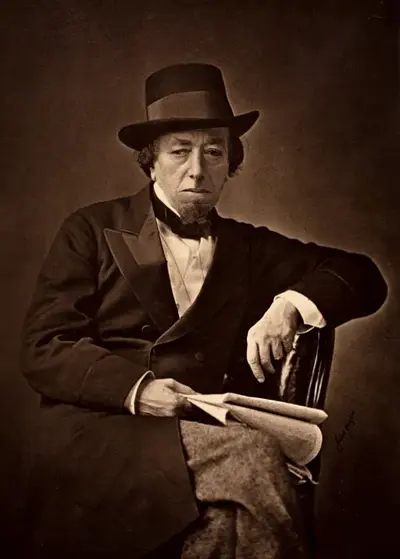
Benjamin Disraeli, 1st Earl of Beaconsfield, KG, PC, MP, FRS, was twice Prime Minister of the United Kingdom, serving in 1868 and from 1874 to 1880. He was a member of the British Conservative Party and played a central role in the creation of the modern Party, defining its policies and its broad outreach. Disraeli is remembered for his influential voice in world affairs, his political battles with the Liberal Party leader William Ewart Gladstone, and his one-nation conservatism or "Tory democracy". He made the Conservatives the party most identified with the glory and power of the British Empire. He is the only British prime minister to have been of Jewish birth. He was also a novelist, publishing works of fiction even as prime minister.
