Alexander Hamilton Quotes
I expect to be told that the militia of the country is its natural bulwark, and would be at all times equal to the national defense. This doctrine, in substance, had like to have lost us our independence.... The facts which, from our own experience, forbid a reliance of this kind, are too recent to permit us to be dupes of such a suggestion
There is a , romantic American myth about the Militiamen in Colonial and Revolutionary America—the citizen soldiers who would leave their farms and rise to the military necessity of the day. However, not only were the militia very hard to muster to duty, but most actually didn’t own or have experience with firearms, and the prevailing opinion of knowledgeable military leaders from George Washington on down was that the militia were not very good soldiers. See {613015}, {613016}, {613022}, {613027}, {621987}, {621988}, {613030}, {613033}, & {613056}
Alexander Hamilton, 1755-1804, Aide-de-camp to General Washington, Member of the Continental Congress and the Constitutional Convention, U. S. Secretary of the Treasury (Federalist, NY), The Federalist, Number 25
Sourced by: Eigen's Political and Historical Quotations

There is a , romantic American myth about the Militiamen in Colonial and Revolutionary America—the citizen soldiers who would leave their farms and rise to the military necessity of the day. However, not only were the militia very hard to muster to duty, but most actually didn’t own or have experience with firearms, and the prevailing opinion of knowledgeable military leaders from George Washington on down was that the militia were not very good soldiers. See {613015}, {613016}, {613022}, {613027}, {621987}, {621988}, {613030}, {613033}, & {613056}.

There is a , romantic American myth about the Militiamen in Colonial and Revolutionary America—the citizen soldiers who would leave their farms and rise to the military necessity of the day. However, not only were the militia very hard to muster to duty, but most actually didn’t own or have experience with firearms, and the prevailing opinion of knowledgeable military leaders from George Washington on down was that the militia were not very good soldiers. See {613015}, {613016}, {613022}, {613027}, {621987}, {621988}, {613030}, {613033}, & {613056}

From the beginning, the issue of whether the country should have a standing army or depend on the militia and the citizen soldier has been controversial. There is a , romantic American myth about the Militiamen in Colonial and Revolutionary America—the citizen soldiers who would leave their farms and rise to the military necessity of the day. However, not only were the militia very hard to muster to duty, but most actually didn’t own or have experience with firearms, and the prevailing opinion of knowledgeable military leaders from George Washington on down was that the militia were not very good soldiers. See {613015}, {613016}, {613022}, {613027}, {621987}, {621988}, {613030}, {613033}, & {613056}

Washington was not a fan of the militia. It was however preferred by much of Congress who favored local institutions rather than national ones. Competence gave way to politics then as often it does in modern times. See {613015}, {613016}, {613022}, {613027}, {621987}, {621988}, {613030}, {613033}, & {613056}.

Theoretically every male citizen was supposed to serve in the Militia at that time. But if one did not, the penalty was a small fine. It became a status symbol. Those middle and upper class men who could get commissions as officers would serve, but those who did not have the political connections or the money to equip his own troops, would rather pay the fine than serve with men he thought beneath him. There is a , romantic American myth about the Militiamen in Colonial and Revolutionary America—the citizen soldiers who would leave their farms and rise to the military necessity of the day. However, not only were the militia very hard to muster to duty, but most actually didn’t own or have experience with firearms, and the prevailing opinion of knowledgeable military leaders from George Washington on down was that the militia were not very good soldiers. See {613015}, {613016}, {613022}, {613027}, {621987}, {621988}, {613030}, {613033}, & {613056}
Washington was very unhappy with militia even from his native Virginia. See also {613030} This quotation is very important because the common belief is that all Americans in Colonial America were skilled with a gun and that there was a strong gun ownership culture. Many people quote {613057}. However, that was not the case as this and other research has shown. Less than one quarter of the Virginia militia had any weapon. Guns were expensive and only a minority of Americans could afford them. Despite the image of sharpshooters, and there were some, most guns were very inaccurate in the hands of most men.

There is a , romantic American myth about the Militiamen in Colonial and Revolutionary America—the citizen soldiers who would leave their farms and rise to the military necessity of the day. However, not only were the militia very hard to muster to duty, but most actually didn’t own or have experience with firearms, and the prevailing opinion of knowledgeable military leaders from George Washington on down was that the militia were not very good soldiers. See {613015}, {613016}, {613022}, {613027}, {621987}, {621988}, {613030}, {613033}, & {613056}
Even today many Americans believe the myth that the American colonial citizen was a skilled marksman who existing skill and familiarity with guns carried the day in the American Revolution. However, even General Washington had to dispel the myth. It was bad politics for members of Congress and other public officials to criticize the local citizenry militias regardless of how inept they were. Less than one fourth of the militia even owned guns and most were unfamiliar with how to use them. Perhaps one of Washington’s greatest military accomplishment was his choosing Van Stuben and other European officers who did such a good job of training a regular army. See {613015}, {613016}, {613022}, {613027}, {621987}, {621988}, {613030}, {613033}, & {613056}.


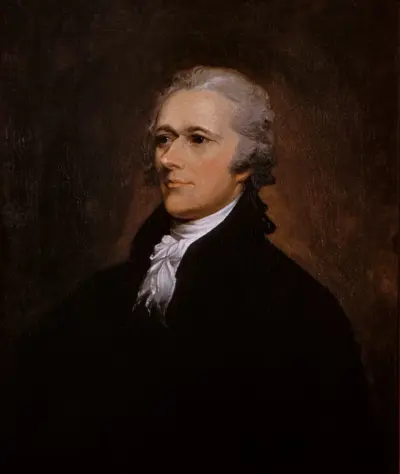
Alexander Hamilton was an American statesman, politician, legal scholar, military commander, lawyer, banker, and economist. He was one of the Founding Fathers of the United States. He was an influential interpreter and promoter of the U.S. Constitution, as well as the founder of the nation's financial system, the Federalist Party, the United States Coast Guard, and the New York Post newspaper. As the first secretary of the treasury, Hamilton was the main author of the economic policies of George Washington's administration. He took the lead in the federal government's funding of the states' debts, as well as establishing the nation's first two de facto central banks, the Bank of North America and the First Bank of the United States, a system of tariffs, and friendly trade relations with Britain. His vision included a strong central government led by a vigorous executive branch, a strong commercial economy, government-controlled banks, support for manufacturing, and a strong military.
