Frederick the Great Quotes
The sky does not rest more firmly on the shoulders of Atlas than the Prussian State does on the Prussian army.
Frederick II, 1712-1786, [The Great], King of Prussia, 1760
Sourced by: Eigen's Political and Historical Quotations


During the presidential debates George W. Bush stated that he would be very hesitant to use the military for nation building around the world. Less than a year later, the Bush administration, faced with the September 11, 2001 terrorist attacks, launched a massive attack on the Taliban regime in Afghanistan. After fighting and winning the war, the military soon realized that they would in fact be involved in nation building. However, with the assistance of the United Nations much of the humanitarian burden was lifted from the U.S. military.

Commenting on the hostilities between the Baltic states and the Russian government:


There is a , romantic American myth about the Militiamen in Colonial and Revolutionary America—the citizen soldiers who would leave their farms and rise to the military necessity of the day. However, not only were the militia very hard to muster to duty, but most actually didn’t own or have experience with firearms, and the prevailing opinion of knowledgeable military leaders from George Washington on down was that the militia were not very good soldiers. See {613015}, {613016}, {613022}, {613027}, {621987}, {621988}, {613030}, {613033}, & {613056}

America is almost unique among nations where the military has never been a force that either dominated or controlled the government or acted independently from it. The Founding Fathers knew well the history of Europe and other nations, and built many checks into our Constitution and our traditions with George Washington, setting the example for American military men forever after.


In early America, there was great concern about a standing army—a military force that exists and is organized in peacetime. History showed the founding fathers that tyrants who siezed power almost always did so by getting control of the standing army. The logic was if there is no standing army, no one can control it and therefore no tyrant can control the country by force. At the time, however, with oceans protecting us, there was penty of time to mobilize a defensive army should any foreign power invade. However, with modern military technology, and the importantance of retaliation as a protective3 strategy, it is virtually impossible to not have a standing army and stoll be secure.


This quotation illustrates some of the interesting attitudes of early Americans. First, note the backhanded slap at a standing army. The navy was much preferred by early Americans as history had demonstrated that most republics had been destroyed by their own armies taking over in some “emergency” of time of “crisis.” This also helps explain why the army and navy were different departments of government—a tradition that lasted until after WWII. The two departments had totally different purposes and objectives and presented different potential dangers to the nation.

Surprising to most Americans today, at that time, the Governors controlled the State militias, and in this case two Governors refused to make their militias available for the war effort. This experience and others led to the change which today allows the Federal Government to “call up” the National Guard of any state regardless of the desire of the State Governor.
This quotation is often cited as it presages the concept of the Military Industrial Complex that was given by President Eisenhower in 1961--{641114}. It is not known whether Eisenhower had read or was briefed on this Mills quotation.

Many of the young men who were given this form to fill out, had never been in Japan and some did not even know there was an emperor there. Nonetheless the Japanese American divisions of enlistees were the most effective and most decorated fighting units for America while their parents who had not been born in America were still imprisoned in the internment camps. See {624010}.


If we replace the word “socialist” with “capitalist” this statement would be approved by almost every American Senior Military officer and Defense Official as well as most members of Congress. The reality was that the basic defense posture of the Soviet Union and the United States was essentially the same during the Cold War.
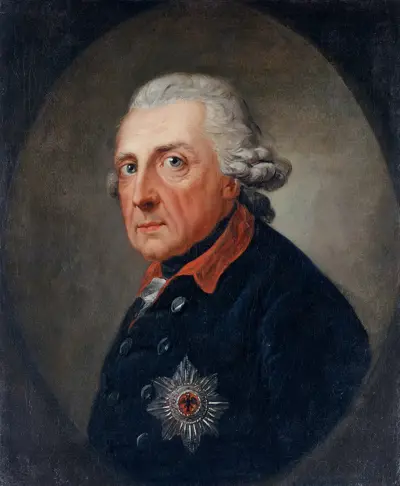
Frederick II was a Prussian king and military leader who ruled the Kingdom of Prussia from 1740 until 1786, reigning longer than any other Hohenzollern king. His most significant accomplishments during his reign included his reorganization of Prussian armies, his military successes in the Silesian wars and the Partitions of Poland, and his patronage of the arts and the Enlightenment. Frederick was the last Hohenzollern monarch titled King in Prussia and declared himself King of Prussia after annexing strategic parts of the Polish–Lithuanian Commonwealth in 1772. Prussia greatly increased its territories and became a leading military power in Europe under his rule. He became known as Frederick the Great (German: Friedrich der Große) and was nicknamed "The Old Fritz" (German: "Der Alte Fritz") by the Prussian people and eventually the rest of Germany.
