John Marshall Harlan Quotes
Have we become inoculated with prejudice of race that an American government professedly based on the principles of freedom ... can make distinctions between such citizens ... simply because of their respective races?
The court. despite Harlan’s dissent, found the Kentucky “Day Law”—making it illegal to have Nego and White Students in the same college even if the college is totally private.
John Marshall Harlan Dissent, Berea College v. Commonwealth of Kentucky
Sourced by: Eigen's Political and Historical Quotations

This quotation shows two important historical facts about Southern Racism. The first is now great the social pressures were against any white who would try and alter the status quo. The second was that none the less there have always been whites in the South who, despite the great social penalties, did the right thing and not only improved the situation, but more important, made most Americans realize that Southerners were not all racists any more than all of any group had any negative behavior.


Referring to Montgomery Alabama in 1950.

Some whites opposed Slavery and new slave states, not becasue of any sympathy with Negroes or concern for the immorality of slavery, but becasue slavery made it difficult for the working white man to thrive.

Nixon, in his second attempt to win the Presidency was told by a small group of Southern Republican politicians that his support was wavering in the South. They had already left the Democratic Party in reaction to the Passage of the 1964 Civil Rights Act. They were concerned because in order to try and capture some of the more liberal anti-war Democrats, Nixon had been making speeches advocating the vigerous enforcement of of civil rights and improving the lot of the Negro. But Nixon could not afford to lose his political base inb the south. Hence the promise which did not keep very long after he was elected President. Nixon was not a strong civil rights President, but he was totally without principles and had no political idiology he would sacrifice any of his political capital for. So once he was elected, he didn't want to offend the centerists whose support he needed for his legislatrive program so he did pay lip service to the prinicples of equality when he himself was anti-Black, andti-Semitic and prejudiced in many areas including against intelelctuals.

Scott was then the Special Advisor on Negro Affairs to the Secretary of War in the Woodrrow Wilson administration. Wilaon hs commited U. S. Troops to fight oversease to "make the world safe for democracy", but many blacks and whites also saw gross hypocricy in asking Negores to fight for a Jim Crow, segregated America. See the related quotation 644805. Scott was also the major aide to Booker T, Washington, one of the leading Negro educators but a very pliable man on equal rights for the Blacks. The problem for the administration was much greater than that of WWII where the president was seen as very sympathetic to Blacks while Wilson was himself a racist. And in WWII the fight against the Nazis was a fight agaisnt racial supremacy. So this quotation and Scott's role was very important to the administration.

Perhaps there is no more dramatic quotation illustrating MacArthur’s arrogance where his own views and decisions should obviously prevail regardless of the policies of his superiors and his commander-in-chief. The army had been officially integrated by President Truman, The reality was that the general honestly believed that he had no superiors among the military, that civilians should not control the military, and in any event that the President—Truman—was not fit to be Commander-in-Chief.


This quotation has been one that has been used to argue against Black and other minority racism as well as white racism.

Sumner would later become a Senator. However over a century before Brown v. Board of Education finally outlawed segregated schools, Sumner made one of the basic legal arguments that was involved in the case.

Incredibly enough, after the Civil War and emancipation, most Virginia leaders opposed any form of rights for Blacks with one of the major reasons being that they were ignorant and uneducated. It was actually a crime to teach even a free Black to read.

The letter was written in the supposed style of a Black after Emancipation and includes most of the ugly false stereotypes of the worst of the racists of the present and the slaveowners of past times. Williams stated that he was not a racist and was trying to make a point about freedom required risk and responsibility. However, the effort was interpreted by many people, Black and white, to be insulting and a put down of African Americans. At the same time, although most of the Tea Party members were not racists, most of the racists in America were supporters of the Tea Party. Those people interpreted the quotation as "telling it like it is" about Blacks who do not want the responsiblities and risks of freedom and are not yet developed sufficiently to be equal citizens in a democracy.

This quote illustrates the Southern segregationist view in the Jim Crow South.

The all white regular Mississippi Delegation was selected in elections where Blacks were barred from voting although Blacks were in the majority in Mississippi. In addition, the regular party was advocating obstructing the Supreme Court school integration decisions and the Civil Rights Act that had just been passed. See {637616}. The insurgent group was selected in integrated elections, contained black and white delegates, and was pledged to support and obey the laws. The President could not make the decision unilaterally, but had a great deal of influence.

This was the first major civil rights speech. He had previously in his political career tread carefully in the civil rights arena. The Southerners had disproportionate control over the Congressional committee chairmanships and they could hold up his entire legislative agenda. JFK’s father was a right wing fascist who supported Hitler earlier and always advised against pushing civil rights.


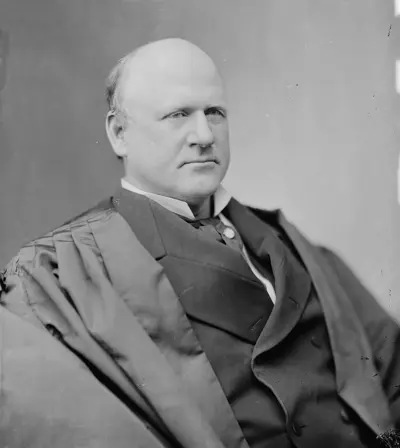
John Marshall Harlan was an American lawyer and politician who served as an associate justice on the U.S. Supreme Court. He is often called "The Great Dissenter" due to his many dissents in cases that restricted civil liberties, including the Civil Rights Cases and Plessy v. Ferguson. Many of Harlan's views expressed in his notable dissents would become the official view of the Supreme Court starting from the 1950s Warren Court and onward. His grandson John Marshall Harlan II was also a Supreme Court justice.
