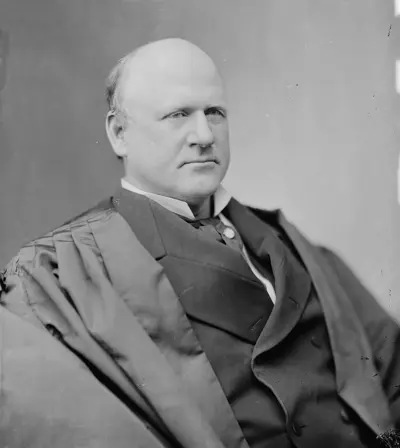
John Marshall Harlan Quotes
Our Constitution is color blind and neither knows nor tolerates classes among citizens. The arbitrary separation of citizens, on the basis of race ... is a badge of servitude wholly inconsistent with civil freedom.
John Marshall Harlan, 1833-1911, U. S. Supreme Court Justice, Plessy v. Furguson, 1896 (sole dissent)
Sourced by: Eigen's Political and Historical Quotations
This was the infamous opinion whereby the Supreme Court upheld the “separate but equal” doctrine thereby preserving racial discrimination until the reversal over 50 years later. See the sole dissent of Justice John Marshall Harlan whose views were those that eventually prevailed although at the time all the other justices voted with the majority. See {583706} and {583703}.
This was the first major civil rights speech. He had previously in his political career tread carefully in the civil rights arena. The Southerners had disproportionate control over the Congressional committee chairmanships and they could hold up his entire legislative agenda. JFK’s father was a right wing fascist who supported Hitler earlier and always advised against pushing civil rights.
Essentially this quotation led to a major war and yhrn a later war of independence for Blacks in South Africa. Porter was the Attorney General of the English Cape Colony in South Africa. In an early legal ruling he observed that South Aftica was a colony under English law which did not permit discrimination on the basis of skin color. However, there was a large proportion of Afrikaners—whites of Dutch Ancestry who were culturally strong racists and saw the Blacks as a combination of potential rivals for land and a potential subjegated labor force. They tended to leave the Capetown area and English law. The Afrikaners ended up in a major war—the Boer War—against the English and although the English won the war, the Afrikaners won the political peace and ended up dominating South Africa and imposing apartheid. The Blacks of the mid 20th century had if nothing else, the 100 year old legal and moral precendent from Porter’s opinion which justified the ANC leading the attack on apartheid which finally succeeded. It took 100 years and millions of suffering and dying people but finally, the law of South Africa was as Porter had stated it, and since the Blacks were in the great majority, the Whites became the minority, but due to the ANC leadership of men like Nelson Mandella, the Blacks did not seek revenge on the Afrikaner whites although there was resentlent for generations.
Eight years and a Civil War later, he had changed his mind and was the sponsor of the Civil Rights Act of 1866—the first Federal civil rights law in America. See {587711}.
The editor at the time was Dr. William H. Boyle but no one is sure whether he, the owner, or someone else, wrote the editorial. The quotation illustrated a fascinating twist of logic that was very commonly held at the time. “If God created men of different colors, he must have meant them to be separate.” It is fascinating that virtually no one at the time made a similar argument about hair or eye color, intellect or other differential traits of people. Although this logical fallacy waned in the latter part of the 20th century, there are some who still hold to it.
Before the civil rights act was passed, most labor unions will racist and discriminated against black workers. The United Auto Workers union was an exception and Reuther was a strong advocate of desegregation and equal rights.
The first sentence is inscribed on the Jefferson Memorial in Washington DC. The last two sentences are rarely quoted.
Billy Sunday was the most famous preacher of the day. Unlike the vast majority of white preachers, he not only preached to black audiences but exuded an atmosphere of friendliness and comfort around Blacks that amazed most. Most Black leaders thought Sunday was very good for race relations, but there were some critics like Grimke. Sunday was castigated by many racist whites for preaching to Blacks, but he did not go as far as to condemn or preach against racism and the discrimination of the day and he would not preach to an integrated audience. See {585416} for another critique.
Racial intermarriage was the greatest fear of those who opposed integration.
to have separate schools for Blacks
- Born: June 1, 1833
- Died: October 14, 1911
- Nationality: American
- Profession: Judge
John Marshall Harlan was an American lawyer and politician who served as an associate justice on the U.S. Supreme Court. He is often called "The Great Dissenter" due to his many dissents in cases that restricted civil liberties, including the Civil Rights Cases and Plessy v. Ferguson. Many of Harlan's views expressed in his notable dissents would become the official view of the Supreme Court starting from the 1950s Warren Court and onward. His grandson John Marshall Harlan II was also a Supreme Court justice.