Lyman Trumbull Quotes
I have never contended for giving the negro equal privileges with the white man. That is a doctrine I do not advocate.
Eight years and a Civil War later, he had changed his mind and was the sponsor of the Civil Rights Act of 1866—the first Federal civil rights law in America. See {587711}.
Lyman Trumbull, 1813-1896, U. S. Senator (Republican, Democrat & Liberal Republican, IL), January 25, 1858
Sourced by: Eigen's Political and Historical Quotations

Trumbull was the sponsor of the bill. Eight years earlier he had not been an advocate of civil rights {587696} but his views changed considerably over time and over the Civil War.


Taft, very progressive on racial matters, was a little too optimistic. The “intelligent” Southerners were in the small minority. Only a week after Taft made this statement, Joseph Gorden, a Negro, was lynched outside Greenwood, Mississippi.

The Quakers were in the forefront of not only the abolition of slavery but of the integration of the races.

As enlightened and progressive that his views on Blacks were, he was amazingly racist when it came to Native Americans. See {588991}.
The editor at the time was Dr. William H. Boyle but no one is sure whether he, the owner, or someone else, wrote the editorial. The quotation illustrated a fascinating twist of logic that was very commonly held at the time. “If God created men of different colors, he must have meant them to be separate.” It is fascinating that virtually no one at the time made a similar argument about hair or eye color, intellect or other differential traits of people. Although this logical fallacy waned in the latter part of the 20th century, there are some who still hold to it.

Jessie Helms was his young assistant who drafted this race baiting ad. There are two vicious but subtle aspects to this kind of attach ads. First, not that the ad does not address the problem of white men working along side of blacks. It only refers to wives and daughter. This interracial sex innuendo played on and increased the fear of whites that Blacks would commonly rape white women. The second nasty aspect of the ad is the specific attack on the opponent. Instead of saying that he favored desegregation, the phrase “mingling of the races” was used which implied that Graham was in favor of biracial intermarriage and children—again another sex innuendo. When integration of the workforce finally occurred in the South, there was no increase in Black men sexually assaulting white women. There has been a substantial increase in racial intermarriage however as racial bigotry has diminished in America.


This quotation is one of the most enlightening about Reconstruction. The Congress was debating the first Civil Rights Act and Harris was one of the few Southern Whites left in the Congress as Maryland had not seceded. He told the other members of Congress that no matter what they did including passing the Civil Right Act of 1866, the states will ultimately control what happens in the states without worring about the Federal government. All the efforts at equality and civil rights would fail, and the Negro must be kept inferior. Harris lost the debate and the Civil Right Act of 1866 was passed. It was vetoed by the Southern President Andrew Johnson but both Houses of Congress overrode the veto easily. But Harris was right historically as to what would happen, and it would be 100 years before civil rights legislation would be meaningful.

Moynihan was actually not the political originator of the "benign neglect" phrase which became so controversial. It had been first used by The Earl of Durham in his 1839 Durham Report on the English policy towards Canada.

See {618215} for a seemingly contradictory quotation by White.


Blacks were fighting and dying in WWII. They were equal when they were under fire, but otherwise not. The war was against fascist protagonists whose creed was inequality while the allies were upholding freedom and equality. But making that aspiration a reality was difficult.

Nixon, in his second attempt to win the Presidency was told by a small group of Southern Republican politicians that his support was wavering in the South. They had already left the Democratic Party in reaction to the Passage of the 1964 Civil Rights Act. They were concerned because in order to try and capture some of the more liberal anti-war Democrats, Nixon had been making speeches advocating the vigerous enforcement of of civil rights and improving the lot of the Negro. But Nixon could not afford to lose his political base inb the south. Hence the promise which did not keep very long after he was elected President. Nixon was not a strong civil rights President, but he was totally without principles and had no political idiology he would sacrifice any of his political capital for. So once he was elected, he didn't want to offend the centerists whose support he needed for his legislatrive program so he did pay lip service to the prinicples of equality when he himself was anti-Black, andti-Semitic and prejudiced in many areas including against intelelctuals.

Referring to Montgomery Alabama in 1950.

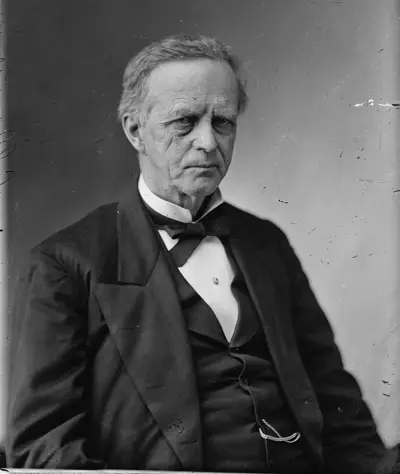
- Born: October 12, 1813
- Died: June 25, 1896
- Nationality: American
- Profession: Politician
Lyman Trumbull was a United States Senator from Illinois and the co-author of the Thirteenth Amendment to the United States Constitution.
