John Marshall Harlan Quotes
The destinies of the two races, in this country, are indissolubly linked together, and the interests of both require that the common government of all shall not permit the seeds of race hate to be planted under sanction of law.
John Marshall Harlan, 1833-1911, U. S. Supreme Court Justice, Plessy v. Furguson, 1896 (sole dissent)
Sourced by: Eigen's Political and Historical Quotations

This was the infamous opinion whereby the Supreme Court upheld the “separate but equal” doctrine thereby preserving racial discrimination until the reversal over 50 years later. See the sole dissent of Justice John Marshall Harlan whose views were those that eventually prevailed although at the time all the other justices voted with the majority. See {583706} and {583703}.
This was the infamous opinion whereby the Supreme Court upheld the “separate but equal” doctrine thereby preserving racial discrimination until the reversal over 50 years later. See the sole dissent of Justice John Marshall Harlan whose views were those that eventually prevailed although at the time all the other justices voted with the majority. See {583706} and {583703}.


The Quakers were in the forefront of not only the abolition of slavery but of the integration of the races.


This view was extremely popular with the White establishment but decried by Du Bois and a few other Black leaders. Unfortunately for African Americans and the rest of the country. Washington in this quotation turned out to be very wrong. Blacks quickly produced all kinds of goods and services that whites wanted, but the Jim Crow culture of the South and much of the North would simply not allow any relations between the races that might diminish the friction. Southerners for over 100 years blamed and resented the Negro for the destruction of the South in the Civil War and trying to act as if he was equal to the whites. And Blacks blamed whites for the century of slavery and then not enforcing the laws and denying them civil rights and equality.


This was passed AFTER segregated schools had been outlawed by the Supreme Court in Brown v. Board of Education and the 1964 Civil Rights Act had been passed.

Throughout the Jim Crowe era of the South, the Southern whites were the poorest Americans with the exception of the Blacks, with few economic and cultural opportunities compared with the rest of the nation, the schools were the weakest of any area of the nation, the universities behind, and politically even whites had few choices with single party (Democratic Party) rule. While desegregation was fought tooth and nail by most white Southerners, it had the effect of elevating all phases of Southern life go that the gap between the South and the rest of the country diminished considerably. But the Blacks were also freed from the evil system and that was the “price” to the whites to which Baldwin referred.

Jessie Helms was his young assistant who drafted this race baiting ad. There are two vicious but subtle aspects to this kind of attach ads. First, not that the ad does not address the problem of white men working along side of blacks. It only refers to wives and daughter. This interracial sex innuendo played on and increased the fear of whites that Blacks would commonly rape white women. The second nasty aspect of the ad is the specific attack on the opponent. Instead of saying that he favored desegregation, the phrase “mingling of the races” was used which implied that Graham was in favor of biracial intermarriage and children—again another sex innuendo. When integration of the workforce finally occurred in the South, there was no increase in Black men sexually assaulting white women. There has been a substantial increase in racial intermarriage however as racial bigotry has diminished in America.


As enlightened and progressive that his views on Blacks were, he was amazingly racist when it came to Native Americans. See {588991}.

Referring to Montgomery Alabama in 1950.


Eight years and a Civil War later, he had changed his mind and was the sponsor of the Civil Rights Act of 1866—the first Federal civil rights law in America. See {587711}.

The editor at the time was Dr. William H. Boyle but no one is sure whether he, the owner, or someone else, wrote the editorial. The quotation illustrated a fascinating twist of logic that was very commonly held at the time. “If God created men of different colors, he must have meant them to be separate.” It is fascinating that virtually no one at the time made a similar argument about hair or eye color, intellect or other differential traits of people. Although this logical fallacy waned in the latter part of the 20th century, there are some who still hold to it.

Of all the defenses is American slavery, this one is probably the most absurd. If it were remotely true, this may have been the only example in human history where people were beaten, debauched, tortured, murdered and degraded by their “friends.”
This quotation illustrates one of the earliest major political dirty tricks. The pamphlet was published supposedly as a Republican campaign piece. The Democratic ploy was to turn votes from Abraham Lincoln to the Democratic candidate, George B. Mclellan. It also appears to be the first English usage of the word “miscegenation”. Lincoln was re-elected in spite of the Republicans being portrayed as radical race mixers.
Bilbo was one of the worst racists who ever served in the Congress.

Taft, very progressive on racial matters, was a little too optimistic. The “intelligent” Southerners were in the small minority. Only a week after Taft made this statement, Joseph Gorden, a Negro, was lynched outside Greenwood, Mississippi.

This painting depicted a young black girl walking to school surrounded by 4 U. S. Marshalls protecting her from the crowd of white racists trying to prevent her from attending an elementary school under court order. The vicious race hatred that school integration revealed was the national problem that was then surfacing. The graphic is the illustration that appeared in Look with that name.

At the time, the Southern segregationists were all Democrats and they blocked any Democratic attempt to pass any Civil Rights legislation. When he could not get a Civil Rights commitment from his own party, Powell turned to the Republicans and the President wrote this letter. In return, in November, Powell endorsed and supported Eisenhower instead of Stevenson, his own party’s nominee. Eisenhower could not get any legislation on Civil Rights as the Southern Democrats would always block it. When President Lyndon Johnson finally forced the 1963 Civil Rights Act through the Congress, the racist Southern Democrats cut a deal with Goldwater and the conservative Republicans, and switched parties. Since then the Civil Rights stance of the two parties reversed. The Democrats were thereafter pro Civil Rights and the Republicans, the party of Lincoln and Reconstruction, thereafter reversed their Civil Rights position and opposed progress in this area.
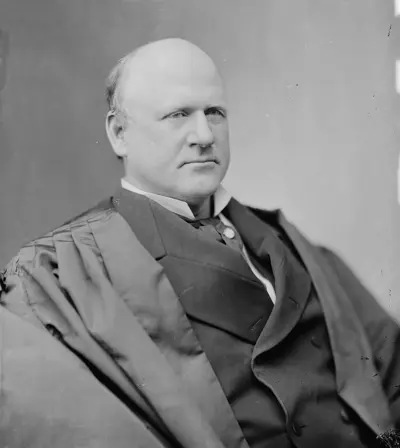
- Born: June 1, 1833
- Died: October 14, 1911
- Nationality: American
- Profession: Judge
John Marshall Harlan was an American lawyer and politician who served as an associate justice on the U.S. Supreme Court. He is often called "The Great Dissenter" due to his many dissents in cases that restricted civil liberties, including the Civil Rights Cases and Plessy v. Ferguson. Many of Harlan's views expressed in his notable dissents would become the official view of the Supreme Court starting from the 1950s Warren Court and onward. His grandson John Marshall Harlan II was also a Supreme Court justice.
