John Marshall Harlan Quotes
In view of the Constitution, in the eye of the law, there is in this country no superior, dominant, ruling class of citizens. There is no caste here. Our Constitution is colorblind, and neither knows nor tolerates classes among citizens.
John Marshall Harlan, 1833-1911, U. S. Supreme Court Justice, Dissent, Plessy v. Ferguson, 1896
Sourced by: Eigen's Political and Historical Quotations


This was the infamous opinion whereby the Supreme Court upheld the “separate but equal” doctrine thereby preserving racial discrimination until the reversal over 50 years later. See the sole dissent of Justice John Marshall Harlan whose views were those that eventually prevailed although at the time all the other justices voted with the majority. See {583706} and {583703}.

This ruling upheld a military draft for males only. The logic was that men and women were dissimilar persons.


This statement in the President’s Second Inaugural. Infuriated the politicians of the Southern States. Remember, at the time there was brutal discrimination throughout most of the South, and more important to the South than the fact if the discrimination was their perverse view that this was a right, proper and necessary state of affairs for the welfare of the people and was required by Christianity’s mandates as they read the Scripture. For the President to state so publicly that discrimination was contrary to the law, justice, good faith, citizenship and fairness was a major shock. Since the early days of reconstruction after the Civil war in the Grant Administration, no president had spoken so publicly and openly against the Southern status quo.

It is surprising that these ideas would come from one of the most autocratic powerful monarch in the world at the time. However there were many very liberal influences on her from Europe. This set of proposals she even sent to Voltaire to get his feedback and criticism.


Most pressure for political correctness comes from the center or the left. On this area however, pressure to avoid speaking of this comes from left and right. The left is concerned that by discussing the reality the poorer performing subgroups will be stigmatized and public behavior will make the situation worse. The right would prefer that there is little or no political dialogue regarding the huge differences in outcome in America where individual ability and effort seems to play such a large part of the differential. I addition, they see the making of these distinctions as the beginning of class warfare.

Wilson was using logic and consistency to show the absurdity of the proposal to count three fifths of the slaves as people for the apportionment of congressional seats. Particularly difficult for the Southern States to refute was his point that who should other property not be considered in addition to slaves in the apportionment formula? Factories, farms, land value, raw materials, merchandise, etc. That compromise however prevailed regardless of its inconsistency and failure to adhere to any principles. This was the only way to have the South join the new nation.

Executed by the English for his part in the Easter Uprising. The Empress of Austria had just been assassinated by Luigi Luccheni in the streets of Geneva, Switzerland.

He was reacting to the racial claims of Adolph Hitler in German


Mormons were not only discriminated against but frequently robbed, murdered and ethnically cleansed from different parts of the country. In general the Federal Government did little or nothing regarding the plight of the Mormons.


Quoted in the Court’s notes of the meeting
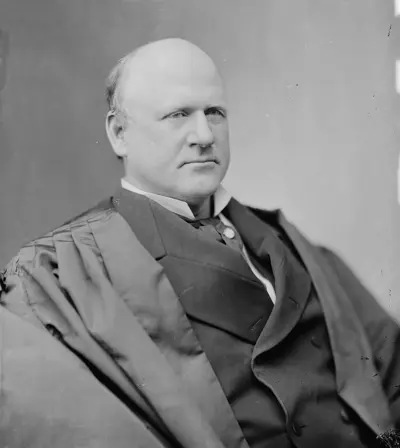
John Marshall Harlan was an American lawyer and politician who served as an associate justice on the U.S. Supreme Court. He is often called "The Great Dissenter" due to his many dissents in cases that restricted civil liberties, including the Civil Rights Cases and Plessy v. Ferguson. Many of Harlan's views expressed in his notable dissents would become the official view of the Supreme Court starting from the 1950s Warren Court and onward. His grandson John Marshall Harlan II was also a Supreme Court justice.
