Millard Fillmore Quotes
God knows that I detest slavery, but it is an existing evil, for which we are not responsible, and we must endure it, and give it such protection as is guaranteed by the constitution, till we can get rid of it without destroying the last hope of free government in the world.
Millard Fillmore, 1800-1874, 13th President of the United States (Whig, NY), Severance, Millard Fillmore Papers, 1959
Sourced by: Eigen's Political and Historical Quotations


There was a committee proposal to terminate the importation of slaves in 1800. There was a majority for this, but Mr. Randolph proposed that the time be extended to 1808, 20 years thence.


Even before we had a Constitution there was major opposition to slavery. The “price” of the American Union was the acceptance of the slavery of the South. But the hypocrisy of a country based on liberty to allow and enforce slavery was not lost on the founding fathers. Ironically the abolitionists among the founding fathers were certain that they could persuade the Southern slaveholders of the error of slavery in a few years and things would be set right in the land. Even George Washington {630626}, and Thomas Jefferson and some other slaveowners at the time wished to see its abolition. Slaveholding Southern Founding Fathers in general were so wary of the abolitionists that they achieved structural, disproportionate, power in the new Constitution to ward off the abolitionists attempts to reform slavery.


The Union troops had just been routed at Bull Run. Many in the North thought that the war would be a short one with little disruption of loss of life. Here Norton, like so many others, provided a a more realistic assessment. Also note the reference to “barbarism” in the South, When the Union was formed, the Southern states were not as well developed as the North from an industrial, educational or cultural perspective. There were vestiges of aristocracy, crude law enforcement, and much more poverty (Virginia excepted) than in the North. Most Northerners thought that the South would reform—modernize and become more like the North, but instead the gulf became greater as the North itself developed and changed rapidly while the South was mired in its traditions with their aristocracy gaining more political, economic and cultural control. This attitude of Northern superiority, objectively valid though it may have been, was sorely resented by the South and this resentment has persisted into relatively modern times.


On the Fugitive Slave Act: As one of the leading American Catholic intellectuals during the 19th Century, Brownson’s opinions went far in keeping Catholics from joining the side of the abolitionists. However, just a few years later his tone would change and he would become one of the few Catholic writers to refuse to defend slavery, see {610710}. While the majority of Catholics refused to join the abolition movement, they often did so because abolitionism was closely tied to anti-Catholicism, see Gordon {611392} or Shaftesbury {611106}. Other reasons included Irish immigrants fearful of competition from Black labor and the fear of liberal individualism and social disorder, which was prevalent in 19th century Catholic thought. For a further explanation on the relationship between American Catholics and slavery, see McGreevy {612036}.

The Mystery was for many years the only Black Newspaper in America.


America’s first political economist


President Andrew Johnson had been impeached by the House of Representatives and was being tried in by the Senate. A majority of the Senators voted for conviction but the vote was 1 short of the two-thirds that were needed. Johnson remained in office.

Jefferson’s views, actions and inactions regarding slavery are very complex and contradictory. This quotation is one example of the many statements and activities to end slavery. Yet he never freed his own slaves (as did George Washington) and he fathered a child by one of his slaves with no attempt at freeing even her and the child. The Andrew Dickson White article is one of the first serious studies of the Jefferson contradictions regarding slavery.

As an entertainer she had toured much of the world and seen American slavery and that of some other nations. She became a staunch abolitionist and like entertainers in the 20th and 21st centuries she used her celebrity to give anti-slavery lectures and perform for audiences where she donated the proceeds of the event to the abolition cause. She is a particularly interesting political figure in that she seems to be one of the first entertainers to perform for a social cause and become an activist.
The political machine of New York City, unlike most others in the Northeast were supporters of the Southern position on slavery. They had strong economic relations with the Southern planters and wanted to keep the federal government far away from state and local affairs.

Even in 1828 there were issues of which politicians would protect Constitutional rights and which might not.

In June of 1850, a bipartisan group of Southern politicians met in Nashville, TN for the purpose of organizing strategy and tactics to ward off and defeat the growing aggressiveness of Northern politicians and other leaders in trying to abolish slavery. They issued an address to the people. This is one of the clearest statements of the position of most of the Southern Politicians on the increased efforts to abolish or curtail slavery. They felt that a deal had been made by the founding fathers and the first Congress not to deal with the slavery issue, and that deal must be honored in perpetuity. Most Northerners agreed that a deal had been made, but it was not binding forever—that a Congress could not limit the scope of a future Congress except via a Constitutional Amendment. The deal on Slavery was a deal not to address it for a while. It was not a deal to accept the Southern point of view. And none of it was written into the Constitution because opinion was even then split and a majority could not be mustered for a compromise that would write legal slavery into the Constitution. But many Southerners believed that its absence implied that it could not be addressed by the government. They demanded the right of their states to choose slavery if they so wished. Time was not on the side of the South and the Southerners who insisted on State’s Rights regarding slavery opposed States Rights for Northern States who wished to disallow fugitive slaves to be returned to owners. The more fugitive slaves there were, the more hypocritical the Southern position became as they needed Federal preemption on the issue of Fugitive Slaves, else slavery would end by escape and non-return of slaves.
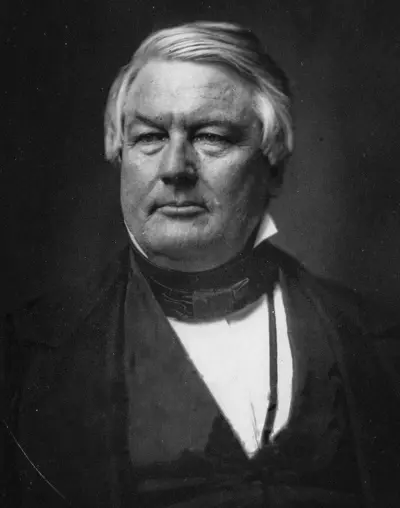
Millard Fillmore was the 13th president of the United States, serving from 1850 to 1853, the last to be a member of the Whig Party while in the White House. A former member of the U.S. House of Representatives from Upstate New York, Fillmore was elected as the 12th U.S. Vice President in 1848, and succeeded to the presidency in July 1850 upon the death of U.S. President Zachary Taylor. Fillmore was instrumental in the passing of the Compromise of 1850, a bargain that led to a brief truce in the battle over the expansion of slavery. He failed to win the Whig nomination for president in 1852 but gained the endorsement of the nativist Know Nothing Party four years later and finished third in the 1856 presidential election.
