New York Tribune Quotes
It is impossible to exaggerate the importance of the recent decision of the Supreme Court. The grounds and methods of that decision we have exposed elsewhere; and we now turn from them to contemplate the great fact which it establishes -- the fact that Slavery is National; and that, until that remote period when different Judges, sitting in this same Court, shall reverse this wicked and false judgment, the Constitution of the United States is nothing better than the bulwark of inhumanity and oppression.
New York Tribune, Editorial on the Dred Scott Supreme Court Decision, March 11, 1857
Sourced by: Eigen's Political and Historical Quotations


The Federal Fugitive Slave Act required all in free states to assist owners of escaped slaves to return them to their owners. In 1854 a Missouri slave owner tracked his escaped slave to Wisconsin and the Federal officials incarcerated the slave pending his return. A Wisconsin mob broke the slave out of jail and helped him escape to Canada. Sherman M. Booth, Publisher & Editor of the Wisconsin Free Soil Democrat was convicted under the Fugitive Slave Act for aiding the escape. Smith’s opinion overturned the Fugitive Slave Act on the grounds that it had usurped state’s rights. The Supreme Court overturned Smith’s ruling, but Booth was pardoned. See {587926} & {587928}. The more “dread calamity” was civil war which of course came a few years later.

The political machine of New York City, unlike most others in the Northeast were supporters of the Southern position on slavery. They had strong economic relations with the Southern planters and wanted to keep the federal government far away from state and local affairs.


In the wake of the Dred Scott Supreme Court decision, most Northern newspapers and leaders opposed the decision and argued against compliance—especially the Republican newspapers. However, some Northern newspapers were Democratic supporters and argued that the Supreme Court must be obeyed and to oppose the court is to oppose the Constitution itself.


On the Fugitive Slave Act: As one of the leading American Catholic intellectuals during the 19th Century, Brownson’s opinions went far in keeping Catholics from joining the side of the abolitionists. However, just a few years later his tone would change and he would become one of the few Catholic writers to refuse to defend slavery, see {610710}. While the majority of Catholics refused to join the abolition movement, they often did so because abolitionism was closely tied to anti-Catholicism, see Gordon {611392} or Shaftesbury {611106}. Other reasons included Irish immigrants fearful of competition from Black labor and the fear of liberal individualism and social disorder, which was prevalent in 19th century Catholic thought. For a further explanation on the relationship between American Catholics and slavery, see McGreevy {612036}.

The Mystery was for many years the only Black Newspaper in America.


There was a committee proposal to terminate the importation of slaves in 1800. There was a majority for this, but Mr. Randolph proposed that the time be extended to 1808, 20 years thence.

Mormons were not only discriminated against but frequently robbed, murdered and ethnically cleansed from different parts of the country. In general the Federal Government did little or nothing regarding the plight of the Mormons.
Responding to suggestions that drug traffickers be summarily executed:

This was the infamous opinion whereby the Supreme Court upheld the “separate but equal” doctrine thereby preserving racial discrimination until the reversal over 50 years later. See the sole dissent of Justice John Marshall Harlan whose views were those that eventually prevailed although at the time all the other justices voted with the majority. See {583706} and {583703}.

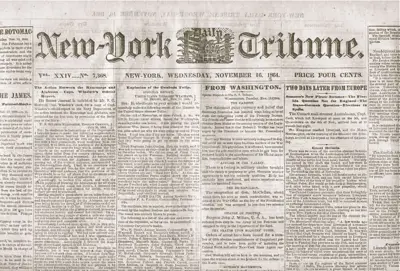
The New-York Tribune was an American newspaper, first established in 1841 by editor Horace Greeley. Between 1842 and 1866, the newspaper bore the name New-York Daily Tribune. From the 1840s through the 1860s it was the dominant Whig Party and then Republican newspaper in the United States. The paper achieved a circulation of approximately 200,000 in the 1850s, making it the largest daily paper then in New York City. The Tribune's editorials were widely read, shared, and copied in other city newspapers, helping to shape national U.S. opinion. It was one of the first papers in the north to send reporters, correspondents, and illustrators to cover the campaigns of the American Civil War.
