Roger Mahony Quotes
Canon law itself says for one case of guilt, a priest can be dismissed from the clerical state. One.
Wakin, Daniel J. "A Move by Cardinals, but So Much Is Unresolved." The New York Times, 25 Apr. 2002, p. A1.


The letter was written at the behest of the Archbishop of Canterbury. The quotation appears to ratify the Pope’s unlimited power, but in actuality carves out an exception whereby the Pope’s authority might be challenged in the future. Specifically, it claims the Pope has not the authority to alter that which “by the word of God, has eternal validity.” Politically, this position put the pope in a box. By arguing against the proposition, the Pope would have to maintain that he should have the right to alter the word of God that had eternal validity which no pope wanted to state. By not challenging the doctrine, there was an opening by which the pope’s omnipotence could be challenged in the future.

Note that the penalty for priests who married was not very great. By this Cannon, they would be forbidden to perform their priestly duties for a short while, and the marriage was dissolved, but they could maintain their rank, status and privileges although they could not advance further. This reflects the greater tolerance for marriage of the Eastern Church then the Westerners of Rome would allow. This grew to total acceptance of married priests in the Eastern Church but there were ideological differences when there was but one church.

This was a fairly radical constraint on what had been a traditional priestly prerogative throughout the ages. However, the penalty for such a sin and infraction was rather modest—a warning for the first offence, followed by reducing the cleric’s income. There were more serious punishments proscribed for repeated offenses, but typical of most reform efforts a newly prohibited activity carries a very light penalty. For example $20 fines for providing alcohol to a minor was the initial penalty in some states. A then current comparison can be made since elsewhere in this council dueling between Christians was also prohibited. But the penalty for even the first offence was excommunication.


William the Conqueror. This is one of the earliest government action separating some church functions from state functions.


Naples was an independent kingdom before the unification of Italy. This quotation illustrates one of the lowest periods of the Roman Catholic Church where the personal morality of the Pope and Cardinals was greatly at odds with the earlier and current positions of the Church. This hypocrisy, nepotism, and corruption was one of the major factors that led to the Reformation. Note that the Pope had an illegitimate son who he named a Cardinal and the Pope wanted his son to marry the daughter of the king. The king was not enthusiastic given the son’s status as a Cardinal of the Church.

This was before the state had officially sanctioned and accepted the church. Most of the institutions were pagan and the kings had subjects of both religions with Christianity not yet dominant. Yet among Christians, the Church had government temporal power, even before the church was allied with the state.

King Henry VIII had left the Roman Catholic church and taken England and Ireland out also. He replaced the Pope as the head of the English and Irish churches. There was much opposition in Ireland and the priests were the most assertive opponents to the change and were still loyal to the Pope. Queen Elizabeth continued to have problems with the Priests. James I, Elizabeth’s successor, became fed up by the Roman Catholic Priests and therefor issued this Proclamation.

Spinoza’s ideas were considered so radical and dangerous that he was the only man in history who was excommunicated by the Catholics, the Jews and the Muslims. This was his observation after his first excommunications -- by his Jewish Congregation in Amsterdam.


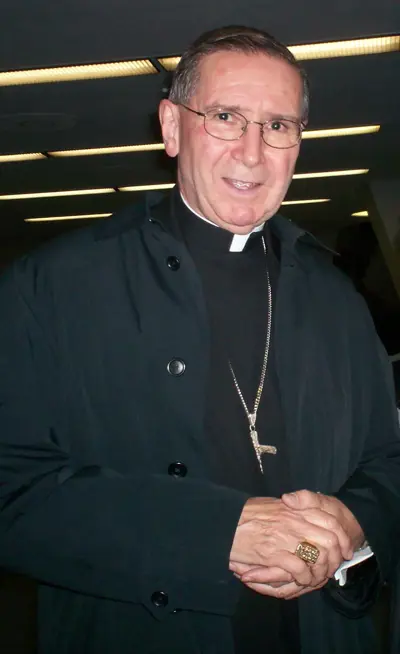
Roger Michael Cardinal Mahony KGCHS is an American cardinal and retired prelate of the Roman Catholic Church who served as Archbishop of Los Angeles from 1985 to 2011. Before his appointment as Los Angeles archbishop, he served as Auxiliary Bishop of Fresno from 1975 to 1980 and as Bishop of Stockton from 1980 to 1985. Mahony played an instrumental part in covering up the sexual abuse of many young people within the Church.
