Benjamin Franklin Quotes
A [desire] to abolish slavery prevails in North America, many of the Pennsylvanians have set their slaves at liberty, and [Virginia legislators] have petitioned the King for permission to make a law for preventing the importation of more [slaves] into that colony. This request, however, will probably not be granted, as their former laws of that kind have always been repealed.
Franklin, Benjamin. "Letter to Anthony Benezet, 22 August 1772." The Papers of Benjamin Franklin, edited by William B. Willcox, vol. 19, Yale University Press, 1975, p. 269.

Jefferson’s views, actions and inactions regarding slavery are very complex and contradictory. This quotation is one example of the many statements and activities to end slavery. Yet he never freed his own slaves (as did George Washington) and he fathered a child by one of his slaves with no attempt at freeing even her and the child. The Andrew Dickson White article is one of the first serious studies of the Jefferson contradictions regarding slavery.


On his deathbed he claimed to Kelly that he had been offered command of the Army of the Potomac but was not willing to "pay the price" which he claimed was to accept the terms. Pleasonton, always more of a bureaucrat than an ideologue or strong leader, like many Union officers, only wanted to defang the South so that they could not threaten the rest of the states but was not convinced that "crushing" the rebels was worth the cost or that slavery or the reelection of Lincoln was worth it. There is no independent verification of his receiving the offer, but what is more likely was as the Cavalry Commander of the Army of the Potomac he was "sounded out" on the subject.

Later changed the name to The Emancipator. Many are surprised that a Southern State would have had such strong abolitionist sentiment so early, but East Tennessee was a hotbed of abolition. See {614117} and {614069}
American reformers followed slavery issues in Africa and elsewhere. The status of Africa was particularly important as the notion of extensive American Black colonization was still viable to many.

The issue of slavery which had been suppressed in Congress for the first decades of the nation broke out when Missouri was considered for statehood. By previous agreement, slavery was not even discussed in Congress but the time period elapsed. Tallmadge not only proposed that no more slaves could come into Missouri but most shocking to the Southerners was that every person born in the new state would be free at the age of 25. In a generation, there would be no more slavery in Missouri and there would be no economic compensation for slave owners at all. The House of Representatives accepted the amendment, but it failed in the Senate. At that time, Senators were not elected by voters but were appointed by the state legislators and the Southern slave states had a disproportionate share of the senate from a population point of view. But what this quotation shows clearly that a majority of the country in 1819 were opposed to slavery and were willing to end it without compensation.

The Act was passed by the Pennsylvania General Assembly whose clerk interestingly enough was Tom Paine.

On February 11, 1790 American Quakers submitted a petition to immediately abolish the African slave trade from America. Southerners like Jackson argued that the Congress should not even “consider” such a petition or debate such as subject for if it did, that per se, would imply the possible consideration of emancipation, and if that were possible, they would be on the slippery slope toward emancipation of existing slaves which would be the end of the world as the Southern whites then knew it.


This quotation is often given by those who argue that Lincoln really did not care about the slavery issue. It is a terrific example of the limitations of quotations where there is artful rhetoric. Douglas, had in the 1st debate posed 7 “interrogatories” to Lincoln asking if he were pledged to certain positions regarding slavery. Douglas was trying to associate Lincoln with the most radical abolitionists in the land. By asking if Lincoln were pledged to the positions, Douglas thought that he had cornered Lincoln. For if Lincoln denied the pledges, he would appear to be backing off his anti slavery positions, and if Lincoln would not, then he would appear to support the most radical elements. Lincoln turned the rhetorical tables on his opponent. He first answered the question literally, emphasizing “pledged”. Just as Douglas thought he had forced Lincoln off his anti-slavery views, Lincoln stated what he would “like to see” as opposed to what he was pledged for. See {615826}.


See {613644} for the earlier decree which this modified.
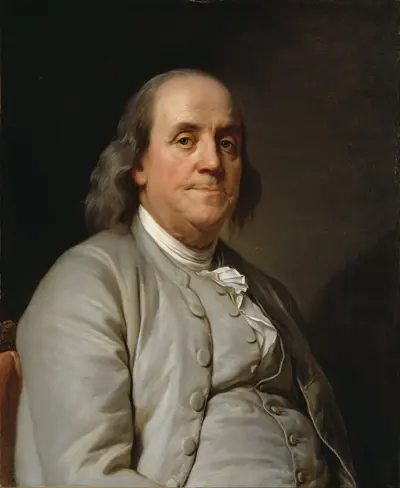
Benjamin Franklin FRS FRSA FRSE was one of the Founding Fathers of the United States. A polymath, he was a leading writer, printer, political philosopher, politician, Freemason, postmaster, scientist, inventor, humorist, civic activist, statesman, and diplomat. As a scientist, he was a major figure in the American Enlightenment and the history of physics for his discoveries and theories regarding electricity. As an inventor, he is known for the lightning rod, bifocals, and the Franklin stove, among other inventions. He founded many civic organizations, including the Library Company, Philadelphia's first fire department, and the University of Pennsylvania.
