Robert E. Lee Quotes
So far from engaging in a war to perpetuate slavery, I am rejoiced that slavery is abolished.
Leyburn, John. "An Interview with General Robert E. Lee." The Century Illustrated Monthly Magazine, vol. 30, no. 1, May 1885, p. 167.


The issue is whether Kansas would enter the Union as a slave state of a free state. If a free state, the free states would be able to block further slavery. If Kansas were to become a slave state, the slave states would have a sufficient majority to make all future expansion hospitable to slavery. The slavery forces started sending men and families into Kansas so that they could vote; the abolitionists did the same. Both sides armed and a war began with each faction trying to kill or drive the other faction out of Kansas before the vote. See {612516} for the anti-slavery perspective.

The critic observed that the South would not give up their slaves voluntarily and that and that vigorous abolition pressure on the South would lead to war and asked Angelina if she would want a civil war. Grimke’s response was predictive of what happened—the most terrible was in U. S. History to end the most terrible cruelty and persecution in American history. Note that she herself was willing to die to end slavery. See {629094}.


The Confederates had a strategy of obtaining material assistance, prestige and recognition from England during the civil war. Confederate diplomats reported favorable attitudes of English diplomats. However, Southern leaders were in absolute denial about and insensitive to the revulsion that most of Europe and the sophisticated nations felt about slavery at the time." 1st Viscount Lyons

The Federal Fugitive Slave Act required all in free states to assist owners of escaped slaves to return them to their owners. In 1854 a Missouri slave owner tracked his escaped slave to Wisconsin and the Federal officials incarcerated the slave pending his return. A Wisconsin mob broke the slave out of jail and helped him escape to Canada. Booth was convicted under the Fugitive Slave Act for aiding the escape. Booth’s conviction was overturned by Wisconsin Supreme Court Judge Smith whose opinion overturned the Fugitive Slave Act on the grounds that it had usurped state’s rights. The Supreme Court overturned Smith’s ruling, but Booth was pardoned. See {587928}, {587927} & {587928}. State’s rights is a concept that we generally identify with Southern slave holding states to maintain slavery, but in this case, Wisconsin used the concept to fight slavery.

His prediction would come true 72 years later. He was a slave trader and a strong supporter of the institution. See {624060}. However unlike most slave supporting Southerners, he came from one of the richest families of New England. His own brother Moses Brown was an ardent abolitionist and John was able to see the arguments and forces lined up against slavery. He saw that abolitionists as the trouble makers because they were trying to change the status quo. Having much experience with Southerners and selling them many slaves, he realized early how the South was totally dependent on slavery for its economic and social way of life. Few Americans had that broad a perspective.
The bill was defeated in the Confederate Senate {590064} so was the last good opportunity for the Confederacy. Lee was totally correct about what the Union would do, and the Northern use of Negro troops from the South was the final nail in the Confederate coffin.
In what turned out to be a tragic prediction of things to come:

In the Civil War a drafted conscript could pay money instead of serving in the army. Many rich and middle class men did so leaving a higher proportion of the poor to be drafted. The song is sometimes misattributed to William Cullen Bryant.

The general issued a military order emancipating slaves in Florida, Georgia and South Carolina. President Abraham Lincoln rescinded the order feeling it was too premature and it would cause the slave states that stayed in the Union--Delaware, Maryland, and Kentucky--to go over to the Confederates.

Lincoln had promised amnesty to Southerners who would pledge loyalty to the Union. What many feared was that this would include slave owners re-enslaving their former "property," or that the government would allow them to do so in order to stop the rebellion.

Fitzhugh was a Southern iconoclast whose view of Northern labor was much like that of Karl Marx but who was an enthusiastic supporter of slavery. Fitzhugh was of the opinion that slavery would be reinstated in the North and his treatise agues for that. More and more intellectual opinion was coming to the conclusion that slavery must be abolished or made universal before Lincoln’s famous statement in his debate against Douglas. Although Northerners and Southerners had come to agree on this point, they disagreed about which alternative would and should prevail.

The country had been completely polarized by 1854. It was only a matter of time for something like the Civil War to break out. The impossibility of compromise was not just held by radicals like Garrison but after the Compromise of 1850 fell apart, most politicians on both sides s
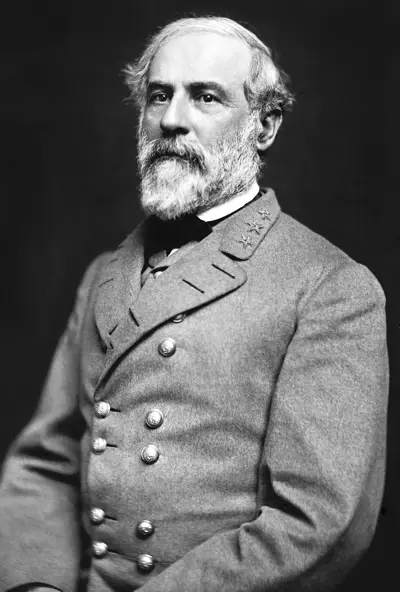
Robert Edward Lee was an American Confederate general best known as a commander of the Confederate States Army during the American Civil War. He led the Army of Northern Virginia from 1862 until its surrender in 1865 and earned a reputation as a skilled tactician.
