Daniel O'Connell Quotes
You will be told I am not qualified to be elected: the assertion, my friends, is not true…. It is true that, as a Catholic, I cannot and of course never will take the oath prescribed to members of Parliament. …. The oath at present required by law is: That the sacrifice of the mass, and the invocation of the Blessed Virgin Mary, and other saints, as now practiced in the Church of Rome, are impious and idolatrous. If course I will never stain my soul with such an oath…. I would rather be torn limb from limb than take it.
At the time, The Oath of Supremacy, was required to take a seat in the British Parliament. It was specifically written to keep Roman Catholics out of Parliament. O’Connell and his colleagues adopted a political tactic whereby Catholics would run for Parliament, and then if an when they won, refuse to take the oath and hence be unable to take their seat. And that is just what happened. The Duke of Wellington, the Prime Minister, was trying to have Ireland join in union with Great Britain, and he didn’t want Irish Catholic anger and resentment because Irish seats in Parliament were empty by virtue of blatant religious discrimination. King George IV however was a virulent anti-Catholic, but Wellington finally persuaded him to relent and O’Connell and other Irish Catholics finally entered Parliament.
Daniel O'Connell, 1775-1847, Irish Nationalist Leader & Lord Mayor of Dublin, Irish Member of the British Parliament, Campaign Speech in his run for a seat in the British Parliament
Sourced by: Eigen's Political and Historical Quotations

The members of the Ribbon Society were referred to as Ribbonists and they saw themselves as a counterweight to the Orange Order of the extremist Protestants. The Protestants were the “Hereticks”—this was the spelling of the time.

It was not until 1780 that Catholics were allowed to even be members of Town Corporations.
All members of Parliament were required to sign and publicly declare this oath. Two days later the Parliament ordered the oath—then called a “protestation”—printed and distributed throughout the realm. All minor officials and clerics were also required to make their “protestation.” It was excesses like this that created a negative attitude in England regarding loyalty oaths and the American Founding Fathers specifically knew of this—then relatively recent—example when they wrote the Constitution and the Bill of Rights. We have left the then English spelling as is.

1st Duke of Wellington. The prohibitions against Catholic participation dated from the time when the Pope and the Vatican tried to support Catholic insurrections in England to return it as a Catholic country which it had been until King Henry VIII had a dispute with the Pope. However, the Catholic attempt to take over England and crush the Protestant Church of England had occurred so long before that there was no practical danger to the then established Church of England. Wellington, an Irish Protestant himself, realized that the law presented no significant protection and caused not only great resentment of English and Irish Catholics, but denied the nation the benefit of their great talents in politics. England took a great step forward and passed the bill.

Wesley had been to Island several times and was interested in affairs there. He was a strong advocate of freedom of religion but the violence of the earlier religious conflict made him very wary of the Irish Roman Catholics who seemed to him particularly prone to religious violence.

Orangemen were the ulta Protestant Nationalists of Northern Ireland. Both Protetants and Catholics had their extremists who publicly spewed their hate, desire for exclusivity, and insults with little moderation from moderates who always risked retaliation from the extremists even of their own religion, not unlike the situation of the beginning of the 21st century, where Muslim moderates were cowed and intimidated by the religious Islamic extremists.
The boycott had been triggered by a breakup of a mixed marriage where the Protestant wife took her two children to Belfast and would only reunite with her husband if he agreed to bring up the children as Protestants. This brought Catholic accusations of a Protestant conspiracy and plot to kidnap Catholic Children and take them to Northern Island to be brought up as Protestants. The boycott soon ended as it was too unfair for all but the most rabid Anti-protestants.

It took only 10 days after the First Continental Congress met for religious bigotry to arise. After hundreds of years of Catholic/Protestant strife, each sect looked upon the other, not only as theologically wrong, but dangerous to the liberty of the other. Unfortunately, the organied religions had acted so badly towards other religions, that everyone was justified in fearing the other religions. This quotation illustrates a then typical attitude of many American Protestants that the Catholic Church was a threat to national security. Ironically, in modern times, anti-Catholic bigots use this quotation to demonstrate that the United States was founded as a Christian Protestant nation—not a general Christian nation. A small, vicious anti-Catholic sentiment still exists, usually by a minority of right wing Protestant religious fundamentalists. Protestant England had just repealed the laws making Catholicism illegal, but this was regarded at that time as intolerable for the new America. This was one of the disputes which that the Founding Fathers were faced with later and one of the reasons that they were so absolute in the need for the 1st Amendment.


The main purpose of the oath was to eliminate Roman Catholics who recognized the Pope as the Supreme Ecclesiastical authority. The subtlety evaporated by 1640 when the official oath actually named Rome as the target. See {617547}.

There was freedom of religion for Protestants in early New Jersey. Note that Catholics and Jews were not allowed to hold office. This constitution was in force until 1844 when the prohibition was repealed by new constitution. Under the original constitution, men were convicted for blasphemy. See {621063} .
Many Protestant Englishmen were shocked to hear this, having little familiarity with the details of the functioning of the Church of England—the Established Church of Great Britain—in Ireland and the contribution of the Church to the discrimination against Irish Catholics and the poverty of Ireland.
While this was an excellent thing to do, it was opposed by most Catholics and Protestants alike. The Protestants did not want their children going to school with the lower class Catholics, and the Catholics feared that if the schools were desegregated the Protestants would control the curriculum and teach heresy to their children. The archbishop died 8 years thereafter, and there were too few enlightened intellectuals to keep the idea alive. Ironically, even in Northern Island of the 21st century, religiously integrated schools would be an excellent amelioration for the religious strife, but the majority of both religions still do not want it, and essentially for the same reasons as 175 years earlier.

He lost be 2 votes.


Prime Minister William Pitt, Edmond Burke, and Irish Patriot Henry Grattan had met with the king to discuss granting Irish Catholics rights to participate in government. The King was quite bigoted against Catholics, but England was at war on the continent and if Irish Catholics were angry enough, they might conspire with the Catholic French for an invasion of Ireland. When the Protestant members of the Dublin Corporation heard about the meeting, they immediately issued their own resolution to the King recommending the continued discrimination against Catholics. In a huge political battle in the English Parliament, Pitt and Burke were able to make some progress. The Penal Laws against Catholics that had been in force for a century were repealed. And Catholic men in Ireland were given the right to vote for members of the Irish Parliament. However, the Conservative Protestants blocked further reforms and Catholics were still not allowed to sit in Parliament of hold public office. Between this quotation and {639274} we see the Irish Protestants somewhat divided with the liberals wanting to give Catholics political equality and the Conservatives opposed.

There has been a similar demographic condition since.

New Ross was under siege by Cromwell and his English Parliamentarian troops. After two days, the town tried to negotiate terms of surrender and one of the main things they asked for was freedom of religion to practice Roman Catholicism. This famous response set the stage for religious bigotry over the next years. Cromwell’s reasons for not allowing Catholicism to be practiced was not only one of religious zeal. At the time, the Roman Catholic Church was a major geopolitical power under a Pope who commonly supported or even dispatched troops for geopolitical and religious ends. The Vatican was particularly resentful of England for separating from the Church and asserting that the King of England was the head of the Church and not the Pope. Therefore Cromwell and many Englishmen had to deal with the reality that every practicing Catholic in the realm was a potential spy, traitor, and/or rebel. This fear of control of countries by the Pope strongly affected America, and was responsible for the defeat of the first Catholic Presidential Candidate, Al Smith. It was also a major factor in the election of John F. Kennedy so he dealt with it head on.

There was a legal requirement that all cadidates for the parliament had to sign before the election an oath swearing to take their seat if elected to close off the possibility that some would cripple the parliament by winning but not taking their seats. De Valera wanted to run, and fully intended to take his seat, but had promised to sign no oaths about the parliament elections. On the last day possible, he went to the election clerk who gave him a piece of paper with the oath printed on the top and below it, the lines for candidate signatures. De Valera took a blank piece of paper and covered the oath but leaving the signature line exposed. He then signed the line and made sure that the clerk would remember that he has not signed an oath, but had signed a blank piece of paper where the oath could not be seen. To him this was a very important distinction but if failed to convince most other Irishmen.


First Irish Bishop in the United States and the First Catholic Cardinal of New York. Moscow had just been burned by the French. No New York Catholic churches were harmed.
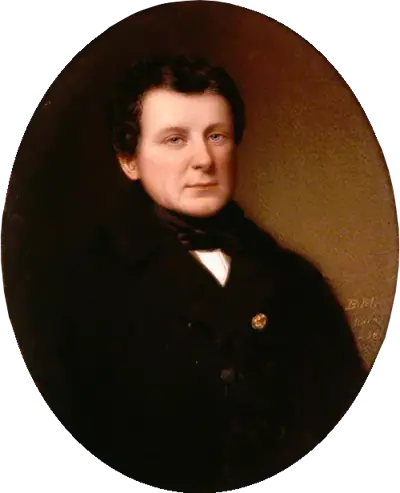
Daniel O'Connell, hailed in his time as The Liberator, was the acknowledged political leader of Ireland's Roman Catholic majority in the first half of the 19th century. His mobilisation of Catholic Ireland through to the poorest class of tenant farmer helped secure Catholic emancipation in 1829 and allowed him to take a seat in the United Kingdom Parliament to which he had twice been elected. At Westminster O'Connell championed liberal and reform causes (he was renowned internationally as an abolitionist) but failed in his declared objective for Ireland: the restoration of a separate Irish Parliament through repeal of the 1800 Acts of Union. Against the background of a growing agrarian crisis and, in his final years, of the Great Irish Famine, O'Connell contended with dissension at home. Criticism of his political compromises and system of patronage led to a split in the national movement he had singularly led.
