Eleanor Roosevelt Quotes
... you will be amused that when Mr. Dulles said goodbye to me this morning he said 'I feel I must tell you that when you were appointed I thought it terrible & now I think your work here has been fine!' So - against the odds the women inch forward, but I'm rather old to be carrying on the fight ... .
She had been appointed by President Truman to be the US Delegate to the First United Nations sessions where she had a major role in forming the organization to meet the needs of the United States (The veto in the Security Council for example). John Foster Dulles, our Secretary of State was publically totally against having any woman in that position and later would come to regard Mrs. Roosevelt as a great danger. See {585211} . Yet he admitted that she did a good job with the UN. She was 62 at the time, and while we do not consider that as very old any longer, there were very few people who would be active in politics at that age and certainly no women. She stayed active however until her death more than a decade later.
Eleanor Roosevelt, 1884-1962, First Lady (Franklin Delano Roosevelt), U. S. Delegate to the United Nations, Letter to Joseph Lash, February 13, 1946
Sourced by: Eigen's Political and Historical Quotations

First Lady Eleanor Roosevelt had more influence and visibility than any other first lady, before or since. She was First Lady for 3+ terms—longer than any other, and in addition to her official duties, she wrote a very popular daily newspaper column. As FDR was handicapped and could not travel much, she traveled all over the nation and the world. She was also very outspoken and no one ever knew whether or not she was speaking with the President’s concurrence or was on her own. She tended to be very liberal—especially in terms of the evils of racial segregation—then legal, and the problems of workers. Her broad influence was very damaging to Southern Segregationist groups and arch Conservative economic groups, who realized that her influence in the change of public opinion was much more effective at changing America than were the socialists and communists who were calling for revolution and were so unappealing that they could easily be attacked. Mrs. Roosevelt was for them more dangerous than Communism.


Women were not, in the decisions of Canadian courts “Persons.” As such they were not allowed to serve as public officials and legislators. In 1929 the Judicial Committee of the Privy Council reversed previous interpretations and declared women eligible for all public offices. It became known as “The Persons Case.” Murphy then wrote her argument. Murphy wrote serious non-fiction under her own name and novels under the pseudonym Janey Canuck.


The Hijra was the spread of Islam after The Prophet organized the first Muslims. Islamic reformers have been trying to improve the legal and cultural position of women in Islamic Societies ever since with little success, even in modern times. The notable exception was the Turkish Revolution led by Ataturk. He was familiar with Aga Kahn arguments for reform and put the force of law behind them. See {444998}.


This statement is referring to the custom of women covering their eyes whenever a man who they did not know passed them. Turks did not ever use Burkas the way some other Muslim countries do, but they wore headscarves and covered their eyes when a strange man appeared. This was a shocking statement in a sexist Islamic culture. Although the process of modernization and reform in Turkey was relatively bloodless, Ataturk was prepared to and did use force to defend it. This and many others made the role of women not only uniquely equal in the Islamic world, but women were suddenly elevated to the level of most Western nations and in voting rights were ahead of most. He used his own family to set an example. See {584503}.


She was also Australia’s First Woman Cabinet Minister.
Women were not, in the decisions of Canadian courts “Persons.” As such they were not allowed to serve as public officials and legislators. In 1929 the Judicial Committee of the Privy Council reversed previous interpretations and declared women eligible for all public offices. It became known as “The Persons Case.”

This Biblical passage has been frequently used to justify discrimination against women.


In 1876 Lockwood applied for admission to the bar of the Supreme Court of the United States and was refused. She lobbied heavily and in 1879 Congress enabled women to qualify (see {598546}) and on March 3 of that year Belva Lockwood became the first woman to be admitted to the Supreme Court bar.

Despite this pronouncement which kept Caliphs from being female, modern Islamic states (Pakistan, Indonesia) have had female Presidents.
Marcus Porcius Cato. This quotation has had two different interpretations over time. One was that women if they received equality of treatment and voting would have an advantage for they also had their traditional “feminine wiles” and their sexuality, hence would dominate men. The second was a also a warning but based on the fact that women were superior in many ways, and given an equal chance, would excel men. The later interpretation is argued by some who point to the 2011 American data that shows more females than males graduating from high school and college, and females outnumber males in medical, law and several other professional schools. With the exception of a few Roman men, most heeded Cato’s warning and never took a chance on female equality.


Given the time, this was an amazing demand. Fuller preceded all the more famous American feminists and was an inspiration to them.

She was chiding the Egyptian military who in the Arab Spring, turned on demonstrators and soldiers in the middle of the central square stripped a female demonstrator half naked and beat her badly;
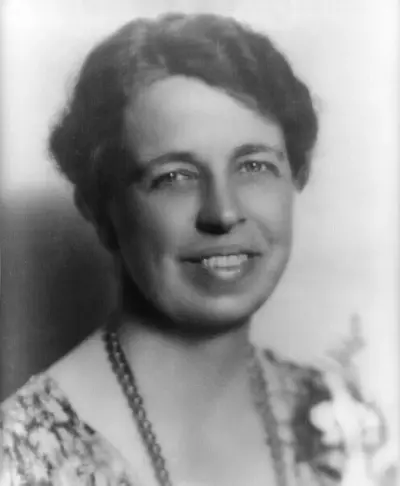
- Born: October 11, 1884
- Died: November 7, 1962
- Nationality: American
- Profession: First Lady
Anna Eleanor Roosevelt was an American political figure, diplomat and activist. She served as the First Lady of the United States from March 4, 1933, to April 12, 1945, during her husband President Franklin D. Roosevelt's four terms in office, making her the longest-serving First Lady of the United States. Roosevelt served as United States Delegate to the United Nations General Assembly from 1945 to 1952. President Harry S. Truman later called her the "First Lady of the World" in tribute to her human rights achievements.
