Belva Lockwood Quotes
I have been told that there is no precedent for admitting a woman to practice in the Supreme Court of the United States. The glory of each generation is to make its own precedents.
In 1876 Lockwood applied for admission to the bar of the Supreme Court of the United States and was refused. She lobbied heavily and in 1879 Congress enabled women to qualify (see {598546}) and on March 3 of that year Belva Lockwood became the first woman to be admitted to the Supreme Court bar.
Belva Lockwood, 1830-1917, Attorney & Feminist, Presidential Candidate, Equal Rights Party, Quoted in Fox, Lady for the Defense, 1975
Sourced by: Eigen's Political and Historical Quotations

See Belva Lockwood {609865} for the view of the woman who lobbied heavily for the law and became the first woman to practice before the Supreme Court.


Prior to WWII there were few women in the labor force, and the traditional “values” of American society relegated women to be homemakers. However with so many men under arms, there were not enough workers to achieve the war production that was necessary. So changes had to be made in public attitudes, not only towards women working, but the nature of the work that they are capable of and ought to be doing. So the government took a proactive role in changing public attitudes towards women in the workforce. It was a successful effort, and the sociological and psychological effects are still felt, half a century later. See {584781}.


Women were needed in industry and the military. See {584783}.

The editorial was in support of women’s suffrage—the right to vote which at the time women did not have in Britain. Women were very active in protests and demonstrations. Tactics sometimes involved civil disobedience and chaining themselves to public buildings. It was the civil disobedience and disruptions that the newspaper referred to as the “follies and excesses.” In retrospect today, it is amazing how threatened the society felt and how they reacted to the “threat” of females voting. It does however give us a perspective on those contemporary societies which restrict women’s voting rights.

She was also Australia’s First Woman Cabinet Minister.


Felton was the first female U. S. Senator although she only served for a day. She had been appointed by the governor upon the death of Senator Tom Watson in 1922 and served until the elected Walter F. George took office.


She had been appointed by President Truman to be the US Delegate to the First United Nations sessions where she had a major role in forming the organization to meet the needs of the United States (The veto in the Security Council for example). John Foster Dulles, our Secretary of State was publically totally against having any woman in that position and later would come to regard Mrs. Roosevelt as a great danger. See {585211} . Yet he admitted that she did a good job with the UN. She was 62 at the time, and while we do not consider that as very old any longer, there were very few people who would be active in politics at that age and certainly no women. She stayed active however until her death more than a decade later.

First female presidential candidate & first divorcee to run for that office

Golden was one of the leading theater producers of the 1920s and 1930s. There is even a theater on Broadway named after him. This statement reflects a common attitude of the late 1930s of even many educated people. A few like Eleanor Roosevelt saw such a statement for what it was—ridiculous and responded publicly – {636785} . Note that for many years, this was a self-fulfilling statement. Producers like Golden thought women could not be great playwrights and therefore would never produce a play authored by a woman. Then others would use the fact that there were no even good plays that were written by female authors as evidence of the act that women could not be great playwrights.

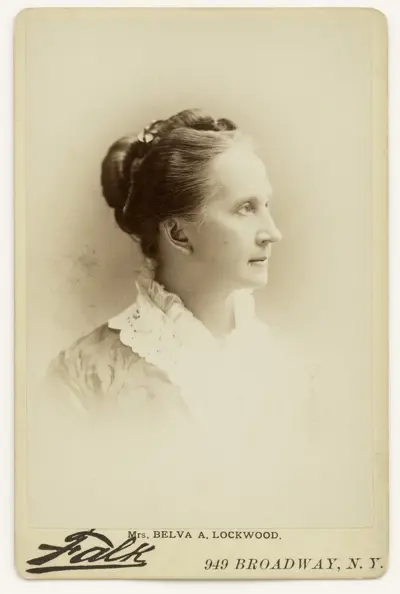
- Born: October 24, 1830
- Died: May 19, 1917
- Nationality: American
- Profession: Lawyer
Belva Ann Bennett Lockwood was an American attorney, politician, educator, and author. She was active in working for women's rights, including women's suffrage. Lockwood overcame many social and personal obstacles related to gender restrictions. After college, she became a teacher and principal, working to equalize pay for women in education. She supported the movement for world peace, and was a proponent of the Temperance movement.
