C. P. Scott Quotes
We do not know whether the present House of Commons will be prepared to do justice to women. A few months ago there can be little doubt that it would, and nothing that has since happened supplies any adequate reason for a change of purpose. The follies and excesses of a small section of women, deeply resented and regretted by the vast majority of women, ought not to be allowed to weigh in the balance against a claim which has been admitted to be just.
The editorial was in support of women’s suffrage—the right to vote which at the time women did not have in Britain. Women were very active in protests and demonstrations. Tactics sometimes involved civil disobedience and chaining themselves to public buildings. It was the civil disobedience and disruptions that the newspaper referred to as the “follies and excesses.” In retrospect today, it is amazing how threatened the society felt and how they reacted to the “threat” of females voting. It does however give us a perspective on those contemporary societies which restrict women’s voting rights.
Charles Prestwich Scott, 1846-1932, British Member of Parliament, Editor of the Manchester Guardian, Manchester Guardian, July 9, 1912
Sourced by: Eigen's Political and Historical Quotations

Billinghurst was physically handicapped without the use of her legs. She protested and marched in protest parades using a hand propelled tricycle which the police sometimes dumped her out of and left her immobile in alleys.

She was the first presidential candidate's wife to admit such a radical position.


This was more than 30 years earlier than the United States.


The Organization's Periodical. The statement was repeated several times in variation between 1890 and 1920. This organization was the national leader of similar organizations in over 20 States. Many notables were involved including Louis D. Brandeis, Francis Parkman and John Lowell.


Although born and educated in the United States, she lived mostly in England and was politically active there.

First female presidential candidate & first divorcee to run for that office. The half to which she was referring were the females, who by many narrow laws were unable to participate in the intellectual and political life of the country. At the time, women could not even vote.


The concept of taxpayers being entitled to vote to avoid taxation without representation was fundamental to the Founding Fathers. However, the only people who paid taxes were those who owned property as there was no income tax at the time. Since the male controlled the family property, not allowing women to vote did no injury to the basic principle. However, the sexist attitude of the times ran up against this basic principles in the case of widows and unmarried women who owned property. Faced with this contradiction, some of the Founding Fathers like Lee actually favored the voting franchise for women who were widows and property owners or even unmarried female property owners. There were not enough people who saw this contradiction so that all women were originally prohibited from voting, but this quotation shows that it was a political issue at the time.
The following year, women got the right to vote, the first nation to reach that level of enlightenment.

Although liberal on many other issues, women voting was anathema to him.


Having passed this law, the state legislature turned down subsequent efforts to expand the female voting franchise, and Wisconsin women had to wait until all American women finally got the right to vote.

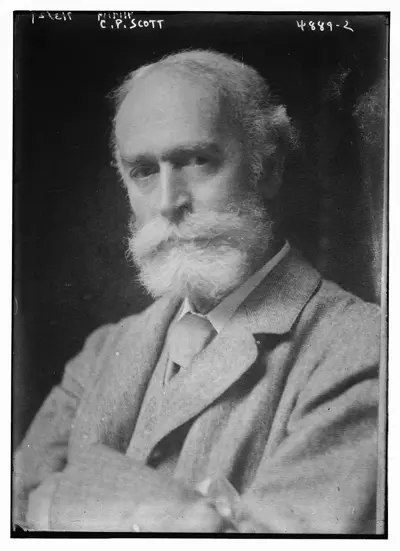
Charles Prestwich Scott, usually cited as C. P. Scott, was a British journalist, publisher and politician. Born in Bath, Somerset, he was the editor of the Manchester Guardian (now the Guardian) from 1872 until 1929 and its owner from 1907 until his death. He was also a Liberal Member of Parliament and pursued a progressive liberal agenda in the pages of the newspaper.
