Rosa May Billinghurst Quotes
I feel that the present government is not acting in accordance with the first principles of Liberalism, by refusing the right of representation to women taxpayers. I have joined no other party and I still claim to be a Liberal woman but a Liberal woman on strike
Billinghurst was physically handicapped without the use of her legs. She protested and marched in protest parades using a hand propelled tricycle which the police sometimes dumped her out of and left her immobile in alleys.
Rosa May Billinghurst, 1876-1953, English Suffragette, Chapter Leader, Women's Social and Political Union, Letter to the Manchester Guardian when she left the Liberal Party over their position on women’s rights
Sourced by: Eigen's Political and Historical Quotations

The editorial was in support of women’s suffrage—the right to vote which at the time women did not have in Britain. Women were very active in protests and demonstrations. Tactics sometimes involved civil disobedience and chaining themselves to public buildings. It was the civil disobedience and disruptions that the newspaper referred to as the “follies and excesses.” In retrospect today, it is amazing how threatened the society felt and how they reacted to the “threat” of females voting. It does however give us a perspective on those contemporary societies which restrict women’s voting rights.

Although liberal on many other issues, women voting was anathema to him.


Hunt gave as an example Mary Smith of Stanmore. This quotation is very interesting in the history of women’s suffrage. Hunt was a strong advocate for Universal Suffrage (See {616653}.) At the time, even men had to be a taxpayer and own a sufficient amount of property to vote. Less than 20% of the population of Britain were allowed to vote. The argument at the time was that the husband would represent the family’s interest at the ballot box and there was no need for women to vote. But by facing parliament with the logical inconsistency of its position, he was able to make his point, although there were very few women like Mary Smith who were single and had the economic resources to qualify. Most widows remarried so even if they had economic resources, there was a man who could assume the then perceived role of head of the household.

The party was not yet ready for women voting. Hardie resigned as Party Leader. In 1910 he agreed to return as Party Leader and the party was then not in opposition to women’s suffrage although many members were still against women voting.

She was the first presidential candidate's wife to admit such a radical position.


The concept of taxpayers being entitled to vote to avoid taxation without representation was fundamental to the Founding Fathers. However, the only people who paid taxes were those who owned property as there was no income tax at the time. Since the male controlled the family property, not allowing women to vote did no injury to the basic principle. However, the sexist attitude of the times ran up against this basic principles in the case of widows and unmarried women who owned property. Faced with this contradiction, some of the Founding Fathers like Lee actually favored the voting franchise for women who were widows and property owners or even unmarried female property owners. There were not enough people who saw this contradiction so that all women were originally prohibited from voting, but this quotation shows that it was a political issue at the time.


In 1639 the Maryland Assembly recorded what was probably the first American attempt to obtain the vote for women.


None of the other parties had any women candidates. The Communists got a lot of votes from women whose only way they could support the participation of women in Italian politics, was to vote for a Communist candidate. And people who were opposed to non-traditional roles for women then conflated the feminists and the Communists just as had been done in America, England and many other countries and accused all feminists of being communists.


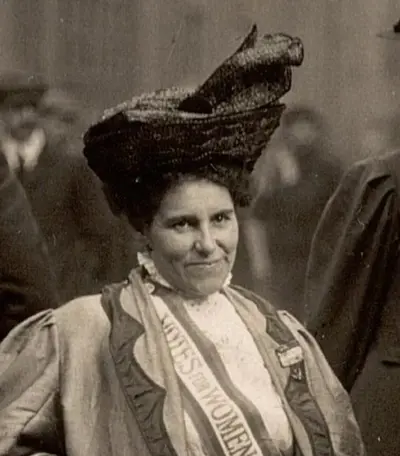
Rosa May Billinghurst (31 May 1875 – 29 July 1953) was a suffragette and women's rights activist. She was known popularly as the "cripple suffragette" as she campaigned in a tricycle.
