Carrie Chapman Catt Quotes
A referendum in many of our states means to defer woman suffrage until the most ignorant, most narrow-minded, most un-American, are ready for it.
Carrie Chapman Catt, 1859-1947, Founder, League of Women Voters, President, National American Woman Suffrage Association, Woman Suffrage By Federal Constitutional Amendment, 1917
Sourced by: Eigen's Political and Historical Quotations


The Organization's Periodical. The statement was repeated several times in variation between 1890 and 1920. This organization was the national leader of similar organizations in over 20 States. Many notables were involved including Louis D. Brandeis, Francis Parkman and John Lowell.


Billinghurst was physically handicapped without the use of her legs. She protested and marched in protest parades using a hand propelled tricycle which the police sometimes dumped her out of and left her immobile in alleys.

The editorial was in support of women’s suffrage—the right to vote which at the time women did not have in Britain. Women were very active in protests and demonstrations. Tactics sometimes involved civil disobedience and chaining themselves to public buildings. It was the civil disobedience and disruptions that the newspaper referred to as the “follies and excesses.” In retrospect today, it is amazing how threatened the society felt and how they reacted to the “threat” of females voting. It does however give us a perspective on those contemporary societies which restrict women’s voting rights.


It would be over 30 years more before American women could vote for President. Lockwood never could.

Hunt gave as an example Mary Smith of Stanmore. This quotation is very interesting in the history of women’s suffrage. Hunt was a strong advocate for Universal Suffrage (See {616653}.) At the time, even men had to be a taxpayer and own a sufficient amount of property to vote. Less than 20% of the population of Britain were allowed to vote. The argument at the time was that the husband would represent the family’s interest at the ballot box and there was no need for women to vote. But by facing parliament with the logical inconsistency of its position, he was able to make his point, although there were very few women like Mary Smith who were single and had the economic resources to qualify. Most widows remarried so even if they had economic resources, there was a man who could assume the then perceived role of head of the household.


First woman elected to Congress. Women could vote in Montana years before women had the right to vote nationally. Women pioneers were critical contributors to an extremely hard life. Many widows and single women ran farms and ranches, fought raiding Indians, and married pioneer women were necessary to survival.


Although liberal on many other issues, women voting was anathema to him.


She was the first presidential candidate's wife to admit such a radical position.
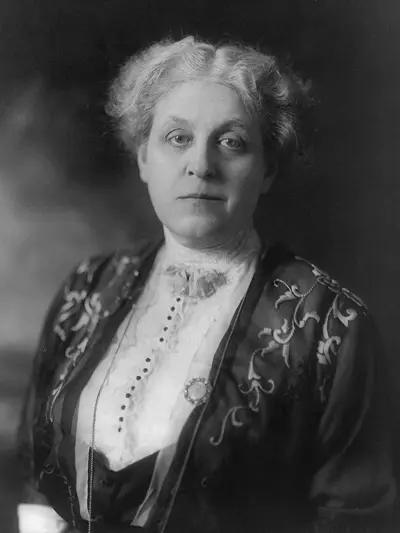
Carrie Chapman Catt was an American women's suffrage leader who campaigned for the Nineteenth Amendment to the United States Constitution, which gave U.S. women the right to vote in 1920. Catt served as president of the National American Woman Suffrage Association from 1900 to 1904 and 1915 to 1920. She founded the League of Women Voters in 1920 and the International Woman Suffrage Alliance in 1904, which was later named International Alliance of Women. She "led an army of voteless women in 1919 to pressure Congress to pass the constitutional amendment giving them the right to vote and convinced state legislatures to ratify it in 1920" and "was one of the best-known women in the United States in the first half of the twentieth century and was on all lists of famous American women."
