Eleanor Roosevelt Quotes
Yesterday afternoon I signed a radio contract with the Lamont, Corliss Company, makers of Pond's products. The money will be paid as usual to the American Friends Service Committee …. I am really looking forward to this work for … I enjoy both the working up of the programs and the feeling of contact with a great many people which comes about through the letters which I get after each broadcast.
This quotation illustrates two things. First, Mrs. Roosevelt always donated the fees and royalties from her books, newspaper column and radio shows. Second, it seems incredible to us today, that this first lady organized the social schedule of the White House, wrote a daily newspaper column for years, authored a number of books, and had her own radio show—all while she was First Lady. She had the additional role of traveling about the nation, observing and giving speeches and press conferences as a proxy for FDR whose polio handicap made traveling very difficult. She also wrote or orally reported to her husband the material aspects of each of her trips, although she was so open that he and everyone else could read about it in the newspapers. She did all this with a staff of only 2 people. There has probably been no one in the history American politics, perhaps other than Thomas Jefferson, who was so busy and productive.
Eleanor Roosevelt, 1884-1962, First Lady (Franklin Delano Roosevelt), U. S. Delegate to the United Nations, Column, My Day, March 5, 1937
Sourced by: Eigen's Political and Historical Quotations

At the time there was no Secrecy & Classification System nor any laws enforcing secrecy or confidentiality. However there was no freedom of information laws of expectations even on the part of journalists. This was the first Freedom of Information policy of the American government. Some politicians were more open than others but there was no national, governmental before this. There were however leakers and whistleblowers though the terms were not in use. Note that Roosevelt herein created the first whistle blower protection—himself.

And the New York press is probably the most difficult and cynical in the world.


Prior to Germany Declaring War on the United States, there was a small but influential group of American Fascists who were great admirers of Hitler and Mussolini and the “reforms” they had made in Germany and Italy. They saw Germany’s invasion of other European nations as a good think to “reform” Europe. The opposed American support of England and U. S. entry into the war. Their influence waned after Pearl Harbor and Germany declaring war on the U. S. Many of them arose again after WWII ended but they no longer expressed admiration for Hitler and Mussolini—concentrating at that time on anti-communisim. This caused some difficulties for the majority of anti communists who were also anti fascists.

This was the veteran newspaper editor’s last column before retirement and he chose to write it about the role of the press in the Japanese imperialist and militaristic nation in the period before and during WWII. He was then a young journalist. While most Japanese see that period as disastrous where the nation lost its way, the ultra conservatives blame the insufficient attention and support of the military and in retrospect do not see that the Japanese have anything to apologize for. Most of Asia disagrees profoundly.

The term baits was a traveling term meaning to stop for rest or refreshment, hence to travel slowly.


See Canadian Prime Minister Kim Campbell for a less elegant attempt to do the same thing.


This quotation not only gives us a good insight into Dolley Madison’s character and popularity but illustrates the sad fact that until much later there were no provisions made for the retirement and the families of American Presidents. The fact that a former slave actually gave his own money to help support his ex-owner is a testament to her popularity and a poignant story of its own. Daniel Webster incidentally loaned Jennings the money with which to buy his freedom.


This particular column brought criticism from some on the left who were distressed that a First Lady might be trying to intimidate the press. Mrs. Roosevelt was, like her husband, not wed to any particular dogma or ideology’ they were practical, common sense politicians who distrusted dogma of any kind.

Haldeman had actually called the network executives on several occasions regarding Cavett’s show. Nixon was particularly furious when Cavett interviewed John Kerry, the decorated soldier who had thrown his medals away in protest to the handling of the Vietnam War. Nixon wanted some stronger actions taken.


He always found something positive to report.

Commenting on media criticism of her:

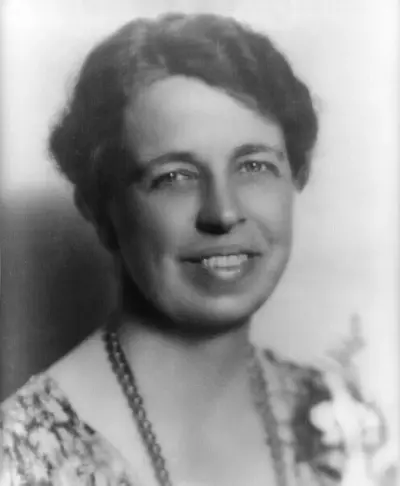
Anna Eleanor Roosevelt was an American political figure, diplomat and activist. She served as the First Lady of the United States from March 4, 1933, to April 12, 1945, during her husband President Franklin D. Roosevelt's four terms in office, making her the longest-serving First Lady of the United States. Roosevelt served as United States Delegate to the United Nations General Assembly from 1945 to 1952. President Harry S. Truman later called her the "First Lady of the World" in tribute to her human rights achievements.
