Umberto Eco Quotes
Not long ago, if you wanted to seize political power in a country you had merely to control the army and the police. Today it is only in the most backward countries that fascist generals, in carrying out a coup d'état, still use tanks. If a country has reached a high degree of industrialization the whole scene changes. The day after the fall of Khrushchev, the editors of Pravda, Izvestiia, the heads of the radio and television were replaced; the army wasn't called out. Today a country belongs to the person who controls communications.
Umberto Eco, Italian Novelist, Il costume di casa, 1973
Sourced by: Eigen's Political and Historical Quotations


Vladimir Lenin. Lenin was echoing criticisms that were made the world over and even by some in the United States. However, his solution to have the press controlled by the ruling party just changed the cast of characters who were propagandizing and distorting the truth. Lenin was not able to offer a better solution nor were others. However, with enough affluence the capitalist society produced enough different publishers all competing that one did not dominate public opinion. With technology of TV and the Internet, the bar to entry is so small that almost anyone can be a publisher and find an interested market. In a way technology has solved much of the problem for capitalistic and totalitarian societies alike. In the latter, even censorship is not easy or feasible on a large scale.


Prior to Germany Declaring War on the United States, there was a small but influential group of American Fascists who were great admirers of Hitler and Mussolini and the “reforms” they had made in Germany and Italy. They saw Germany’s invasion of other European nations as a good think to “reform” Europe. The opposed American support of England and U. S. entry into the war. Their influence waned after Pearl Harbor and Germany declaring war on the U. S. Many of them arose again after WWII ended but they no longer expressed admiration for Hitler and Mussolini—concentrating at that time on anti-communisim. This caused some difficulties for the majority of anti communists who were also anti fascists.

This was a Nationally Broadcast Speech speech in the run up to American entry to WWII, Lindbergh had been a national here for being the first aviator to fly over the Atlantic to Europe. Politically, the National Hero became an active fascist supporter of Mussolini and Adolph Hitler who awarded him a Medal for Supporting Fascism, Anti-Semitism and advocating for America to allow Hitler to conquer German and the rest of Europe. After WWII he was in disgrace. This quotation is one of his many attempts to keep America from interfering with Hitler in Europe as he was a great admirer of Fascism and the two leading proponents in Europe.


Surprising to most people who know of President Theodore Roosevelt’s general liberal views, his 4th son was an ultraconservative who founded and joined racist, anti-Semitic, right wing organizations, and to the distress of many in the family and without lent his name to many of the most extreme right wing causes and organizations.

What is amazing about this quotation is that it shows the naivety of one of the most sophisticated politicians in the country. He and many politicians were really surprised that commercial consumer marketing techniques would work so well. He and many others thought that the issue of marketing political candidates was something that should be debated. Meanwhile, all the pragmatic politicians of both political parties jumped on the commercial marketing bandwagon, but the Republicans tended to master and execute the techniques more skillfully.


Ronald Reagan’s media expert, Michael Deaver, developed a new approach to Presidential appearances. He realized that if the President made a 5 or 10 minute speech at an event, the Evening News would choose one or two 10-15 second excerpts, and that was what the vast majority of the country would see. Therefore, he reasoned, the words spoken meant relatively little. It was the image what would last in people’s memory. Therefore, he worked hard to concentrate on getting the right background for the President’s appearance. The Statue of Liberty, a naval ship, a factory at work. The set of images that people would have of the President in these different appearances would define the President in the minds of most people. Deaver would be more concerned that the TV camera’s showed the background scene he had planned (rather than a strange angle or just a close-up of the President’s face) than he would be about which words—sound bytes—the TV station would select. Hence Baker’s observation that words were less important than the TV images.


This was her response to Sander Vanocur {618913}


Stalin was very astute in realizing the power of the press and the modern media. As a result, his solution was to not only develop a strong party media apparatus, but deny any contrary groups the fight to press and media. He was so effective at media control that most dictators and theocrats would thereafter model the Russian system of monopoly control over the media.
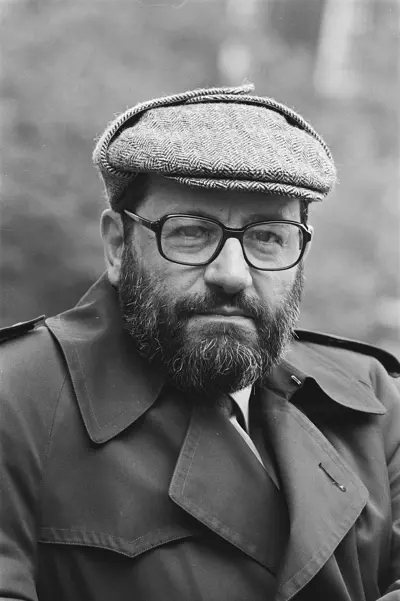
Umberto Eco OMRI was an Italian medievalist, philosopher, semiotician, cultural critic, political and social commentator, and novelist. In English, he is best known for his popular 1980 novel The Name of the Rose, a historical mystery combining semiotics in fiction with biblical analysis, medieval studies, and literary theory, and Foucault's Pendulum, his 1988 novel which touches on similar themes.
