Andrew Johnson Quotes
WHEREAS, Certain persons, unfriendly and hostile to the Government of the United States, have banded themselves together, and are now going at large through many of the counties in this State, arresting, maltreating and plundering Union citizens wherever found; Now, therefore, I, ANDREW JOHNSON, Governor of the State of Tennessee, by virtue of the power and authority in me vested, do hereby proclaim that in every instance in which a Union man is arrested and maltreated by the marauding bands aforesaid, five or more rebels from the most prominent in the immediate neighborhood shalt be arrested, imprisoned, and otherwise dealt with as the nature of the case -may require ; And further, in all cases in which the property of citizens loyal to the Government of the United States is taken or destroyed, full and ample remuneration shall be made to them out of the property of such rebels in the vicinity as have sympathized with, and given aid, comfort, information or encouragement to the parties committing such depredations.
Johnson was then Governor or Tennessee. Extremist Southerners physically attacked even civilian “Unionists” who lived in Tennessee. Singled out as victims were Federal officials from postal workers to soldiers off duty and federal judges and court employees. Johnson would not tolerate such behavior, and this proclamation is an example of his crackdown. He himself was a Unionist and called anyone advocating secession guilty of treason. This is what made him a good ticket balance for Abraham Lincoln in the election of 1964 and eventually propelled him to the Presidency.
Andrew Johnson, 1808-1875, 17th President of the United States (War Democrat), May 9, 1862
Sourced by: Eigen's Political and Historical Quotations

President Andrew Johnson had been impeached by the House of Representatives and was being tried in by the Senate. A majority of the Senators voted for conviction but the vote was 1 short of the two-thirds that were needed. Johnson remained in office. One of the major accusations against Johnson was that he had appointed Southern rebels to positions.

At this point, there had hardly been any fighting and no outrages or war crimes were yet committed by either side. These would come later—more on the Confederate side as they did not want to take the limited resources they had from their troops to fulfil abstract obligations to prisoners of war or to civilians. A few deliberately chose to use terror tactics. The Union troops also at various points in the war got out of hand and looted personal property of civilians. But at this point, this proclamation was just lies and propaganda.


The professor was addressing a theory of some gun rights advocates that the framers of the constitution intended the 2nd Amendment as a check on a dictatorial Federal Government. The history of the militias shows that they have been used by states never to foment rebellion but often called out to suppress rebellions of citizens who thought that their rights had been infringed such as Shays Rebellion, the Whisky Rebellion and the repeated use of state militias to enforce laws and quell riots and labor disputes.

The Spartacist Group was the German Bolshevik organization led by Karl Liebknecht and Rosa Luxemburg. They were both killed by right-wing death squads shortly thereafter.

The ambassador's hyperbole caused or was the excuse for President Lyndon Johnson to send the marines into the Dominican Republic. There were only two American civilian casualties—both were reporters accidently shot by U.S. Marines.

Defending his administration and the Chicago police against the charge that they used excessive force and caused a police riot during the Democratic National Convention of 1968:


In early America, the political parties had their own newspapers where “truth” was not an important journalistic virtue. Red scares and other fears of foreign conspiracies are as old as our nation. In 1798 the Federalists accused Vice President Thomas Jefferson, among others, of being in contact with the foreign conspirators and printed details of a "manufactured" plot to massacre the citizens of Philadelphia in one of their controlled newspapers. The nation was so alarmed that the infamous Alien and Sedition Acts were passed by Congress a few months later. These were probably the greatest infringements on American civil liberties in our history.

The African National Congress violent attack on apartheid in South Africa was amazing in the sense that with all the anger and the terrible behavior including murder and shooting of unarmed demonstrators, the ANC not only urged rejection of terrorism against civilians but managed to keep their followers under control. When apartheid finally fell and the ANC Black majority government came to power, the lack of retribution was not only a model of reconciliation for the world but maintained the best industrial economy in Africa.

For the required Oath, see {623308} . There were several to the amnesty. These included graduates of West Point and the Naval Academy who had joined the rebellion, senior officers and officials of the Confederacy, those who were accused of war crimes and abusing Union prisoners of war, persons who went abroad to help the Confederacy, and Northerners who had gone South to aid the rebellion. Many scholars think that although Lincoln had expressed his desire to provide an amnesty after the war was over, he probably would have been more lenient than Johnson who exempted many on the Southern side—especially the leaders. Ironically, Johnson was a Southerner but was personally, morally outraged at taking up arms against the United States and in that sense was much more of a hawk than Lincoln and many of the radical Republicans even. However, he was an inveterate racist and resisted most of the attempts to implement equality during the Reconstruction. Many argue that but for Johnson, Reconstruction might have been much more successful. It was easy for Southerners to resist equal rights for Blacks when they knew that the President was also opposed to measures to produce equality.

He had no authority to do this. He just took it upon himself. This was one of the incidents which caused later Congresses to pass very strict laws limiting the authority of all Federal Military and other intelligence and police forces so that they have little or no authority within the United States. President Lincoln did not allow the order to stand, although he repudiated it very delicately and as privately as possible. Many in his own party strongly favored this proclamation as it cracked down on the Southern Rebels and emancipated slaves—both objectives of many Republicans. In addition, Fremont was very popular with the people and had strong political connections. (He would later run for President.) See {635739}.
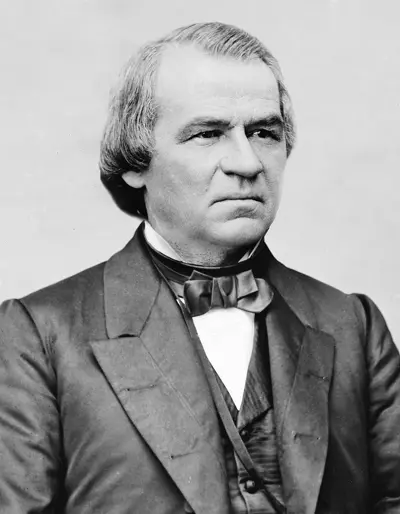
Andrew Johnson was the 17th president of the United States, serving from 1865 to 1869. He assumed the presidency as he was vice president at the time of the assassination of Abraham Lincoln. Johnson was a Democrat who ran with Lincoln on the National Union ticket, coming to office as the Civil War concluded. He favored quick restoration of the seceded states to the Union without protection for the former slaves. This led to conflict with the Republican-dominated Congress, culminating in his impeachment by the House of Representatives in 1868. He was acquitted in the Senate by one vote.
