John C. Calhoun Quotes
Where wages command labor, as in the non-slaveholding States, there necessarily takes place between labor and capital a conflict, which leads, in process of time, to disorder, anarchy, and revolution if not counteracted by some appropriate and strong constitutional provision. Such is not the case in the slaveholding States.
Calhoun, John C. The Works of John C. Calhoun. Edited by Richard K. Crallé, vol. 3, D. Appleton and Company, 1853.


Sinclair had written an expose of the meat packing industry – the Jungle – which used as its setting the Armour meat packing factory. It changed the way the public thought about the industry, the role of government and regulation. President Roosevelt took up the reform role, and got Congress to Regulate the quality and cleanliness of the meat packing industry. Sinclair, however not only wanted that reform, but also wanted the labor wages and conditions reformed. He referred to the Armour plant as the fortress.


Referring to the newly imposed income tax:


See {616053}. The strike was broken by jailing one of the main leaders.


In his economic view, managers, accountants, attorneys, owners, shareholders, landlords, were all supported by the workers who have to support themselves and all the others.

At the time, it did seem impossible that labor and capital would ever have harmonious relations. But the notion that slavery would solve the problem is as preposterous as anything ever entered into the American political dialogue. But there were many in the South, and some in the North, who actually believed it. Even 150 years later, while labor and capital relations were much better than pre Civil War, they still could not be described as “harmonious” or “friendly”.

Labor unions as we know them did not then exist. Calhoun and many others saw the struggle as a inherent class struggle, not unlike that particular view of Karl Marx. See {606584} for one his more extreme views on the subject.


This fascinating quotation is very frequently quoted out of context. For example even in modern times some Southern slavery apologists quote this passage stating that Adams saw no moral difference between slavery and employment of the lower classes. And anti-capitalists have claimed that this was an attack on capitalism as no better than slavery for many workers. Neither is true. The debate was on the head taxes that states should pay to the central government. Southerners were claiming that they should not have to pay per person taxes on slaves. Adams position was that they should pay in that there is no practical difference in the work and working conditions very often. If slaves should be exempted from the head tax, so should the poor, lower class workers like the fisherman in New England. He always maintained at huge moral difference between a poor free worker and a slave even thought their working conditions might be similar.
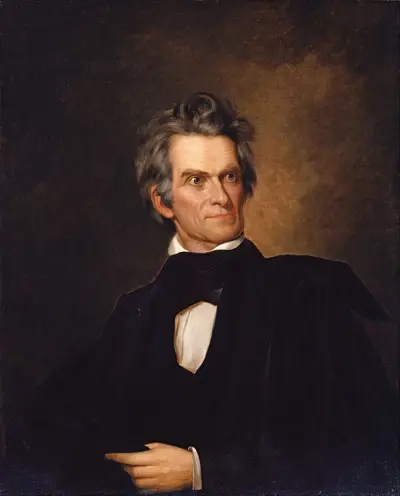
John Caldwell Calhoun was an American politician and political theorist from South Carolina who held many important positions including being the seventh vice president of the United States from 1825 to 1832, while adamantly defending slavery and protecting the interests of the white South when its residents were outnumbered by Northerners. He began his political career as a nationalist, modernizer, and proponent of a strong national government and protective tariffs. In the late 1820s, his views changed radically, and he became a leading proponent of states' rights, limited government, nullification, and opposition to high tariffs. He saw Northern acceptance of those policies as a condition of the South remaining in the Union. His beliefs and warnings heavily influenced the South's secession from the Union in 1860–1861.
