John C. Calhoun Quotes
There is and always has been in an advanced stage of wealth and civilization, a conflict between labor and capital.
Labor unions as we know them did not then exist. Calhoun and many others saw the struggle as a inherent class struggle, not unlike that particular view of Karl Marx. See {606584} for one his more extreme views on the subject.
John C. Calhoun, 1782-1850, Vice President of the United States (Democrat, SC), U. S. Congressman & Senator (Democrat, SC), Senate Speech, February 6, 1847
Sourced by: Eigen's Political and Historical Quotations


In 1902 there was a major coal strike in which Roosevelt pressured the coal operators to make concessions to labor. The abuses of some of the large monopolistic enterprises were turning large segments of America against capitalism. TR always believe that he saved capitalism from its own self destruction. The same has been felt about Franklin Delano Roosevelt who many believe saved American capitalism in the Great Depression.


At the time, it did seem impossible that labor and capital would ever have harmonious relations. But the notion that slavery would solve the problem is as preposterous as anything ever entered into the American political dialogue. But there were many in the South, and some in the North, who actually believed it. Even 150 years later, while labor and capital relations were much better than pre Civil War, they still could not be described as “harmonious” or “friendly”.
This quotation and other material were so radical and inflammatory that Calhoun wrote and published this anonymously.
Salisbury was a brilliant, effective prime minister, but he was a snob and not a democrat. See {639131}.


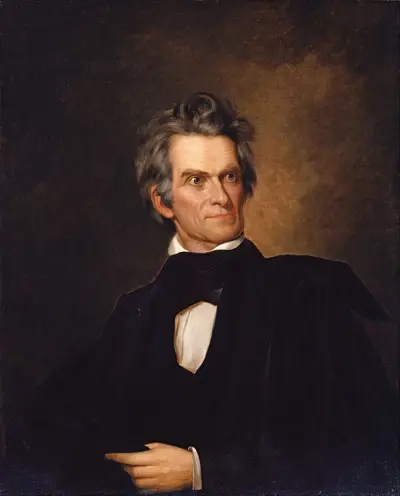
- Born: March 18, 1782
- Died: March 31, 1850
- Nationality: American
- Profession: Statesman
John Caldwell Calhoun was an American politician and political theorist from South Carolina who held many important positions including being the seventh vice president of the United States from 1825 to 1832, while adamantly defending slavery and protecting the interests of the white South when its residents were outnumbered by Northerners. He began his political career as a nationalist, modernizer, and proponent of a strong national government and protective tariffs. In the late 1820s, his views changed radically, and he became a leading proponent of states' rights, limited government, nullification, and opposition to high tariffs. He saw Northern acceptance of those policies as a condition of the South remaining in the Union. His beliefs and warnings heavily influenced the South's secession from the Union in 1860–1861.
