Maxim Gorky Quotes
What did the workers and peasants gain when power passed from the kings and nobles to the bankers and manufacturers?
Aleksei Maximovitch Peshkov
Maxim Gorky 1868-1936, Russian Writer, “The People Must Know Their History!,” Culture and the People, 1939
Sourced by: Eigen's Political and Historical Quotations

Opposition to the Bolsheviks

The class warfare and control of society previously by the wealthy made this the first article of the new Spanish Constitution. This very concept was one of the factors that led to the Spanish Civil War as Spain was in many ways still a feudal society.


In 1902 there was a major coal and railroad labor crisis. The owners and operators refused to negotiate or bargain with labor: This quotation is very famous because it is an iconic picture of the views and attitudes of the large industiralists at the turn of the 20th Century. More than opposing labor unions, they actually believed that God had selected them to run the economic and business affairs of the country if not the world. It was their Christian values and paternalism that the workers should look to in order to determine the rights and priviliges of the working man or woman. This upper class attitude was one of the major reasons that class warfare broke into the open. Ironically, there was not much difference between the attidudes of the industiral leaders and the notions of fudalism.


There are some who question the authenticity of this Steinbeck quotation on the grounds that all the references to it seem to be secondary sources. However, we lean toward its authenticity.


Labor unions as we know them did not then exist. Calhoun and many others saw the struggle as a inherent class struggle, not unlike that particular view of Karl Marx. See {606584} for one his more extreme views on the subject.

the Bolshevik Communists of Russia Zenzinov was often a critic of the Bolsheviks.


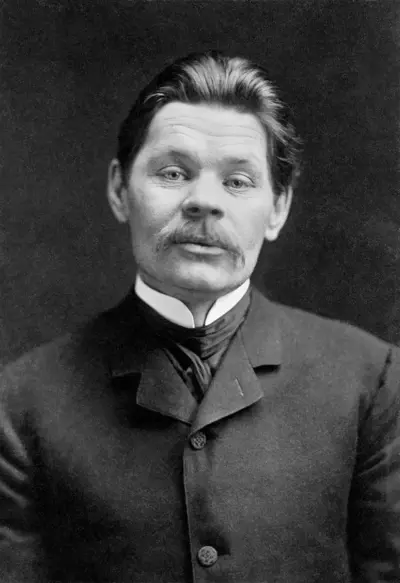
Alexei Maximovich Peshkov, primarily known as Maxim Gorky (Russian: Макси́м Го́рький), was a Russian and Soviet writer, a founder of the socialist realism literary method, and a political activist. He was also a five-time nominee for the Nobel Prize in Literature. Prior to his renown as an author, he frequently changed jobs and roamed across the Russian Empire; these experiences would later influence his writing. Gorky's most famous works were The Lower Depths (1902), Twenty-six Men and a Girl (1899), The Song of the Stormy Petrel (1901), My Childhood (1913–1914), Mother (1906), Summerfolk (1904) and Children of the Sun (1905). He had associations with fellow Russian writers Leo Tolstoy and Anton Chekhov; Gorky would later mention them in his memoirs.
