Karl Marx Quotes
Political Economy regards the proletarian ... like a horse, he must receive enough to enable him to work. It does not consider him, during the time when he is not working, as a human being.
Karl Marx, 1818-1883, German Economist & Socialist, Paris Manuscripts
Sourced by: Eigen's Political and Historical Quotations

Jefferson was one of the first political and economic thinkers to express concern over the “wage slave” concept of the industrial revolution. This was one of the major reasons that he was not in consonance with Alexander Hamilton in his economic vision for America. While we followed the Hamilton direction, there are still issues of maintaining freedom and independence for an employee in modern nations and economies.


Sinclair had written an expose of the meat packing industry – the Jungle – which used as its setting the Armour meat packing factory. It changed the way the public thought about the industry, the role of government and regulation. President Roosevelt took up the reform role, and got Congress to Regulate the quality and cleanliness of the meat packing industry. Sinclair, however not only wanted that reform, but also wanted the labor wages and conditions reformed. He referred to the Armour plant as the fortress.


the Bolshevik Communists of Russia Zenzinov was often a critic of the Bolsheviks.


Labor leader Samuel Gompers used this statement to publically praise the passage of the Clayton Anti-Trust Act.


Ten cents a day was a very low wage—it was about the equivalent of a meal at a tavern at the time. Workers throughout the country were outraged and give him a derogatory nickname—see Quotation 643585.

This is not a common quotation from Thoreau. The great man for whom the establishment had so much respect had a very anti-capitalist streak. His view is that the employer will generally never pay his laborers a fair wage. Instead he will pay the laborer the lowest rate for which he can obtain the laborers services. If the laborer generates added value for his wage, the employer is in a zero sum game with the laborer. If part of the added value—the profit is paid to the laborer, the employer does not have it for himself (or his stockholders). In most cases, the laborer is forced to work for his and his family’s subsistence. This theory argues that they only way the laborer will get a fair wage is if there is a labor shortage (assuming no government laws or union pressure is in the picture. Many capitalists argue that a “fair” wage is what a free man is willing to work for and a free employer is willing to pay. So economics is like politics in general with respect to fairness—there is no universally accepted definition of what is fair.


At the time many workers lived in housing owned by their employer. When the Pullman company had a labor dispute, they not only locked the workers out of their jobs but evicted them from their meager housing.


She was writing about the textile mills of Manchester, England in the Industrial Revolution. Workers’ wages were so low that many of them could not feed themselves and their family decently
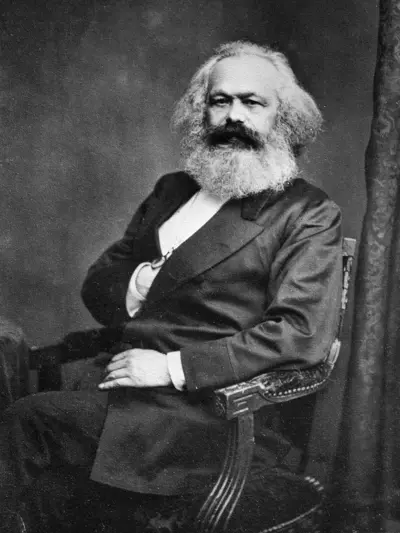
Karl Heinrich Marx was a German philosopher, economist, historian, sociologist, political theorist, journalist and socialist revolutionary. Born in Trier, Germany, Marx studied law and philosophy at university. He married Jenny von Westphalen in 1843. Due to his political publications, Marx became stateless and lived in exile with his wife and children in London for decades, where he continued to develop his thought in collaboration with German thinker Friedrich Engels and publish his writings, researching in the reading room of the British Museum. His best-known titles are the 1848 pamphlet The Communist Manifesto and the three-volume Das Kapital (1867–1883). Marx's political and philosophical thought had enormous influence on subsequent intellectual, economic and political history. His name has been used as an adjective, a noun, and a school of social theory.
