Henry George Quotes
Our boasted freedom necessarily involves slavery, so long as we recognize private property in land. Until that is abolished, Declarations of Independence and Acts of Emancipation are in vain.
Henry George, 1839-1897, Political economist, Unsuccessful Candidate for New York Mayor, Progress and Poverty, 1879
Sourced by: Eigen's Political and Historical Quotations


The Diggers were a religious-economic movement that even today would be considered very radical. They advocated the right of the poor to go onto public lands and farm them—thus the name “Diggers.” Beyond their opposition to the private ownership of land to the exclusion of the poor, Winstanley and the Diggers promulgated another very modern doctrine: That the poor should take the responsibility and have the right to determinine how the society should provide for the poor. A version of this became one of the Mottos of the Poverty Program of 1964. See {616966}.
He was the Russian Reformer who ended serfdom and gave land to the peasants and then was assassinated. Ironically, both Alexander II and Lincoln were assassinated—because of their reform efforts—Lincoln for going too far; the Czar for not going far enough. See the Nickname that was given to the Czar: {622809}.

Socialism in its then pure form had the state owning and controlling all the major assets of the nation. In this sense it was contradictory to individual freedom and hence democracy. However, in the years after Tocqueville’s quotation and the industrial revolution, socialism has gradually moved away from state ownership and operations of all institutions and resources. Democracy has tended to adopt a more regulatory view to control the excesses of unbridled capitalism. The range of democratic nations by the 21st century encompassed differences but some were described as “social democracies” and had some state ownership but were basically capitalistic economies. Even the self-described Communist nations had become heavily capitalistic albeit with less political freedom. At the same time, even the United States—the epitome of 21st century capitalism, owned and controlled a few of the resources and means of production and tended to regulate the others—a substantial difference from the American democracy which Tocqueville studied.


In every society where there had been past unjust ownership of land, all efforts of land reform were faced with the problem of having to dispossess the current “owners” who themselves had not been guilty of the crimes of their ancestors in unjustly obtaining the land originally. In America land reform was unworkable in most cases and the solution was usually a large monetary payment as compensation for the land.

The doctrine of the Southern Cotton industry before the Civil War was that Capital should not only use labor and control labor, but that in true capitalism, Capital should own labor—slavery. This Southern hostility towards labor rights and organized labor was derived from this extremist view of capitalism.


This fascinating quotation is very frequently quoted out of context. For example even in modern times some Southern slavery apologists quote this passage stating that Adams saw no moral difference between slavery and employment of the lower classes. And anti-capitalists have claimed that this was an attack on capitalism as no better than slavery for many workers. Neither is true. The debate was on the head taxes that states should pay to the central government. Southerners were claiming that they should not have to pay per person taxes on slaves. Adams position was that they should pay in that there is no practical difference in the work and working conditions very often. If slaves should be exempted from the head tax, so should the poor, lower class workers like the fisherman in New England. He always maintained at huge moral difference between a poor free worker and a slave even thought their working conditions might be similar.


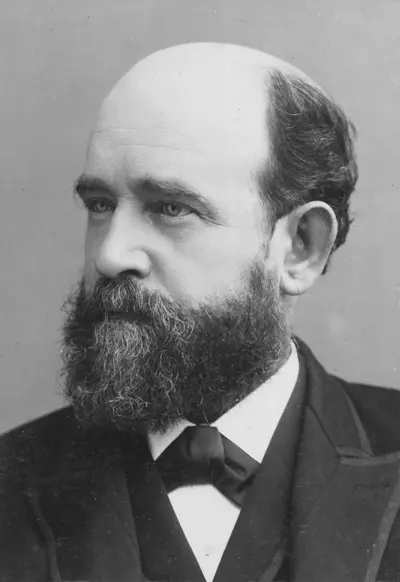
Henry George was an American political economist and journalist. His writing was immensely popular in 19th-century America and sparked several reform movements of the Progressive Era. He inspired the economic philosophy known as Georgism, the belief that people should own the value they produce themselves, but that the economic value derived from land (including natural resources) should belong equally to all members of society. He argued that a single tax on land would create a more productive, more just society.
