Ruhollah Khomeini Quotes
When anyone studies a little or pays a little attention to the rules of Islamic government, Islamic politics, Islamic society and Islamic economy he will realize that Islam is a very political religion. Anyone who will say that religion is separate from politics is a fool; he does not know Islam or politics.
Khomeini, Ruhollah. Islamic Government: Governance of the Jurist. Translated by Hamid Algar, The Institute for Compilation and Publication of Imam Khomeini's Works, 2001, p. 21.


This quotation helps to explain the religious revelry in military achievements in Islam.


Here Khomeini takes the classic Islamic view of the Koran that leaders should be obeyed unless they do not follow Islam. To the leaders of Islamic nations, this means that even if the state is not a theocracy, the Muslim clergy has the final say as to whether a ruler may justly remain in power since they are the ones who determine if a ruler is properly following Islam.

Khomeini was a politician as well as a cleric. He was not always consistent depending on his audience. This book was the publication of 17 different speeches with different audiences. Here he opposes all monarchy, but there is little doubt that his main target was the monarchy of Saudi Arabia. In {620335} he suggests that monarchy would be acceptable if the monarch followed Islamic law. Here he leaves no room for monarchies of which there were and are a number in the Muslim world. And at the height of Islam there was a Caliph who not only had absolute rule of ALL Muslim countries, but he was the absolute ruler of the religion. The Caliph and later the Islamic Sultan held more absolute power than any king or Pope ever had. Most of the Islamic fundamentalists claim that they want a return to having a Caliph with absolute power. And even in Iraq today, the “Supreme Leader” exercises more autonomous power, than any monarch or dictator does in his own country.


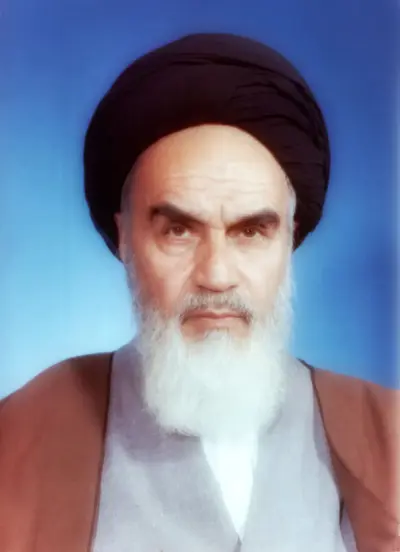
Sayyid Ruhollah Musavi Khomeini, also known in the Western world as Ayatollah Khomeini, was an Iranian political and religious leader. He was the founder of the Islamic Republic of Iran and the leader of the 1979 Iranian Revolution, which saw the overthrow of the last Shah of Iran, Mohammad Reza Pahlavi, and the end of the 2,500-year-old Persian monarchy. Following the revolution, Khomeini became the country's Supreme Leader, a position created in the constitution of the Islamic Republic as the highest-ranking political and religious authority of the nation, which he held until his death. Most of his reign was taken up by the Iran–Iraq War of 1980–1988. He was succeeded by Ali Khamenei on 4 June 1989.
