Ruhollah Khomeini Quotes
Islam is politics or it is nothing.
Khomeini, Ruhollah. Islam and Revolution: Writings and Declarations of Imam Khomeini. Translated by Hamid Algar, Mizan Press, 1981, p. 137.


This is a very important quotation as it focused on one critical difference between historical Islam and all the other major religions and fundamentally on the separation between church and state. In Islam there was a Caliph who was both the political ruler and the religious ruler. In comparison at the time, the Christians had a Holy Roman Emperor who was theoretically the overlord of all the Christian Kings but in reality he really could not exercise total or even much authority over all the other kings. At the same time, there was the Pope who was the religious leader of all the Christians. Since the distinction between Church and state was constantly in flux, the Christian Pope and Holy Roman Emperor were often at odds. The third Abrahamic religion, Judaism, had neither a secular leader or a religious one and no hierarchy other than local. Khaldun observed the theoretical advantage of Theocracy as a model, however he did not analyze the disadvantages among which were the assassination of many Caliphs and the laces. Even the Muslim Arabic states abandoned the idea of a Caliph in modern times until Iran adopted a Theocracy with a single Leader all powerful. However, all the other Arab nations wanted no part of a singular leader for all Muslim nations or even a single civil and religious leader within any other country. Al Qaeda however claimed to be fighting for a return to a Caliphate not only for the current Islamic Nations but for all nations which must be subservient to Islam.

Gabriel exaggerates in the sense that while the quotation is correct for many Muslims, it is by no means true of all. Iran for example is an Islamic theocracy, but Turkey is a 99 percent Muslim nation which is totally secular and in some ways is much more restrictive of Islamic teaching and practice than most secular democracies. The fundamentalist Muslim view of the state and religion is essentially the same as the ultra orthodox Jews and Christians. It is true that a greater proportion of Muslims believe in the merging of civil and religious law than Jews and Christians, but by no means all. The non Arab Muslims are much less likely to see the unity of state and religion.


This quotation helps to explain the religious revelry in military achievements in Islam.


The notion that Islam would be practiced by individuals was in the Ayatollah’s view insufficient. Islam must also control the government—the head.

The Manual was found by the Manchester (England) Metropolitan Police during a search of an Al Qaida member's home.


They are so different that most people in the West think of what Khamenei describes as “religious democracy” as not even close to democracy—almost the antithesis of democracy, and Islamic fundamentalists perceive Western democracy as sinful and evil.


Religious obligation of Islam requires all Muslims to try and convert all others. However that is not different from some of the Christian, fundamentalist religions where attempted conversion of non-believers is a duty. However, where many in the Islamic world see that obligation as a peaceful, nonviolent, effort to persuade others to accept Islam, there are many others who believe that Jihad should impose Islamic law—Sharia—upon the world and the use of force and violence is not only acceptable but is necessary and desirable to achieve their objection.
The last Caliph of the Muslims was removed in 1924 as part of the Turkish Reform. The position has had attraction for many Muslim leaders who saw themselves in the role, but since 1924, nationalism and modernism and the lack of an effective international Muslim leader has precluded it. This anti-revolutionary sentiment of the Islamic political state that is so traditional, may in part account for the Islamic tolerance of autocratic regimes. Note that the distinction between religious responsibilities and civil are important. Tyranny must be tolerated but not blasphemy or heresy. Traditional Muslims provide more tolerance and forbearance for a leader’s civil failings than religious. But Muslims were not the only people to do this. A British prime minister had a view with the same conservative logic. See {639130}. The ancient Jewish Macabean revolt against the Jewish king was all based on failure to perform required religious duties of sacrifice as opposed to tyranny and poor government which also existed. Popes excommunicated Kings for religious reasons, not because of their civil failures at governing. Holding rulers accountable for civil performance is a relatively new concept yet is indispensible in a modern democracy.
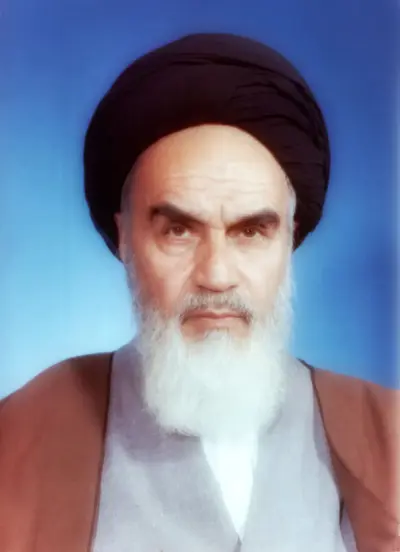
Sayyid Ruhollah Musavi Khomeini, also known in the Western world as Ayatollah Khomeini, was an Iranian political and religious leader. He was the founder of the Islamic Republic of Iran and the leader of the 1979 Iranian Revolution, which saw the overthrow of the last Shah of Iran, Mohammad Reza Pahlavi, and the end of the 2,500-year-old Persian monarchy. Following the revolution, Khomeini became the country's Supreme Leader, a position created in the constitution of the Islamic Republic as the highest-ranking political and religious authority of the nation, which he held until his death. Most of his reign was taken up by the Iran–Iraq War of 1980–1988. He was succeeded by Ali Khamenei on 4 June 1989.
