Michel Foucault Quotes
It is often said that definitions of Islamic government are imprecise. To me, however, they seemed to have a clarity that was completely familiar and also, it must be said, far from reassuring.
Foucault, Michel. "What Are the Iranians Dreaming About?" Foucault and the Iranian Revolution: Gender and the Seductions of Islamism, by Janet Afary and Kevin B. Anderson, University of Chicago Press, 2005, p. 206.

Gabriel exaggerates in the sense that while the quotation is correct for many Muslims, it is by no means true of all. Iran for example is an Islamic theocracy, but Turkey is a 99 percent Muslim nation which is totally secular and in some ways is much more restrictive of Islamic teaching and practice than most secular democracies. The fundamentalist Muslim view of the state and religion is essentially the same as the ultra orthodox Jews and Christians. It is true that a greater proportion of Muslims believe in the merging of civil and religious law than Jews and Christians, but by no means all. The non Arab Muslims are much less likely to see the unity of state and religion.


This quotation helps to explain the religious revelry in military achievements in Islam.

They are so different that most people in the West think of what Khamenei describes as “religious democracy” as not even close to democracy—almost the antithesis of democracy, and Islamic fundamentalists perceive Western democracy as sinful and evil.


Theological & Legal Expert. The Sunnah, like the Koran, has statements of the Prophet, Mohammad. A fatwa is a religious legal ruling. This particular Fatwa shows the great difference between the Islamic State and a Republic or Democracy. In the latter forms, any religious practices must be consistent with the Constitution. Even though blasphemy might be prohibited by a religion, the United States Constitution for example protects anyone’s right to be blasphemous. In the Islamic system any constitution or law is subservient to and must be consistent with, the sayings of the Prophet Muhammad. In that sense, unless the Muslim populated nation is secular like Turkey, then the governments are partial or total theocracies.

The notion that Islam would be practiced by individuals was in the Ayatollah’s view insufficient. Islam must also control the government—the head.
Here Khomeini takes the classic Islamic view of the Koran that leaders should be obeyed unless they do not follow Islam. To the leaders of Islamic nations, this means that even if the state is not a theocracy, the Muslim clergy has the final say as to whether a ruler may justly remain in power since they are the ones who determine if a ruler is properly following Islam.


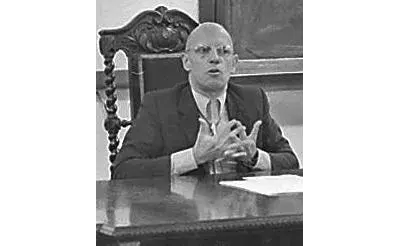
Paul-Michel Foucault was a French philosopher, historian of ideas, writer, political activist, and literary critic.
