Pope Alexander VI Quotes
We have indeed learned that you, who for a long time had intended to seek out and discover certain islands and mainlands remote and unknown and not hitherto discovered by others, to the end that you might bring to the worship of our Redeemer and the profession of the Catholic faith their residents and inhabitants...
This bull, divided up the lands being “discovered” between Spain and Portugal and left Spain to conquer and colonize the New World.
Alexander VI, 1431-1503, [Rodrigo Borgia], Roman Catholic Pope, Papal Bull, May 4, 1493
Sourced by: Eigen's Political and Historical Quotations

This was a large part of the “moral” justification of conquering the New World peoples.


Also known as Ferdinand II or Aragon. We have provided an extensive quotation from the letter. In retrospect, it is incredulous today that Ferdinand would make such demands or even would believe that the Indians would understand the terms or their consequences, the threats. Even the promises that are made were ignored because of the Indian’s “intransigence.”


This church which was so active later in sending missionaries throughout the world, at first thought the idea absurd.
This edict in effect divided up the New World between Spain and the other Catholic countries. The Pope wanted to avoid conflict among the Catholic powers of Europe. Shortly afterward, the Pope brokered a specific deal, The Treaty of Tordesillas, dividing exploration rights between Spain and Portugal. The Pope divided up the New World, land he had never visited, people he had never met, among Catholic European powers.

Christian Neophytes were Indians who claimed that they had converted to Christianity. The French initially banned giving or selling firearms to the Indians of North America. However in 1640, they made an exception to provide arms to the Huron Indians who they thought had converted to Christianity. Four years later the Jesuits were using guns as the major motivation for conversion of Indians. The hypocrisy of using weapons of war to attract converts to a religion of peace gave way to the incredible success that the trading of guns for souls had achieved. The French military also thought that the armed Indians could be used as allies in the coming battle with England for control of North America. The English then armed their Indian allies, and the French and Indian Wars saw armed Indians on both sides.


This decree is an example of the Catholic Church’s official response to the advent of slavery in the New World. Slavery here should be distinguished from what the Catholic Church called “just title” slavery, which approved of the practice in circumstances in which the person was deprived of their liberty justly. Specific examples have included slaves captured in war, persons condemned to slavery for a crime, and those who sold themselves into slavery. For an example of a type of “just title” slavery being legitimatized, see Nicholas V {612174}. The practice of enslaving entire ethnic groups like South American natives was, however, “never before heard of” and was immediately condemned. In many cases the line between slavery for no morally justifiable reason, i.e. racial slavery, and “just title” slavery remained unclear to Catholic laity and clergy alike.

It is an error to say that. It is an error to say that He was the last Pope to hold temporal power. Years later, the Vatican rejected this view and adopted the modern concept of freedom of conscience. See {612714}.

The contrast between the Christian piety memorializing the taking of the city and then as soon as the ceremonies were complete the pillaging and plundering, is dramatic. Religion controlled and permeated the military thoroughly at the time—even to the organization of un-Christian acts like plunder and murder of civilians.

One might think that this remarkable pronouncement would have put an end to Catholic participation and support of slavery. However, in an exercise of theological hair splitting, the Southern Catholic Bishops of the United States took the position that In Supremo outlawed Catholic participation and support of slave trading but not the institution of slavery itself. See {617544} for their official position to the United States Government.
The “enemy of the human race” is the Devil, Note that the Pope labels as “allies” of the Devil those who advocate and participate in slavery. Slavery was not only immoral, but the Devil was behind it all. The fact that slavery persisted on a massive scale by Catholic countries illustrates that while the Pope was a powerful leaders and figure, even he could not influence all the “sinners.”
Conceptually this is one of the most absurd documents in history, written by a European King to the native Indians of the new world, virtually all of whom were illiterate, knew nothing of Christianity or of European politics.

The boycott had been triggered by a breakup of a mixed marriage where the Protestant wife took her two children to Belfast and would only reunite with her husband if he agreed to bring up the children as Protestants. This brought Catholic accusations of a Protestant conspiracy and plot to kidnap Catholic Children and take them to Northern Island to be brought up as Protestants. The boycott soon ended as it was too unfair for all but the most rabid Anti-protestants.
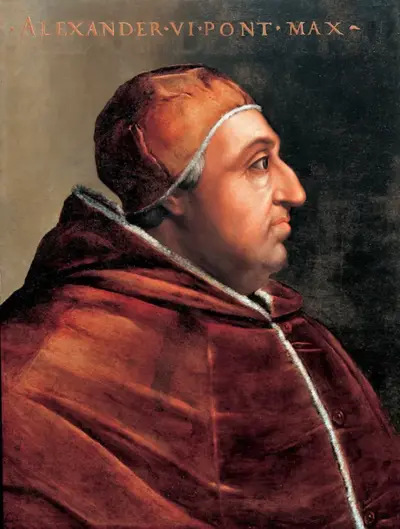
Pope Alexander VI, was pope from 11 August 1492 until his death in 1503. Born into the prominent Borgia family in Xàtiva under the Crown of Aragon (now Spain), Rodrigo studied law at the University of Bologna. He was ordained deacon and made a cardinal in 1456 after the election of his uncle as Pope Callixtus III, and a year later he became vice-chancellor of the Catholic Church. He proceeded to serve in the Curia under the next four popes, acquiring significant influence and wealth in the process. In 1492, Rodrigo was elected pope, taking the name Alexander VI.
