Pope Alexander VI Quotes
In our times especially the Catholic faith and the Christian religion be exalted and be everywhere increased and spread, that the health of souls be cared for and that barbarous nations be overthrown and brought to the faith itself.
This was a large part of the “moral” justification of conquering the New World peoples.
Alexander VI, 1431-1503, [Rodrigo Borgia], Roman Catholic Pope, Papal Bull, May 4, 1493
Sourced by: Eigen's Political and Historical Quotations

Christian Neophytes were Indians who claimed that they had converted to Christianity. The French initially banned giving or selling firearms to the Indians of North America. However in 1640, they made an exception to provide arms to the Huron Indians who they thought had converted to Christianity. Four years later the Jesuits were using guns as the major motivation for conversion of Indians. The hypocrisy of using weapons of war to attract converts to a religion of peace gave way to the incredible success that the trading of guns for souls had achieved. The French military also thought that the armed Indians could be used as allies in the coming battle with England for control of North America. The English then armed their Indian allies, and the French and Indian Wars saw armed Indians on both sides.

This church which was so active later in sending missionaries throughout the world, at first thought the idea absurd.

This bull, divided up the lands being “discovered” between Spain and Portugal and left Spain to conquer and colonize the New World.

This is a very important quotation because it reflects the attitude of many of the leading American expansionists and imperialists of the period—ie that American imperialism would uplift peoples around the world. This was an extension of the religious motive of many of the British imperialists who referred to the “3 Cs”: Commerce, Civilization & Christianity. Seelye himself was a missionary of the Protestant Dutch Reformed Church.


Those who argue that the United States is a Christian country often point to this quotation to illustrate the fundamental religious purpose to the Massachusetts Colonies


The Empress provided freedom of religion in order to induce many settlers to immigrate to Russia. However, the clerics of the Russian Orthodox Church were terribly fearful that they would lose parishioners to other religions and they prevailed upon Catherine to outlaw preaching and conversion of the Russians. However, they were all for any attempt to convert the Muslims in the Russian Empier or at the borders. This limitation on conversion lasted until the Communist Revolution when the Communists even prohibited the Russian Orthodox from converting people. It was not until the fall of the Soviet Union that other religions were allowed to try and convert Russians and even then the number of sects that were allowed to do so were limited.

The Sultan responded (See {612151}) The King should have worried. The Sultan’s troops soundly defeated the French and then beheaded tens of thousands of French prisoners. The King was captured and ransomed.


At that time, and in much of the world today, religious preaching and those who do it are licensed by the state. Lucian’s response was one of the first statements that governments and temporal powers endorsement was not required, nor was any formal ordination or grant of authority from a formal church as existed among the pagans of the time where the religion was seen as another extension of the state. Even in America there is some ambivalence on this point. Many religions require not only training but a grant of authority from the religious hierarchy. Others such as some Baptists and many Protestant Fundamentalist groups believe that no specific authority is needed other than the “calling of god.” Lucian was apparently the first person to claim the authority as an individual. He was burnt alive for his position. There is a second Saint Lucian. To distinguish the latter is often referred to as Saint Lucian the Syrian.


Most fundamentalist Muslims view advocacy of any religion other than Islam as an “aggression” against Islam. While Americans are used to evangelizing and very aggressive attempts to convert others to and from various religion, the lack of freedom in most Islamic societies makes this a foreign notion. Also, Muslims read the works of some Christian missionaries and generalize this view to the West in its entirety. For example, See {607979}

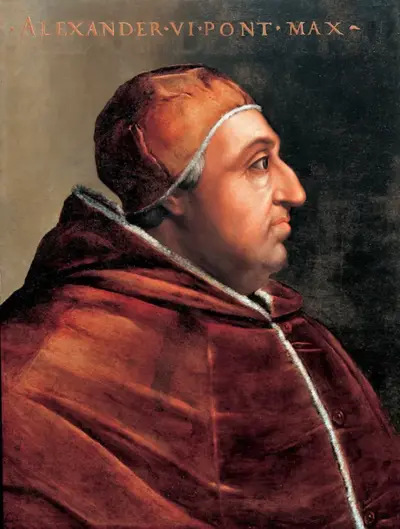
Pope Alexander VI, was pope from 11 August 1492 until his death in 1503. Born into the prominent Borgia family in Xàtiva under the Crown of Aragon (now Spain), Rodrigo studied law at the University of Bologna. He was ordained deacon and made a cardinal in 1456 after the election of his uncle as Pope Callixtus III, and a year later he became vice-chancellor of the Catholic Church. He proceeded to serve in the Curia under the next four popes, acquiring significant influence and wealth in the process. In 1492, Rodrigo was elected pope, taking the name Alexander VI.
