Ahmed Deedat Quotes
In the battle for the hearts and minds of mankind, "cruci-FICTION" is the only card the Christian holds. Free him from his infatuation and you will have freed the Muslim world from missionary aggression and harassment.
Most fundamentalist Muslims view advocacy of any religion other than Islam as an “aggression” against Islam. While Americans are used to evangelizing and very aggressive attempts to convert others to and from various religion, the lack of freedom in most Islamic societies makes this a foreign notion. Also, Muslims read the works of some Christian missionaries and generalize this view to the West in its entirety. For example, See {607979}
Ahmed Deedat, South African Islamic Scholar and Evangelist, Crucifixion or Crucifiction, Islamic Propagation Centre International, 1984
Sourced by: Eigen's Political and Historical Quotations

In some countries political candidates run on religious platforms to convert the part of the population that is not of their religion and turn the nation into a theocracy.

Christian Neophytes were Indians who claimed that they had converted to Christianity. The French initially banned giving or selling firearms to the Indians of North America. However in 1640, they made an exception to provide arms to the Huron Indians who they thought had converted to Christianity. Four years later the Jesuits were using guns as the major motivation for conversion of Indians. The hypocrisy of using weapons of war to attract converts to a religion of peace gave way to the incredible success that the trading of guns for souls had achieved. The French military also thought that the armed Indians could be used as allies in the coming battle with England for control of North America. The English then armed their Indian allies, and the French and Indian Wars saw armed Indians on both sides.

See {586039} for a quotation that goes further and seeks to punish and humiliate the non believers. This sura is often used by those wishing to illustrate the intolerance of Islam—especially of other religions. They fail to put this into the context of the Old Testament which proscribed death for heretics or the history of Christianity regarding the murder of nonbelievers. The difference is however, that a very small proportion of Jews or Christians today believe in following Biblical instructions in this respect while the proportion of Muslims who believe in the literal interpretation of scripture on these points is much larger. However there are Islamic modernists and moderates throughout the world who reject this notion of warring on all other religions and there is a struggle going on within Islam itself.

In 1453 the Ottoman Turks shocked Christendom by capturing Constantinople, the capital of the Byzantine Eastern Christian Empire. It was always perceived as a religious conflict between Christians and Muslims but that is an over simplification of a very complex sociological, religious, and political historical period. As this quotation shows us there were many Christians aiding the Muslim side. There were also many Muslims fighting on the Christian side.

This church which was so active later in sending missionaries throughout the world, at first thought the idea absurd.
Toleration is a relative term. The Muslim Moors made Christians (and Jews) pay a special tax. At times they were forced to wear special clothing so that they could be readily identified. And they could not build churches larger or taller than the smallest mosque in the community. At times, their occupations were restricted but at other times Christians and Jews were appointed to the highest positions like Vizier. The Inquisition, in contrast, forced all Muslims (and Jews) to leave the country without any of their property or money or be tortured and killed—usually by burning at the stake unless of course that they converted to Christianity.
The place of non-Muslims in an Islamic country, if any, has been a point of great anxiety among Christians, Jews, Bhais, and others. These have been persecuted and expelled from numerous Islamic countries while in others such as modern Turkey there is no problem. This particular cleric is seen as more “modern” and “liberal” than most. Even he has little concept of equality and freedom of religion.


These Christians are hard-line missionaries who have inserted themselves into Islam like a parasite.
This is an important quotation because it reflects the extreme Muslim antipathy toward non Islamic missionaries. An Islamic theocracy like Iran gets itself in a bind over missionaries because Islamic law (Sharia) which they follow requires the Death Penalty for ANY Muslim who converts to another religion. There is no opportunity for repentance; death is required. Of course, modern and reformist Muslims do not follow this Koranic requirement any more than Christians and Jews today will execute for Heresy or Adultery as is required in their Bible. The lack of balance illustrates a very difficult problem other religions have in dealing with Muslims. Christian missionaries who convert Muslims are “parasites.” Muslim missionaries who convert Christians are doing the will of God.

One remarkable aspect of this quote is that most Western nations have the exact same perception he claims the Islamic word does of what the West is doing. While the Western nations think the defense is necessary and desirable, the Muslim nations fundamentally believe that Christianity and Judaism should and will be supplanted by Islam. To the Islamic fundamentalist religion is a zero sum game. Every person in the world who is not a Muslim is an attack on Islam in that God wants all to follow Islam and wants the faithful to make it so.

While not in the Koran, this attributed statement is the basis for the ban on non-Muslims going on a Hajj and going to the most holy Muslim places—Mecca, Mina, Muzdalifa, and Arafat as well as the anti-religious hostility to all religions but Islam which is present in some Muslim countries.

His protest was focused on Middle East policies which he believed did not value the lives of Muslims as highly as Christians and Jews. The irony of this protest is that United States policy claims to value all life equally as do virtually all industrialized democracies. Omeish however is unusual among world Islamic leaders and politicians in that he values Christian and Jewish life as much as Muslim. Most, typically value Muslims almost exclusively and many advocate the killing of Christians and Jews.


Many, if not most, non-Muslim scholars and thinkers very much disagree with Hamid on this point. The great exceptions of Islam are almost 1,000 years in the past. Current Islam, they argue, is not more exceptional than the beliefs of modern Mongolia which dominated most of the known world centuries ago, but has little that deserves special respect in the 21st country beyond the general respect which is owed to all religions and nationalities. With the exception of Turkey, Islamic nations are for the most part, backward, and virtually no other non-Muslim nations try to emulate them in any way.


He is a Greek Orthodox Christian, and he correctly observes that the Islamic world was considerably more tolerant than the Christian until the 18th century when Islam had become less tolerant in the Middle East while the Christians were modernizing and going through a cultural and intellectual enlightenment and societal modernization while the Muslims, became less tolerant than they were in earlier years leading to the modern situation.


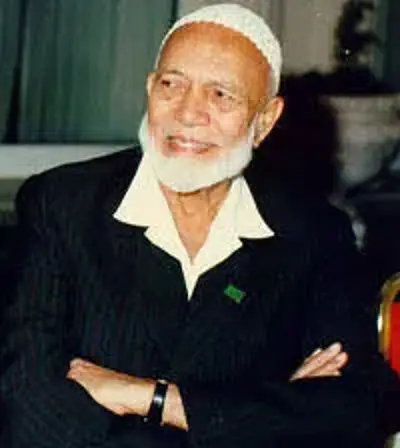
- Born: July 1, 1918
- Died: August 8, 2005
- Nationality:
- Profession: Missionary
Ahmed Hoosen Deedat (Gujarati: અહમદ હુસેન દીદત; Urdu: احمد حسین دیدات) was a South African writer and public speaker of Indian descent. He was best known as a Muslim missionary, who held numerous inter-religious public debates with evangelical Christians, as well as video lectures on Islam, Christianity, and the Bible. Deedat established the IPCI, an international Islamic missionary organisation, and wrote several widely distributed booklets on Islam and Christianity. He was awarded the King Faisal International Prize in 1986 for his fifty years of missionary work. He wrote and lectured in English.
