Lucian Quotes
The laws of charity and humanity oblige all men to endeavor the conversion of their neighbors, and to do everything in their power to rescue them from the snares of the Devil.
At that time, and in much of the world today, religious preaching and those who do it are licensed by the state. Lucian’s response was one of the first statements that governments and temporal powers endorsement was not required, nor was any formal ordination or grant of authority from a formal church as existed among the pagans of the time where the religion was seen as another extension of the state. Even in America there is some ambivalence on this point. Many religions require not only training but a grant of authority from the religious hierarchy. Others such as some Baptists and many Protestant Fundamentalist groups believe that no specific authority is needed other than the “calling of god.” Lucian was apparently the first person to claim the authority as an individual. He was burnt alive for his position. There is a second Saint Lucian. To distinguish the latter is often referred to as Saint Lucian the Syrian.
Lucian, ?-~250, Magician, Christian Convert, and Roman Catholic Saint, Response to the Roman Prelate who wanted to know by whose authority Lucian was preaching, ~250
Sourced by: Eigen's Political and Historical Quotations


This is a very important quotation because it reflects the attitude of many of the leading American expansionists and imperialists of the period—ie that American imperialism would uplift peoples around the world. This was an extension of the religious motive of many of the British imperialists who referred to the “3 Cs”: Commerce, Civilization & Christianity. Seelye himself was a missionary of the Protestant Dutch Reformed Church.


Jefferson was a deist but had little love for the organized religions and did not consider the Bible as the revealed word of God.


Jacques Anatole Francois Thibault


Kneeling next to a black slave at a church alter:


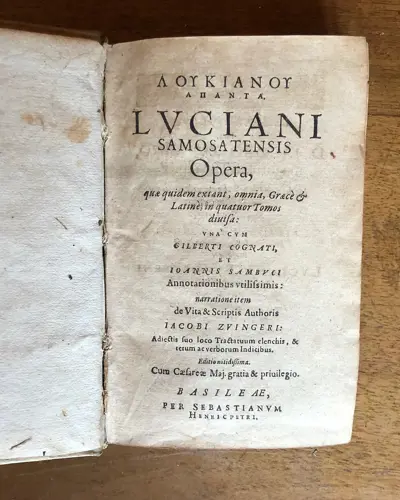
Lucian of Samosata (c. 125 – after 180) was a Syrian satirist and rhetorician who is best known for his characteristic tongue-in-cheek style, with which he frequently ridiculed superstition, religious practices, and belief in the paranormal. Although his native language was probably Syriac, all of his extant works are written entirely in Ancient Greek (mostly in the Attic Greek popular during the Second Sophistic period).
