Richard Cameron Quotes
We for ourselves do by thir presents disown Charles Stewart [King Charles II], that has been reigning (or rather tyrannizing as we may say) on the throne of Britain these years bygone, as having any right, title to, or interest in the said crown of Scotland for government as forfeited several years since by his perjury and breach of covenant both to God and his Kirk.
He was captured and executed shortly thereafter by the King’s troops.
Richard Cameron, ~1648-1680, Scottish Covenanter Leader, Sanquhar, Scotland, June 22, 1680
Sourced by: Eigen's Political and Historical Quotations


When Henry came to “George II” he was interrupted by the Speaker, John Robinson, who shouted “Treason!” Henry had been railing against the Stamp Act.

Note that the Queen always used the 3rd person rather than the 1st when referring to herself. This was true of most of the leading public figures in England at the time. Although she detested Gladstone, she gained control of her feelings and did her duty and “sent for” him to form the Government. She was personally delighted when, as she predicted, his government then had political difficulties.


Sir Walter was imprisoned in the Tower of London for 13 years, during which time he turned to historical pursuits.

1st Earl of Beaconsfield

Campbell carried out the order although many MacDonalds escaped in the highlands. The particular massacre has always taken on an even greater infamy because the Campbell murderers had been given food and hospitality by the MacDonalds. This began the most bitter of the Scottish clan feuds that persists into modern times.


The Queen was visiting South Africa and an Afrikaner mayor buttonholed her to complain about all the indignities that his people had subjected to by the English.

Since the English removed the Stone in 1296 to Westminster, all British Monarchs have been crowned while sitting over the Stone. Suffragettes had bombed the Stone in protest before the First World War cracking it in two. In 1950 some University of Glasgow students removed the two pieces from under the coronation chair of Westminster Abbey. After much publicity for their protest they returned it—repaired—in time for Elizabeth’s coronation. However, when it was repaired, Bertie Gray’s message was placed into the copper tube connecting the two pieces. After the Queen had sat upon the stone, the message was made public.

unions and federations of two countries

Although James’ mother, Mary Queen of Scots had been a Catholic, James was a fervent Protestant. However, he found the separation of the State from authority over the church and the Presbyterian approach not to his liking. Also, the early tradition of the Presbyterian preachers scolding the monarch, especially his mother, was uncomfortable for James.


Referring to the behavior of English King Edward I, 1239-1307, towards Scotland:

He was expelled from Parliament for such.
Ivan the Terrible. He was referring to himself as God’s Chosen One. He and the Church were aligned against the Nobles, whose lands Ivan wanted. He would execute hundreds of “traitors” every month. He even executed the families of his enemies in very cruel ways. He claimed to be “cleansing” the land of sinners in preparation for the coming judgment day, and the church backed him up on this. The Church gave him carte blanche to “punish” all sinners and his paranoia eventually got around to the church fathers themselves who became the final victims.

Mitchel was convicted for his writings and deported to New Zealand from which he escaped to the United States where he worked as a journalist before returning to Ireland.


Khomeini was a politician as well as a cleric. He was not always consistent depending on his audience. This book was the publication of 17 different speeches with different audiences. Here he opposes all monarchy, but there is little doubt that his main target was the monarchy of Saudi Arabia. In {620335} he suggests that monarchy would be acceptable if the monarch followed Islamic law. Here he leaves no room for monarchies of which there were and are a number in the Muslim world. And at the height of Islam there was a Caliph who not only had absolute rule of ALL Muslim countries, but he was the absolute ruler of the religion. The Caliph and later the Islamic Sultan held more absolute power than any king or Pope ever had. Most of the Islamic fundamentalists claim that they want a return to having a Caliph with absolute power. And even in Iraq today, the “Supreme Leader” exercises more autonomous power, than any monarch or dictator does in his own country.

This quotation is one of the most powerful indictments of religion in the political sphere. Historically, religions have supported the status quo in political society even. However, individual clerics have been in the forefront of many if not most of the movements toward freedom and democracy. For example, American religious institutions general supported slavery and legal discrimination thereafter, yet clerics were major abolutionists and major contributors to the Civil Rights Movement. Even today, American churches are the most racially segregated institutions left in America. See {620780} for his view on Christianity in particular.
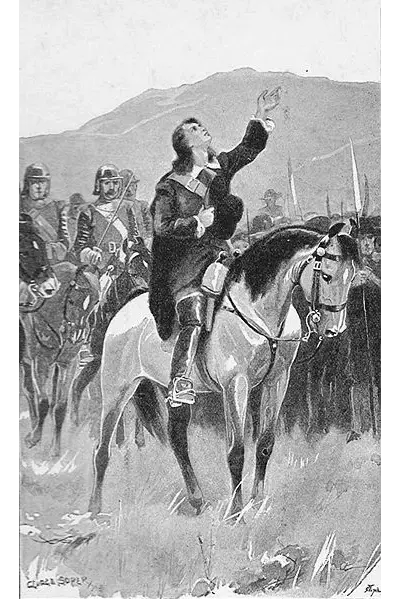
Richard Cameron was a leader of the militant Presbyterians, known as Covenanters, who resisted attempts by the Stuart monarchs to control the affairs of the Church of Scotland, acting through bishops. While attempting to revive the flagging fortunes of the Covenanting cause in 1680, he was tracked down by the authorities and killed in a clash of arms at Airds Moss in Ayrshire. His followers took his name as the Cameronians and ultimately formed the nucleus of the later Scottish regiment of the same name, the Cameronians. The regiment was disbanded in 1968.
