King James I Quotes
That which concerns the mystery of the King's power is not lawful to be disputed; for that is to wade into the weakness of Princes, and to take away the mystical reverence that belongs unto them that sit in the throne of God.
James I, King of England. "A Speach in the Starre-Chamber." The Workes of the Most High and Mightie Prince, Iames. Robert Barker and John Bill, 1616, p. 557.

She was Queen of Scotland and claimed the English throne as well. While Elizabeth I was on the throne of England, Mary claimed that the court had no jurisdiction over an absolute monarch. Her son was in France at the time but eventually succeeded to the Scottish throne as James VI and the English throne as James I.

of the monarch of Spain See {629456} for a good example of this.


The early human idea that human rulers must somehow divine and/or designated and supported by the deity was present over many cultures and geographies.

This and many other statements have been used to refute the allegation made by some that the Japanese Emperor and Commander in Chief had no influence and control over the military and thus was not responsible for any war crimes.
William the Conqueror. See Henry of Huntington for another similar description of the King's authority.

This newspaper was his communications outlet.

Prior to Cooke’s indictment of English King Charles I, there was a concept of Royal Impunity—that a sovereign could not legally be called to account for his actions as ruler of the state. The concept of “sovereign immunity” was a concept where the sovereign and his agents could be given immunity for specific actions, but they never would have impunity again where there were no limits to the crimes they might commit against their own people. Charles I refused to even recognize Cooke’s indictment and so have heads of state called to account for their major crimes since then all the way down to Saddam Hussein in 2006 who made the same argument. Cooke was himself hanged, drawn and quartered almost 20 years after the Charles I trial for his part in the “Regicide” so the concept of Royal Impunity did not die quickly.
This statement has represented the reality of governments before and after.

England had, under Henry VIII, left the Roman Catholic Church where the King replaced the Pope as head of the English Church. Henry’s successors then had to organize and manage the national Christian church. James was discussing the hierarchy of the Church of England and there was a suggestion that Bishops be eliminated and have every priest directly responsible to the crown. Bishops would be powerful figures who might form a power center. (They did later). However, King James I observed that the King is God’s choice and rules by divine right. So there had to be bishops to crown kings. The bishoprics were retained.


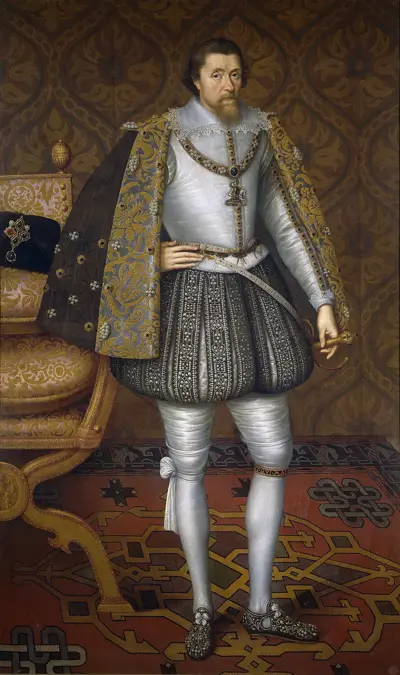
James VI and I was King of Scotland as James VI from 24 July 1567 and King of England and Ireland as James I from the union of the Scottish and English crowns on 24 March 1603 until his death in 1625. The kingdoms of Scotland and England were individual sovereign states, with their own parliaments, judiciaries, and laws, though both were ruled by James in personal union.
