Gerd von Rundstedt Quotes
We are in no position to withstand a prolonged static war. Wherever the allies concentrate their forces they will break through. For us there can be no question of military victory or of winning the war. Our only hope is to hold on long enough to allow some development on the political front to save Germany from complete collapse.
He was absolutely right, but Hitler paid him no heed. See {631290} for his suggested course for Germany.
Gerd von Rundstedt, 1875–1953, German Field Marshal, Analysis of the WWII military situation
Sourced by: Eigen's Political and Historical Quotations

He was a realist who wanted to sue for peace before Germany was destroyed.

After the war Donitz was found guilty of Unrestricted Submarine Warfare and using thousands of slave laborers in his shipyards. He was sentenced to 10 years, one of the lightest sentences if the German War Crimes Trials.


The Americans had attacked the Belgian city of Brest and had been repulsed by a well fortified and led German contingent. Analysis of the wartime situation showed that Brest, a port city was no longer necessary for the Allied supplies as numerous other ports were taken and were available. Many of the officers wondered why Bradley wanted them to attack and defeat the Germans in Brest when all they had to do was surround them and eventually starve them out. Bradley’s response explained a subtle aspect of military and foreign policy. It is that the United States Army, once committed, will never be defeated or stopped. Had the Americans not already attempted to take Brest, they would not have bothered at this stage of the war, but since they had, it was imperative that they succeed. Otherwise, it was felt that Allies and enemies would not take future American threats as seriously and that the morale of American soldiers would even be affected if they thought they could be beaten. A similar problem occurred in the Vietnam War and later in the Iraq war. Once the short term military necessity of fighting was gone, the long-term factors came into play and often will. Others argue that the United States military is so strong and well equipped, that it no longer necessary to take casualties just to prove a psychological point.


Prior to this the Japanese had not even considered what terms they might fight for if there were to be a peace negotiation. What the Japanese leadership apparently totally missed was the fact that President Roosevelt and all other American leaders throughout the war had promised that only unconditional surrender would be acceptable. This was reiterated in a Joint Declaration of the U. S. , China, and Great Britain. The Japanese thought this just propaganda and never took it seriously.

Note that he assumes that not only will there be another World War, but he assumes that we will be on opposite sides.

The Nazis occupied the cities, but the partisans survived in the mountains. The resistance was ferocious and very effective. From a German Soldier’s point of view, the Yugoslav front was the most dangerous assignment where his odds of being killed was even greater than the Russian front.

Germany had just attacked Russia with whom it had a treaty. For a while, Hitler paid little attention to Italy and just gave their “ally” orders and instructions. Italian public opinion was concerned about the same question. See {627973} .

Nonetheless, Eisenhower was persuaded to send militay and financial aid to France to assist in trying to militarily defeat the Vietname Nationalsits and maintain contol over their Colony.


This is the quotation that came to define Chamberlain’s naivety for history and the icon of failed diplomacy. However to see the beginning of the sequence of events that would lead up to this statement, see {585940} when Chamberlain suggested the infamous meeting in Munich. There had been an interesting history to Chamberlain’s appeasement of Germany. 39 years earlier, Chamberlain’s father, then Britain’s Colonial Secretary, and advocated a natural alliance with Germany. See Joseph Chamberlain, 1836-1914: {585939}.

The Kaiser, facing a revolution, instructed Groener to use the army to put down the revolution. The Kaiser had to abdicate and the German Republic was born, soon to fall to the Nazis.
Ironically, the Japanese Government and military were so polarized that it took several days for the authorities to get together and agree on a course of surrender action. The second atomic bomb dropped on Nagasaki speeded things up.

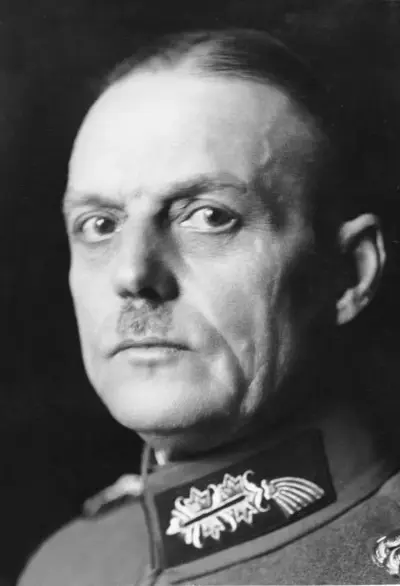
- Born: December 12, 1875
- Died: February 24, 1953
- Nationality: German
- Profession: Soldier
Karl Rudolf Gerd von Rundstedt was a German field marshal in the Wehrmacht of Nazi Germany during World War II.
