Ruhollah Khomeini Quotes
We affirm that music engenders immorality, lust, and licentiousness, and stifles courage, valor, and the chivalrous spirit; it is forbidden by Koranic laws and must not be taught in the schools.
Fifty years later, the Taliban of Afghanistan make the fundamentalist prohibition against music the law. See {620308}. Where he got his ‘facts’ about music is unknown, but it does not even comport with Islamic history. The Muslim Ottoman Turks invented the military band and the playing of music to increase men’s courage. It was so effective that virtually every other military on earth adopted the use of a military band playing music. Yet this Ayatiollah claimed music stifled courage and valor.
Ruhollah Khomeini, 1900-1989, Iranian High Cleric (Ayatollah) & Revolutionary Leader, Kashf al-Asrar, 1942
Sourced by: Eigen's Political and Historical Quotations

To examine the earlier theological history of the Muslim fundamentalist prohibition against music, see {620334}. What is fascinating is that fundamentalist Muslims differ profoundly on the propriety of music in Islamic society. For example, in Egypt, the largest Middle Eastern Islamic nation, music is not only allowed but has a thriving musical world that generates much music which is enjoyed by Egyptians but others of the Muslim and non-Muslim world. Even in fundamentalist Saudi Arabia and the Theocracy of Iran there is music and a culture of music. Even fundamentalist Islam is not monolithic.


Theological & Legal Expert. The Sunnah, like the Koran, has statements of the Prophet, Mohammad. A fatwa is a religious legal ruling. This particular Fatwa shows the great difference between the Islamic State and a Republic or Democracy. In the latter forms, any religious practices must be consistent with the Constitution. Even though blasphemy might be prohibited by a religion, the United States Constitution for example protects anyone’s right to be blasphemous. In the Islamic system any constitution or law is subservient to and must be consistent with, the sayings of the Prophet Muhammad. In that sense, unless the Muslim populated nation is secular like Turkey, then the governments are partial or total theocracies.

This verse has been one of the bases of Muslim theocratic states like Iran’s claim to legitimacy. The word “govern” is sometimes translated as “judge.” In the context of the 6th century, there were no separation of powers as we know them and judging, governing and legislating were melded.
This is the famous sura that has been interpreted to require women to be covered, wear the chador or burka completely covering them or just a headscarf as other Muslims interpret it. Note that a literal reading does not require complete covering. Fundamentalists in Islam do not only rely on the precise literal statement through they would never dispute it. But many would believe that it is metaphorical for not revealing anything that might be stimulating to men. The sura goes on to list those male relatives who are exempted. These are the same as those where marriage is forbidden.


Abu Nuas was not only gay but wrote much poetry about the beauty and love of homosexuality. He was a tutor to Caliph Muhammad al-Amin when the Caliph was a boy. The Caliph also had affairs with boys one of which was openly public. This Caliphate was a period of great scientific and cultural development in the Islamic world and at that time the Islamic world was the scientific and cultural leader of the world—far in advance of Christian Europe—still in the Dark Ages. Today, in most Islamic countries, and particularly Iran, homosexuals or those who write about it, if they get caught, are usually jailed or even executed—for the very activity that Abu Nuwas, a great Persian Poet and Abu Nuwas, the highest religious and civil authority in Islam openly engaged in. After about 1100. Islamic fundamentalists got control of the religion, closed the society to open inquiry and tolerance of ideas, and Islam has gone from the most advanced cultural and scientific culture in the world to one of the worst cultures in terms of modernism. Those Islamic fundamentalists who yearn for a return to the Caliphate know little about the history of that period or they would condemn it heartily. The situation is not dissimilar as for devout Roman Catholics who discovered that some Popes who were Saints were also libertines, married, had mistresses and children. In one case the son of the Pope himself became Pope. At first the reaction is to deny the happenings and ascribe to them falsehoods spread by enemies of the faith.

One Islamic belief that has stood since the inception of the religion is that if a true believer who is defending the faith in a jihad is killed, he will immediate be transported to Paradise where he will receive the best of the other world. If a Muslim dies under normal circumstances, he is judged and may or may not attain Paradise depending on his past life. However, if he dies in jihad, all past sins are immediately erased and he is guaranteed Paradise. This quotation is exactly what is told to Muslim fighters and suicide bombers today (see {635766}, {588728} and {590762}) and it is just as effective as ever in persuading men to fight and sacrifice themselves. The Roman Catholic Pope issued a similar edict in the Crusades and fights of both religions were willing and almost anxious to die in battle. In modern times Christian leaders do not make such appeals and if they did, few would believe them.
This is not terribly different however from Christians and Jews selectively quoting the Bible.

This is another of De Tocqueville’s prescient statements that in retrospect seem so amazing given the time. This quotation could serve as an op ed in a newspaper of any of the industrial democracies of the early 21st century. However, he did not have the information of the details we have today that showed Islam as the pinnacle of scientific, philosophical, literary and medical achievement at the beginning of the second millennium, while the Christian nations of Europe were mired in the Dark Ages. It was the same Koran but a very different interpretation and framework that led to the decadence while it was the Protestant Reformation that triggered a Christianity that was hospitable to modernity and enlightenment.


Legal Religious Ruling. This is an example of a source of tension between some Muslims and others. Non-Muslims are required to have a Muslim Education in Muslim countries, but they insist that any required Christian or secular education in a non Muslim country is anti-Islamic.


At the time, the chief executive of these states were called Presidents because they presided over the legislature as well. This proclamation was issued before the Constitutional Convention in 1787 and the later ratification separating church and state. However, even after the Constitution was ratified some states continued to use state law to enforce the Christian Sabbath. That practice would continue in some places until the 2nd half of the 20th century.

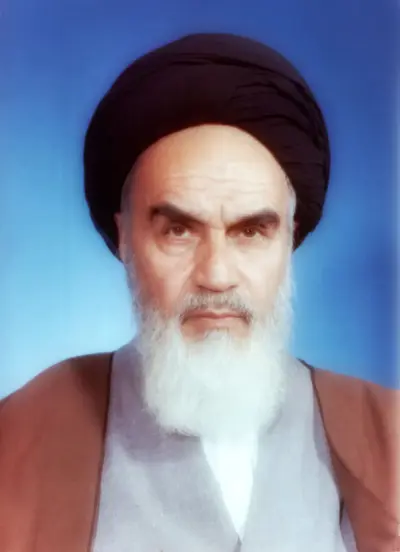
- Born: May 17, 1900
- Died: June 3, 1989
- Nationality: Islam
- Profession: Statesman
Sayyid Ruhollah Musavi Khomeini, also known in the Western world as Ayatollah Khomeini, was an Iranian political and religious leader. He was the founder of the Islamic Republic of Iran and the leader of the 1979 Iranian Revolution, which saw the overthrow of the last Shah of Iran, Mohammad Reza Pahlavi, and the end of the 2,500-year-old Persian monarchy. Following the revolution, Khomeini became the country's Supreme Leader, a position created in the constitution of the Islamic Republic as the highest-ranking political and religious authority of the nation, which he held until his death. Most of his reign was taken up by the Iran–Iraq War of 1980–1988. He was succeeded by Ali Khamenei on 4 June 1989.
