Philip II of Macedon Quotes
Was is being declared against the Persians on behalf of the Greeks, to punish the barbarians for their lawless treatment of the old Greek temples.
From earliest times, leaders have justified war using religion as the lever to convince the people to fight and pay the other costs of a war. The leaders may have been motivated by hegemony, land, trade and the like but almost always tried to make the war a moral crusade.
Philip II of Macedon, 382 BC–336 BC, King of Macedonia, Father of Alexander the Great, Explanation of Why the Greeks were declaring war on Persia, Quoted in Robin Lane Fox, Alexander the Great
Sourced by: Eigen's Political and Historical Quotations

Alexander and his army were approaching the city of Persian King Darius. The King asked for a truce assuming that a settlement of treasure and land could be worked out as war was usually fought in those days. However, Alexander had led a punitive war where revenge was the major objective. Alexander rejected a truce and chased Darius to his death.


Ironically, when he attacked Athens in 480 BC, the Athenians under Themistocles, abandoned the city—see {612656}—and lured the overly-confident Xerxes into a sea battle at Salamis where the Persians were totally destroyed. A few public buildings of Athens were burned, but before Xerxes could fulfill his vow, he was defeated and had to retreat to Persia.

The Confession was a statement of doctrine to which the Swiss Anabaptists adopted.

Enemy captives were sometimes adopted by Indian families to replace a lost loved one.

Lee had advised the Southern leadership to avoid secession and the war that would follow. However, the Southern leaders did not really believe that the remainder of the Nation would fight and take casualties to end the institution of slavery. While many would not, they misjudged the intensity of those who would, the moral power of the abolitionists and most Northern religious leaders. Nor did they understand the importance to most Northerners of preserving the Union. And they really had no comprehension of the industrial capability of the Northern free labor states or the importance of that in a long protracted war. Lee, more sophisticated than the other Southern leader, had a more realistic assessment, but thought that there was a chance that the South might have enough early success that the North would politically make the war untenable, but he realized the cost in men and material under the best of circumstances. Lee’s surrender came shortly afterward.


Shahin’s empire which he conquered for Khosrow II comprised all of the Middle East into parts of India. The Byzantine Roman Empire controlled everything from Constantinople to the West. They were the two “superpowers” of the day. Shahin was attacking various Byzantine holdings outside of the city of Constantinople. Even before Islam, religion was a major conflict between East and West.

This was the day after the Al Qaeda attack on the World Trade Center and the Pentagon, 9-11. Perle, a leading neoconservative advisor and guru, from that day on advocated for the invasion of Iraq. The irony was that at that time, Iraq had never attacked an American, anywhere in the world. Also, there was no Al Qaeda presence in Iraq. Many believe that the neocon main reason to invade Iraq was a regime change and democratization that would, they believed, be a catalyst for democracy throughout the Middle East. The supposed role in 9-11 and the WMD were for them just excuses to initiate military action, so they, the Vice President, and others who agreed with their objective did not question very seriously the so called intelligence about Iraq.

Describing the conquest and destruction of Jerusalem and the Second Temple in 70 AD.

The Ottoman Turks had already conquered the Eastern Roman empire outside of Byzantium. They had overwhelming superiority and it was just a matter of time when they would take the city. Surrender would have been the sensible course, but religious passion against surrendering the holy city capital of Christendom to the Muslims was dominant in the Emperor and some of the leadership. But the morale of most was very low—and for good reason. The Ottomans soon captured the city.

The Turks could not take the city then, but they did 56 years later in 1453.


The Christian Crusaders then believed, like many Muslims even in modern times, that the person who dies in Battle defending God and the Faith shall ascend immediately to paradise. The Muslims threw in many virgins to go along with the ascendency, but the basic idea was the same.


The deep enmity between Albanian Muslims and Serbian Christians had existed for 1000 years and continued after Boletini was long gone.


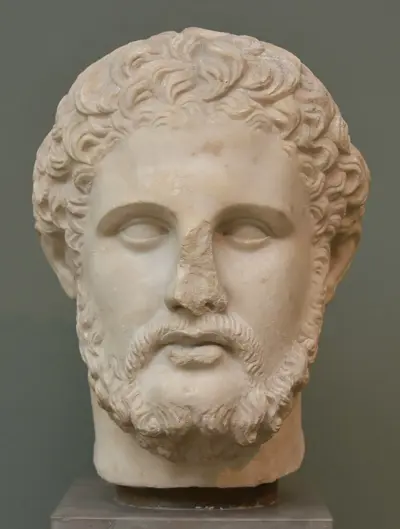
Philip II of Macedon (Greek: Φίλιππος, Fílippos; 382–336 BC) was the king (basileus) of the kingdom of Macedon from 359 BC until his assassination in 336 BC. He was a member of the Argead dynasty of Macedonian kings, the third son of King Amyntas III of Macedon, and father of Alexander the Great and Philip III. The rise of Macedon, its conquest and political consolidation of most of Classical Greece during the reign of Philip II was achieved in part by his reformation of the Ancient Macedonian army, establishing the Macedonian phalanx that proved critical in securing victories on the battlefield. After defeating the Greek city-states of Athens and Thebes at the Battle of Chaeronea in 338 BC, Philip II led the effort to establish a federation of Greek states known as the League of Corinth, with him as the elected hegemon and commander-in-chief of Greece for a planned invasion of the Achaemenid Empire of Persia. However, his assassination by a royal bodyguard, Pausanias of Orestis, led to the immediate succession of his son Alexander, who would go on to invade the Achaemenid Empire in his father's stead.
