Richard Perle Quotes
Iraq has to pay a price for what happened yesterday.
This was the day after the Al Qaeda attack on the World Trade Center and the Pentagon, 9-11. Perle, a leading neoconservative advisor and guru, from that day on advocated for the invasion of Iraq. The irony was that at that time, Iraq had never attacked an American, anywhere in the world. Also, there was no Al Qaeda presence in Iraq. Many believe that the neocon main reason to invade Iraq was a regime change and democratization that would, they believed, be a catalyst for democracy throughout the Middle East. The supposed role in 9-11 and the WMD were for them just excuses to initiate military action, so they, the Vice President, and others who agreed with their objective did not question very seriously the so called intelligence about Iraq.
Richard Perle, Assistant Secretary of State (Republican) Remark to George W. Bush Key Staff, White House, September 12, 2001
Sourced by: Eigen's Political and Historical Quotations


Jorge Mario Bergoglio


Sherman, one of the most gifted generals of the Civil War. He hated the cruelty of war and the Civil War in particular as he had specifically warned his Southern friends ahead of time about what war would bring. See {585882}. Sherman was one of the first American military men to look at war without any of the romantic, patriotic, noble attributes that most others did.

The Security Counsel was meeting it the Situation room at the White House


The President had earlier threatened to execute Confederate prisoners, if the South implemented its threat to execute any Union Negro soldiers they captured. The threat seems to have worked. See Lincoln.

Lee had advised the Southern leadership to avoid secession and the war that would follow. However, the Southern leaders did not really believe that the remainder of the Nation would fight and take casualties to end the institution of slavery. While many would not, they misjudged the intensity of those who would, the moral power of the abolitionists and most Northern religious leaders. Nor did they understand the importance to most Northerners of preserving the Union. And they really had no comprehension of the industrial capability of the Northern free labor states or the importance of that in a long protracted war. Lee, more sophisticated than the other Southern leader, had a more realistic assessment, but thought that there was a chance that the South might have enough early success that the North would politically make the war untenable, but he realized the cost in men and material under the best of circumstances. Lee’s surrender came shortly afterward.

Johnson was Vice President at the time. What he did not realize at the time was that one of the plotters was supposed to have killed him at the same time as the others, but the assassin got cold feet at the last minute and never entered Johnson’s house.


This proverb only makes sense in the light of understanding the Arab concept of revenge—“blood.” In a rural desert environment where little can be expected of government, the Arabs have developed a law enforcement and peace keeping mechanism which while primitive from modern standards, nevertheless worked to some degree. It is that revenge—“blood” is a moral necessity and obligation of all people, and revenge is not limited by time or to the individuals involved in the first incidence. The immediate family are the first to exact revenge, but the extended family follows and often the entire clan. Sometimes revenge is tribal or even national. Anyone who fails to revenge a member in his group is not only a disgrace, but is a clear and present danger to the group because then they can be attacked with impunity. So revenge is a strong obligation of the group members and blood must be paid with blood no matter how many generations it may take. The only thing that keeps me and my family safe, is the surety what whosoever kills one of us will themselves be killed or if they die a natural death we will take revenge on one of the evildoers relatives and no one is exempt. Crime must never pay!


An American ambassador and 3 staff had been killed in a terrorist attack on our Consulate in Bengasi, Libya. The CIA and the rest of the American intelligence had initially analyzed the event and gave a report to the Administration “explaining” the event. American officials who did not see the incorrect intelligence report, hypotheses that it was a planned terrorist attack which it appeared to be from the news reports read by amateurs, However, the United Nations Ambassador was given the incorrect report and was asked by the White House to appear on the News Shows, reveal the contents of the report and state that this was a preliminary analysis and subject to change upon further data and analysis. She did that, but many journalists and politicians thought that her version did not comport with the facts. Soon it was discovered that the initial Intelligence report was all wrong and not even close to the truth and the people who guessed from the press reports had gotten it right. Graham and other members of Congress were very angry. So Graham made a public announcement stating the U. N. Ambassador was unfit for a senior job as she either lied to the country of was too naïve to see the truth which so many others had seen. There were dozens of people who might have either made a mistake or were otherwise responsible for the erroneous report which in hindsight appeared very flawed. At the top of the list was the CIA Director who had been America’s best heroic and victorious general who had recently taken the post and was very popular. So Graham and some of his fellow members of Congress called for the head of the one person involved and at a high level who had NOTHING to do with preparing and approving the wrong and misleading intelligence report and did not cast blame on any of the people who made the error or approved it. The quotation is typical of members if Congress who, insist on having the public stage before they know most of the facts, have little idea of how to manage anything, pick the easiest target to attack without worrying top much about the real culprits if any, and the lack of courage enough to blame a very powerful figure who if he did not personally err, the problem occurred on his watch. See {625924} for a view of the courage of Congressmen. Graham was actually a much better than average Senator, at the time but Congress had a 90% disapproval rating with the citizens.


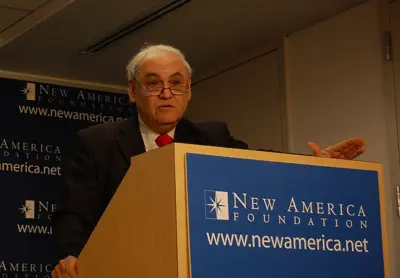
Richard Norman Perle is an American political advisor who served as the Assistant Secretary of Defense for Global Strategic Affairs under President Ronald Reagan. He began his political career as a senior staff member to Senator Henry "Scoop" Jackson on the Senate Armed Services Committee in the 1970s. He served on the Defense Policy Board Advisory Committee from 1987 to 2004 where he served as chairman from 2001 to 2003 under the Bush Administration before resigning due to conflict of interests.
