Roger B. Taney Quotes
Unquestionably a military government, established as the permanent government for the State, would not be a republican government, and it would be the duty of Congress to overthrow it. But the law of Rhode Island evidently contemplated no such government. It was intended merely for the crisis, and to meet the peril in which the existing government was placed by the armed resistance to its authority. It was so understood and construed by the State authorities. And unquestionably a State may use its military power to put down an armed insurrection too strong to be controlled by the civil authority. The power is essential to the existence of every government, essential to the preservation of order and free institutions, and is as necessary to the States of this Union as to any other government. The State itself must determine what degree of three the crisis demands.
There was an armed attempt of one party to take over the government of Rhode Island. The Government used the state military to put down the rebellion leading to this Supreme Court Case on the legitimacy of using the military. See {616594}.
Roger B. Taney, 1777-1864, Chief Justice of the U. S. Supreme Court, U. S. Treasury Secretary, Luther v. Borden, 1849
Sourced by: Eigen's Political and Historical Quotations

There was an armed attempt of one party to take over the government of Rhode Island. The Government used the state military to put down the rebellion leading to this Supreme Court Case on the legitimacy of using the military. See {616593}.

There is a , romantic American myth about the Militiamen in Colonial and Revolutionary America—the citizen soldiers who would leave their farms and rise to the military necessity of the day. However, not only were the militia very hard to muster to duty, but most actually didn’t own or have experience with firearms, and the prevailing opinion of knowledgeable military leaders from George Washington on down was that the militia were not very good soldiers. See {613015}, {613016}, {613022}, {613027}, {621987}, {621988}, {613030}, {613033}, & {613056}

This quotation shows that the dissent leading to the American Revolution did not emerge suddenly in 1776 after the Battle of Bunker Hill. Dissent, sedition and even violence was documented here in 1774. Salem at the time was the second largest port in the colony and the customs tax collectors—Loyalist Americans—were run out of Salem.

In Rhode Island only land owners could vote. When most Americans were farmers and owned land, this was not an anti-democratic requirement, but Rhode Island developed very rapidly with the Industrial Revolution and the shipping and fishing industries. In 1841 60 percent of the adult males in Rhode Island could NOT vote. The non voters tended to be Catholic Immigrants and Black skilled freemen. Thomas Wilson Dorr of an old RI family called a “People’s Convention” which voted a “New Constitution eliminating the land ownership requirement. The regular government saw this as a rebellion and the Governor ordered the State Militia to take Dorr and his followers into custody. However, most of the militia were Catholics and they refused, Governor King asked President Tyler for Federal troops and was refused. Finally the “rebellion” fell apart and Dorr was captured and sent to prison for life. But the regular legislature having gotten the message, within a year passed a new constitution which gave all free males—white and black—the right to vote. Dorr was released from prison and a few years later was pardoned and returned his civil rights. Thus ended what is sometimes called Dorr’s Rebellion.

The professor was addressing a theory of some gun rights advocates that the framers of the constitution intended the 2nd Amendment as a check on a dictatorial Federal Government. The history of the militias shows that they have been used by states never to foment rebellion but often called out to suppress rebellions of citizens who thought that their rights had been infringed such as Shays Rebellion, the Whisky Rebellion and the repeated use of state militias to enforce laws and quell riots and labor disputes.

A state militia is necessary


The Civil War was on.

He had no authority to do this. He just took it upon himself. This was one of the incidents which caused later Congresses to pass very strict laws limiting the authority of all Federal Military and other intelligence and police forces so that they have little or no authority within the United States. President Lincoln did not allow the order to stand, although he repudiated it very delicately and as privately as possible. Many in his own party strongly favored this proclamation as it cracked down on the Southern Rebels and emancipated slaves—both objectives of many Republicans. In addition, Fremont was very popular with the people and had strong political connections. (He would later run for President.) See {635739}.


He fought in Algeria and other counterinsurgencies and then studied them. He wrote the classic book on counterinsurgency warfare. After all the mistakes the U. S. made after the successful invasion of Iraq, his book and doctrine were very influential in the change in strategy and tactics that turned the Iraq War in our favor.


The “Revolutionary Government” were the Patriot Coup leaders who had seized part of the country but the monarch still had many supporters including his soldiers. This proclamation, with the French troops to back it up, assured that the coup would succeed. Daendels had earlier fled to France when his first Dutch revolutionary efforts failed and he had a price on his head. He was in Paris during the French Revolution and was an enthusiastic supporter. For his support and with his military experience not associated with royalty, he was made a General of the Revolutionary French Army. When the Dutch Patriots tried again to revolt, the new French Government took their side and sent Daendels to Holland at the head of a small French Army to protect the Patriots. This was his position when he issued this proclamation to the great distress of William V and his supporters. William’s troops were particularly intimidated and many deserted and would not protect the monarch against the Patriots.
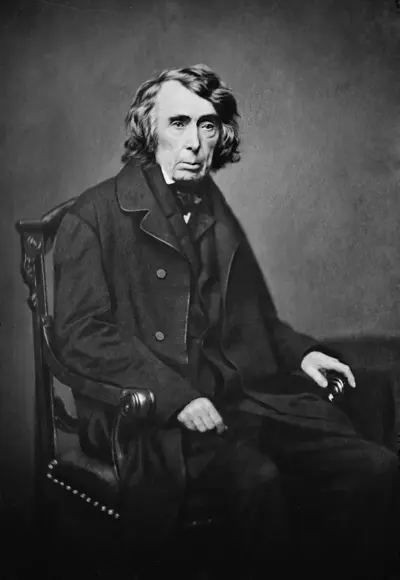
- Born: March 17, 1777
- Died: October 12, 1864
- Nationality: American
- Profession: Judge
Roger Brooke Taney was the fifth Chief Justice of the United States, holding that office from 1836 until his death in 1864. He delivered the majority opinion in Dred Scott v. Sandford (1856), ruling that African Americans could not be considered citizens and that Congress could not prohibit slavery in the territories of the United States. Prior to joining the Supreme Court, Taney served as the United States Attorney General and United States Secretary of the Treasury under President Andrew Jackson.
