Roger B. Taney Quotes
It was a state of war; and the established government resorted to the rights and usages of war to maintain itself, and to overcome the unlawful opposition. And in that state of things the officers engaged in its military service might lawfully arrest any one who, from the information before them, they had reasonable grounds to believe was engaged in the insurrection, and might order a house to be entered and searched, where there were reasonable grounds for supposing he might be there concealed. Without the power to do this, martial law and the military array of the government would be mere parade, and rather encourage attack than repel it.
There was an armed attempt of one party to take over the government of Rhode Island. The Government used the state military to put down the rebellion leading to this Supreme Court Case on the legitimacy of using the military. See {616593}.
Roger B. Taney, 1777-1864, Chief Justice of the U. S. Supreme Court, U. S. Treasury Secretary, Luther v. Borden, 1849
Sourced by: Eigen's Political and Historical Quotations

There was an armed attempt of one party to take over the government of Rhode Island. The Government used the state military to put down the rebellion leading to this Supreme Court Case on the legitimacy of using the military. See {616594}.

This quotation shows that the dissent leading to the American Revolution did not emerge suddenly in 1776 after the Battle of Bunker Hill. Dissent, sedition and even violence was documented here in 1774. Salem at the time was the second largest port in the colony and the customs tax collectors—Loyalist Americans—were run out of Salem.

There is a , romantic American myth about the Militiamen in Colonial and Revolutionary America—the citizen soldiers who would leave their farms and rise to the military necessity of the day. However, not only were the militia very hard to muster to duty, but most actually didn’t own or have experience with firearms, and the prevailing opinion of knowledgeable military leaders from George Washington on down was that the militia were not very good soldiers. See {613015}, {613016}, {613022}, {613027}, {621987}, {621988}, {613030}, {613033}, & {613056}

The Civil War was on.


In Rhode Island only land owners could vote. When most Americans were farmers and owned land, this was not an anti-democratic requirement, but Rhode Island developed very rapidly with the Industrial Revolution and the shipping and fishing industries. In 1841 60 percent of the adult males in Rhode Island could NOT vote. The non voters tended to be Catholic Immigrants and Black skilled freemen. Thomas Wilson Dorr of an old RI family called a “People’s Convention” which voted a “New Constitution eliminating the land ownership requirement. The regular government saw this as a rebellion and the Governor ordered the State Militia to take Dorr and his followers into custody. However, most of the militia were Catholics and they refused, Governor King asked President Tyler for Federal troops and was refused. Finally the “rebellion” fell apart and Dorr was captured and sent to prison for life. But the regular legislature having gotten the message, within a year passed a new constitution which gave all free males—white and black—the right to vote. Dorr was released from prison and a few years later was pardoned and returned his civil rights. Thus ended what is sometimes called Dorr’s Rebellion.
Even today many Americans believe the myth that the American colonial citizen was a skilled marksman who existing skill and familiarity with guns carried the day in the American Revolution. However, even General Washington had to dispel the myth. It was bad politics for members of Congress and other public officials to criticize the local citizenry militias regardless of how inept they were. Less than one fourth of the militia even owned guns and most were unfamiliar with how to use them. Perhaps one of Washington’s greatest military accomplishment was his choosing Van Stuben and other European officers who did such a good job of training a regular army. See {613015}, {613016}, {613022}, {613027}, {621987}, {621988}, {613030}, {613033}, & {613056}.


Perez was a virulent racist who was the strongest political boss in Louisiana. Perez wanted to maintain segregation despite any Federal Court orders, and if the Federal Government would send Federal Marshalls or Federal Troops to enforce desegregation court decision, he would have the Louisiana State Police keep them out or the state, even if it came to a shooting battle. The Governor used this quotation to talk him out of the idea.

The Army actually violated the laws of West Virginia as well as the Constitutional rights of thousands of people. The justification was that there was a labor dispute in the West Virginia mines and there had been some violence. Capt. Morgan was one of three military officers of a military court which actually took over and assumed absolute control of the strike district. They army broke many more laws than they enforced.

In 2002 George Speight attempted a military coups and failed. This statement is one of the most hypocritical political statements.

He had no authority to do this. He just took it upon himself. This was one of the incidents which caused later Congresses to pass very strict laws limiting the authority of all Federal Military and other intelligence and police forces so that they have little or no authority within the United States. President Lincoln did not allow the order to stand, although he repudiated it very delicately and as privately as possible. Many in his own party strongly favored this proclamation as it cracked down on the Southern Rebels and emancipated slaves—both objectives of many Republicans. In addition, Fremont was very popular with the people and had strong political connections. (He would later run for President.) See {635739}.


This statement was made in response to the leaked disclosure that the U. S. Security agencies had software which would allow them to turn Smart TV Sets into listing devices without ever physically touching the TV set—for that matter from any place in the world. This area wgere there was a wide range of poarized scholarly legal opinion. The view here in articulated by Comey was that in a nation, Law enforcment personnel and authorities. albeit with checks and court supervision. must be able to override all comes to and rights of privacy in order to enforce the law. The other view is that from the earliest days of our nation there were certain areas of privacy that may not be breached. Much of the debate in over 200 year has been about the checks and balances that are associated with why the provacy needs to be breached and the due process thereof. But especially with the changes in technology iver the last centuries, the other side that it is not merely the issue of due process, When brain scanning technology is developed can there be any possiuble leagal justificaion to forcing a person to be brain scanned to determine is real rellings about his wife or children, Can privacy of individual thoughts be subject to a search warrant as is speech or action? More and more legal s holars have moved away from Comey's position becasue of the ver poor pewrformance that law enforcement has had in being checked. If the chances of a FISA Court ever denying a warrant is less thatn the odds of being struck by lightening, is there really any meaningful surveilance in our current systems. In addtion to the hundreds of throusands of State and local police department and investigator scandals that have been revealed in teh last 50 years, the FBI, The CIA, Military Inteligence Agencies and the NSA -- all of whom have been exposed for violating the laws about illegal searches and siezures, lying to the Courts and to the Congressional Oversight Commitees and even to a number of Presidents, has shifted the thinking of some to regulate by providing absolute limits on abridging certain kinds of privacy like brain scanning, statements of religioully protected concessions, spousal privilege etc.


He had secretly asked the United States to send American troops back to Cuba to help keep law and order as the Cubans could not nor could they govern the polarized society that had been festering under incompetent Spanish rule. President Roosevelt was furious that the Cubans could not govern the country. See {640520}.

20th century Africa and South America were particularly good examples.
This was one of the several early unofficial Emancipations that was issued in the Civil War.


See {613949} for the Governor’s letter to George Washington.
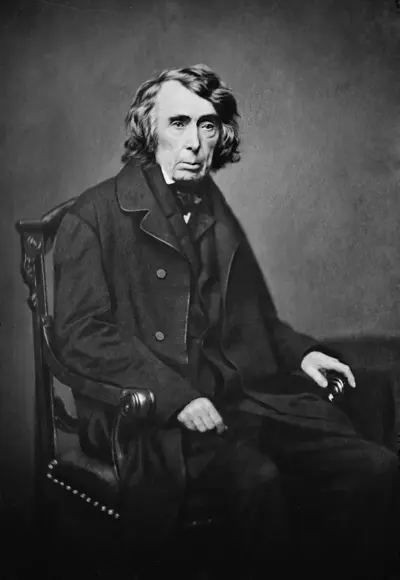
- Born: March 17, 1777
- Died: October 12, 1864
- Nationality: American
- Profession: Judge
Roger Brooke Taney was the fifth Chief Justice of the United States, holding that office from 1836 until his death in 1864. He delivered the majority opinion in Dred Scott v. Sandford (1856), ruling that African Americans could not be considered citizens and that Congress could not prohibit slavery in the territories of the United States. Prior to joining the Supreme Court, Taney served as the United States Attorney General and United States Secretary of the Treasury under President Andrew Jackson.
