Samuel Ward King Quotes
WHEREAS sundry persons, citizens of this State or residents within the same, are conspiring and confederating to usurp the Government thereon—are deceiving and seducing honest and well-meaning citizens under various pretenses, to engage in said criminal enterprise contrary to the laws in such case made and provided …. give no aid or countenance to those, who in violation of the law… I do hereby exhort all the good people of this State, that they give no countenance to said unlawful enterprise, but that they do by their advice and example, aid and support the civil authority in its exertions to suppress all unlawful combinations and maintain the peace and dignity of the State.
In Rhode Island only land owners could vote. When most Americans were farmers and owned land, this was not an anti-democratic requirement, but Rhode Island developed very rapidly with the Industrial Revolution and the shipping and fishing industries. In 1841 60 percent of the adult males in Rhode Island could NOT vote. The non voters tended to be Catholic Immigrants and Black skilled freemen. Thomas Wilson Dorr of an old RI family called a “People’s Convention” which voted a “New Constitution eliminating the land ownership requirement. The regular government saw this as a rebellion and the Governor ordered the State Militia to take Dorr and his followers into custody. However, most of the militia were Catholics and they refused, Governor King asked President Tyler for Federal troops and was refused. Finally the “rebellion” fell apart and Dorr was captured and sent to prison for life. But the regular legislature having gotten the message, within a year passed a new constitution which gave all free males—white and black—the right to vote. Dorr was released from prison and a few years later was pardoned and returned his civil rights. Thus ended what is sometimes called Dorr’s Rebellion.
Samuel Ward King, 1786–1851, Governor of Rhode Island (Law & Order Party), Proclamation Against Thomas Wilson Dorr’s alternative government convention, 1841
Sourced by: Eigen's Political and Historical Quotations

The professor was addressing a theory of some gun rights advocates that the framers of the constitution intended the 2nd Amendment as a check on a dictatorial Federal Government. The history of the militias shows that they have been used by states never to foment rebellion but often called out to suppress rebellions of citizens who thought that their rights had been infringed such as Shays Rebellion, the Whisky Rebellion and the repeated use of state militias to enforce laws and quell riots and labor disputes.

This was a year after the United States gave women the right to vote.

The issue was the voting franchise for Negroes in the aftermath of the Civil War.


2nd Earl Grey

There was an armed attempt of one party to take over the government of Rhode Island. The Government used the state military to put down the rebellion leading to this Supreme Court Case on the legitimacy of using the military. See {616594}.

This was a classic debate over universal male suffrage. Rainborough had made a forceful argument for equality as a spokesperson for the Levellers in this famous debate. Ireton (See {619711}) eloquently gave the classic counter-argument that property owners had much more at stake and therefore should have much more of a say on governmental affairs. Early America actually sided with Ireton but modern America holds with Rainborough.

This was a classic debate over universal male suffrage. Rainborough had made a forceful argument for equality as a spokesperson for the Levellers in this famous debate. See {619710}. Ireton eloquently gave the classic counter-argument that property owners had much more at stake and therefore should have much more of a say on governmental affairs. Early America actually sided with Ireton, but modern America holds with Rainborough.

Jackson makes the case against the South Carolina argument for nullification. In the related quote, he makes his threat which was very successful in ending the notion of “nullification”. The extensive quotation is given as it summarizes the entire issue that was one of the crises of early America.

12 Indians had originally come to the new colony from Massachusetts. Williams admitted them with the full rights, including voting rights, of the colonists and opened the way for other Indians who wanted to join. Although a minister and theologian, Williams created the first jurisdiction in America where there was freedom of religion.


What is interesting, that few people realize, is that large number of men who had never voted before, and would not be able to vote afterwards (the were not property owners for example), were allowed to vote in the ratification debate. As a result, an entire new socio-economic class was empowered and became interested in politics for the first time in history. The result was greater and wider public interest than there had been or would be for many years to come. All voting requirements had been set by the states and were still so after the Constitution was adapted and still is the current situation, although there has been a constant battle in many states to keep Blacks and other minorities from voting between the desires of the states and Federal pressure after the Civil War Constitutional amendments.


He had no authority to do this. He just took it upon himself. This was one of the incidents which caused later Congresses to pass very strict laws limiting the authority of all Federal Military and other intelligence and police forces so that they have little or no authority within the United States. President Lincoln did not allow the order to stand, although he repudiated it very delicately and as privately as possible. Many in his own party strongly favored this proclamation as it cracked down on the Southern Rebels and emancipated slaves—both objectives of many Republicans. In addition, Fremont was very popular with the people and had strong political connections. (He would later run for President.) See {635739}.
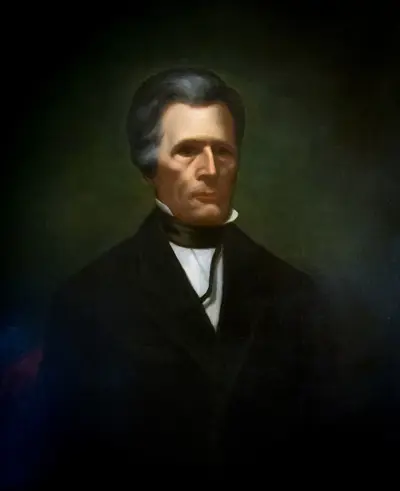
Samuel Ward King was the 15th Governor of Rhode Island from 1839 to 1843.
