Evelyn Baring Quotes
… twice as big as Germany and France together. The worst forms of misgovernment existed over this vast tract of country.... The rich soil on the banks of the [Nile] river, which had a few years since been highly cultivated, was abandoned. There was not a dog to howl for a lost master. Industry had vanished; oppression had driven the inhabitants from the soil.... The entire country was leased out to piratical slave-hunters and traders, under the name of traders, by the Khartoum Government. It was against the “Christian” morals of most English to capture and enslave residents of African villages. However, if the Blacks were already enslaved, most had little compunction to buying slaves, and reselling them in the Carribean or America. Almost all the Aftical slaves were originally captured and enslaved by Arab Slave Traders who could not enslave fellow Moslems but could do so for animists. The Englsh in control of the Sudan would look with askance at the “primitive” and “immoral” Arab slave traders, but would make money by the enslavement process by licencing Slave traders in the Sudan and of course charging a high fee.]
Earl of Cromer
Evelyn Baring, 1841-1917, British Governor General of Egypt, Describing Sudan, Quoted in Pierre Crabites, “Egypt, the Sudan and the Nile”, Foreign Affairs, December 1924
Sourced by: Eigen's Political and Historical Quotations


This quotation is often given by those who believe that nothing has really changed regarding the Arabs and non-Islamic Westerners in the last century. While the support of dictators, Israel and support for that democracy, the artificial Western imposed borders, 9-11, or the Iraq war is often cited as the cause of Arab hostility and murderous aggression, as this quotation demonstrates, the problems and attitudes and behaviors existed long before any of these occurred. The borders were not set until after WWI and all the other causes occurred almost 50 years later, Yet there was still the propensity for fanaticism and violence. Sikes actually was one of those who was to determine the Arab borders, making one of the first “suggested” maps of the area for the English.

The Parliament was debating the reaction to the Stamp Act by the American Colonies. One of the members, reflecting a majority view, asked sarcastically when the American Colonies had been emancipated so that they could make their own independent decisions. Pitt then hit this one out of the park by reversing the question.


What is interesting is that when he cites the dreadful facts about American slavery, he never points out that the American slave traders rarely raided the villages and captured the slaves themselves. Most often this was done my Khamenei’s Muslim brethren slave traders who dominated the slave trade in Africa. Nor does he point out what after realizing the evil that Americans perpetrated with slavery, we ended it in the 1860s. Saudi Arabia, the central nation of Islam, did not make slavery illegal until 100 years later, and even today, there are many Saudi’s who get caught practicing slavery with household servants and forms of indentured servitude. And while Christians and the Bible tolerated slavery, the Koran and the Prophet never once condemn the practice of slavery. Democracy at any point in time is not always morally right, but it is a process by which under pressure from the people it improves over time because the people can change it and do.

Hobson, like Mark Twain in America, was a major critic of imperialism.

The Germans allied themselves with the Islamic insurgency of the day as a strategic maneuver. The Grand Mufti of Jerusalem broadcast propaganda from Nazi radio in Berlin and was dispatched to organize Muslim fighters in Iraq. Fascism was introduced into the Middle East and the Arabs and Persians saw it as a natural extension of their authoritarian and highly prescriptive forms of religious and civil government. 60 years later, there would be Islamic Fascists throughout the Middle East in control or vying for control of many of the countries.
He was a German physician and explorer who had converted to Islam. Nonetheless, he was caught up in the Arab uprising of the Madhists, who had conquered much African territory.

American reformers followed slavery issues in Africa and elsewhere. The status of Africa was particularly important as the notion of extensive American Black colonization was still viable to many.
He was writing about the natives of what is today Indonesia. At the time Indonesia was controlled by the Dutch. Heurmius was writing about the difficulty in converting Indonesians to Christianity.

After his Presidency, Adams served in the House of Representatives for many years and was thus active in politics.

At the time, some Palestinian Arabs claimed exclusive rights to the territory on the grounds that Arabs had dominated the area for the longest period of time. They gave no credence to the fact that the Jews had dominated the area and it was the center of their kingdom for many years before—that Jews had constantly lived in the area of longer than the Arabs, nor did they give any credence to the fact that the Christians had conquered the area from the Muslims during the Crusades.

The British saw the American colonies and the East Coast Canadian provinces all as their North American possessions. With the growing dissatisfaction of the New England and other Colonies, the British wanted to secure Quebec as a safe base where there were few rebels. Fox, of the opposition, criticized the heavy-handed control of Quebec wanting to give the rights of Englishmen under the English Constitution to all citizens of the North American colonies. Had Britain done so, there may never have been an American Revolution.


Earlier, his father had also castigated the ministers over their inept hard-line handling of the American Revolution. See {641505} .

In 1672, the English trading company, the Company Of Royal Adventurers, rechartered itself changing it name to the Royal African Company to focus on the Slave Trade. By 1687 the company was given the exclusive right to trade between the Gold Coast and the British colonies in America. James, Duke of York, (later to be King James II, was interested in this company, and it agreed to supply the West Indies with three thousand slaves annually. in 1698, on account of the incessant clamor of English merchants, the trade was opened generally, and any vessel carrying the British flag was, by act of Parliament, permitted to engage in it on payment of a duty.

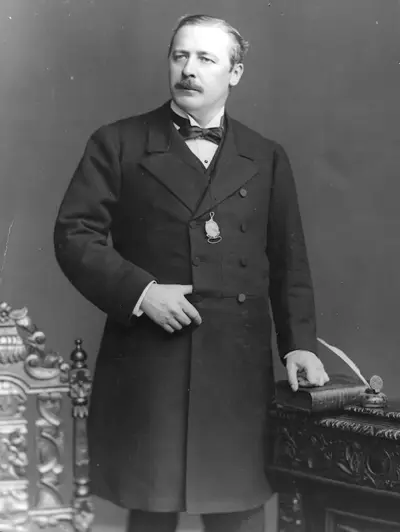
Evelyn Baring, 1st Earl of Cromer, GCB, OM, GCMG, KCSI, CIE, PC, FRS was a British statesman, diplomat and colonial administrator. He served as the British controller-general in Egypt during 1879, part of the international control which oversaw Egyptian finances after the Egyptian bankruptcy of 1876. He later became the agent and consul-general in Egypt from 1883 to 1907 during the British occupation, prompted by the Urabi revolt. This position gave Baring de facto control over Egyptian finances and governance.
